

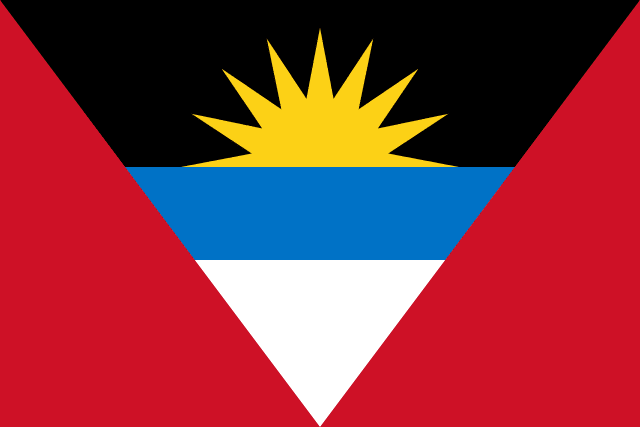
Few national flags pack as much movement and optimism into a single rectangle as the banner of Antigua and Barbuda. With its bold red field interrupted by a downward-pointing wedge of black, blue, and white, all crowned by a rising golden sun, it looks less like a static emblem and more like a freeze-frame of a Caribbean dawn. The design is deliberately dynamic, the symbolism is layered, and the story behind its creation is unusually personal for a national flag. This article walks through the colors, the geometry, the history, and the cultural weight carried by one of the most distinctive flags in the West Indies.
A Sunrise Over a Twin-Island Nation
Antigua and Barbuda is a twin-island state in the eastern Caribbean, part of the Leeward Islands within the wider North American region. Its flag was adopted in 1967, the year the islands gained the status of an associated state with internal self-government, a meaningful step on the road to full independence. Rather than commissioning a foreign heraldic office or borrowing a colonial template, the new government held a national design competition. The winning entry came from a local art teacher, and the result feels rooted in the place it represents: warm, hopeful, and unmistakably Caribbean. The flag has remained in use ever since, carrying the islands from associated statehood through to sovereign nationhood.
The Colors and What They Stand For
The flag draws on five colors, each chosen to mean something concrete rather than to fill space. The palette is red, white, blue, black, and gold, and the symbolism is tied closely to both the landscape and the people.
- Gold (the sun) represents the dawning of a new era for the islands, a fresh chapter of self-determination breaking over the horizon.
- Black honors the African heritage of the majority of the population, acknowledging the ancestry of the people who built the nation.
- Blue stands for the surrounding sea, the Caribbean waters that define island life and connect the two islands to the wider region.
- White evokes the bright sand of the beaches for which the islands are famous.
- Red fills the broad field of the flag and speaks to the energy and dynamism of the people.
Together these colors compress geography, history, and aspiration into one image. The sun rising against the dark band is the emotional center of the whole composition, and it gives the flag its forward-looking mood.
Reading the Design and Layout
The construction is what sets this flag apart from its neighbors. The background is a red field. Set into it is a large inverted triangle, its point aimed toward the bottom of the flag, divided into horizontal bands of black, light blue, and white. Resting at the top of this triangle, against the black band, is a stylized golden sun with rays radiating upward.
That overall arrangement does something clever. The red areas of the field meet at the lower portion of the flag to form a shape resembling the letter V, which is widely read as standing for victory. So the flag carries two readings at once: a literal sunrise scene of sun, sky, sea, and sand, and a more abstract emblem of triumph. The downward triangle also lends the design a sense of energy and direction that purely horizontal stripes could never achieve. Where many flags are calm and symmetrical, this one feels like it is in motion, a quality that suits a young nation announcing itself to the world.
How the Flag Came to Be
The flag's origin story is refreshingly human. When the islands moved toward associated statehood in the mid-1960s, the authorities wanted an emblem that came from the community rather than from above. A public competition was held, and the chosen design was the work of Reginald Samuel, an art teacher whose entry beat out a large number of submissions. Because the design emerged from a local creative rather than an inherited colonial arms, it has always felt like an authentic expression of the islands' own identity.
Adopted in 1967, the flag predates full independence, which the country achieved later, in 1981. Crucially, the design was not changed at independence. The emblem that had represented the islands during the era of internal self-government carried straight through to sovereign statehood, giving it a continuity that many post-colonial flags lack. To learn more about the islands themselves, their geography, and their history, see the antigua and barbuda country guide.
How It Compares to Similar Flags
Caribbean flags share a recognizable visual vocabulary: bright primary colors, suns and stars, triangles, and references to sea and sand. That makes comparison interesting, because Antigua and Barbuda's flag both fits the regional pattern and breaks from it.
The rising sun is a motif seen elsewhere in the region, and the blue-for-sea, gold-for-sun, black-for-heritage logic echoes the symbolic grammar of several neighboring nations. Yet the inverted-triangle layout is genuinely unusual. Most flags place their charges on plain fields or horizontal and vertical stripes; few build the entire composition around a downward wedge that simultaneously frames a sunrise and carves a victory "V" out of the background. Compared with, say, the simpler tricolor-and-emblem flags of some other Caribbean states, Antigua and Barbuda's banner is busier and more pictorial, closer to a small painted scene than a piece of geometric heraldry. The use of five colors is also relatively generous; many flags restrict themselves to three. The combination of a half-sun against a multi-band triangle on a red field makes it hard to confuse with any other national flag, which is precisely the kind of distinctiveness a vexillologist looks for.
National Identity and Everyday Presence
For a small nation, a well-loved flag does heavy lifting. Here, the imagery resonates because every element points back to something real: the beaches that anchor the tourism economy, the sea that surrounds daily life, the African heritage of the population, and the sunrise of self-government. The flag therefore reads as a compact statement of who the people are and where they have come from.
In modern life the flag appears in all the expected places and a few that matter especially to islanders. It flies on government buildings, at schools, and at diplomatic missions abroad. It is hoisted and celebrated each year around Independence Day at the start of November, a focal point for national pride. It travels with athletes to regional and international competitions, where the rising sun becomes a rallying image for fans. It turns up at Carnival, in tourism branding, and on souvenirs, threading the design through both civic ceremony and everyday culture. The fact that the same emblem has represented the country since 1967 means generations have grown up under it, deepening its emotional hold.
Interesting Facts at a Glance
- The flag was adopted in 1967, well before the country's full independence in 1981, and was never replaced.
- It was designed by Reginald Samuel, a local art teacher, after winning a national design competition.
- The red portions of the field form a V for victory at the lower edge of the flag.
- The golden sun symbolizes the dawn of a new era of self-government.
- Five colors carry distinct meanings: gold for the sun, black for African heritage, blue for the sea, white for the sand, and red for the dynamism of the people.
- The inverted-triangle layout makes it one of the more visually distinctive flags in the Caribbean.
Frequently Asked Questions
When was the flag of Antigua and Barbuda adopted?
The flag was adopted in 1967, the year the islands became an associated state with internal self-government. It was retained without change when the country gained full independence in 1981, giving it more than half a century of continuous use.
What do the colors of the flag mean?
Each color carries a specific meaning. The gold sun marks the dawning of a new era, black honors the people's African heritage, blue represents the surrounding sea, white stands for the islands' beaches, and red reflects the energy and dynamism of the population. The red field also forms a "V" for victory.
Who designed the flag?
The flag was created by Reginald Samuel, a local art teacher, whose entry won a national design competition held when the islands moved toward self-government in the 1960s. Because it came from a local artist, the design is regarded as an authentic homegrown symbol.
What continent is Antigua and Barbuda on, and how does its flag compare to others?
Antigua and Barbuda is a twin-island Caribbean nation in the North American region, within the Leeward Islands. While it shares the sun, sea, and heritage symbolism common to many Caribbean flags, its inverted-triangle layout and the victory "V" formed by the red field make it unusually distinctive and easy to tell apart from its neighbors.
