
Few national flags wear their heritage quite so literally as the flag of Belarus. While most banners rely on stars, stripes, or heraldic beasts to tell their story, the Belarusian flag stitches a slice of the country's folk culture directly into its design: a vertical band of red-and-white ornament lifted straight from traditional embroidery. The result is a flag that feels less like a political emblem and more like a textile heirloom hung from a pole. Adopted in its current refined form in 2012, the red, green, and white tricolor sits at the crossroads of Eastern Europe, carrying centuries of craft, struggle, and aspiration in a single horizontal sweep.
A Flag Built From Three Colors
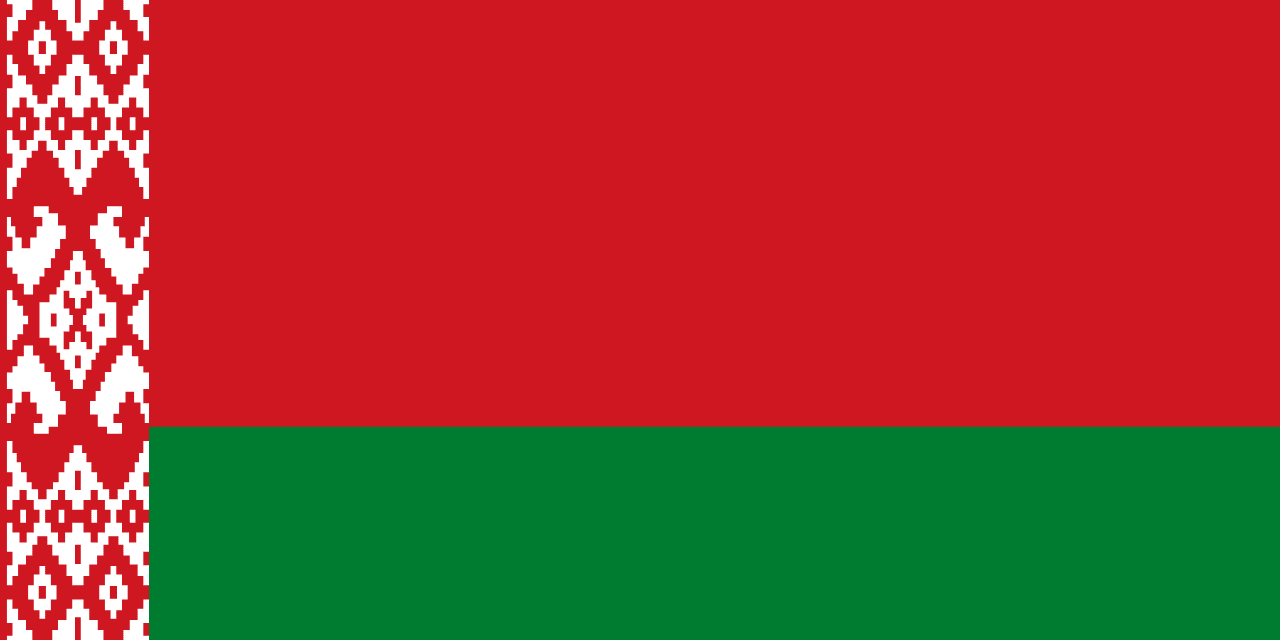
At first glance the Belarusian flag reads as a simple horizontal arrangement, but each of its three colors carries deliberate weight. The broad upper field of red recalls the hardships and struggles of the nation's past, an acknowledgment of the sacrifices made across a long and frequently difficult history. Beneath it, a narrower band of green looks the other direction, toward the future, toward growth, and toward the forests and fields that blanket so much of the Belarusian landscape.
Running vertically along the hoist side is the third element, rendered in white on a red ground: the ornamental pattern. White here functions as more than a neutral backdrop. It carries connotations of purity and freedom that recur throughout Slavic visual tradition. Together these three colors form a palette that is warm and earthy rather than cold or martial, and that warmth is part of what gives the flag its distinctive character among European banners.
Reading the Design and Layout
The construction of the flag follows a clear logic. The body is a horizontal bicolor, with red occupying the upper two-thirds and green the lower third, giving the red far greater visual presence. This unequal division keeps the flag from reading as a balanced, symmetrical tricolor and instead lets the red dominate as the field across which the rest of the symbolism plays out.
The truly defining feature, however, is the decorative band placed against the hoist. This vertical stripe is filled with an intricate geometric pattern picked out in white, and it is what immediately separates the Belarusian flag from any other in the world. The motif is not abstract invention; it is drawn from the embroidered ornaments that decorate traditional Belarusian woven cloth, the kind of patterning found on ceremonial towels, shirts, and household textiles. Placing this craft on the national flag transforms an everyday domestic art form into a statement of identity, ensuring that anyone who studies the banner is looking at a genuine fragment of folk heritage.
How the Flag Took Shape Over Time
The modern flag did not appear out of nowhere. Its lineage runs through the Soviet era, when the territory flew a red banner in keeping with the symbolism of the wider union, embellished with a green stripe and a national ornamental pattern. After the dissolution of the Soviet Union, Belarus briefly used a very different white-red-white flag before the population reaffirmed, by referendum, a design that retained the red, green, and ornamental character familiar from the earlier period.
That post-Soviet design was essentially a modified version of the older flag, and it remained in service for years before receiving a careful update. In 2012 the flag was refined, most notably in the rendering of the ornamental pattern, which was adjusted so that the white-on-red embroidery motif appeared cleanly and consistently. This 2012 version is the flag flown today. The story it tells is therefore one of continuity rather than rupture: rather than discarding its visual past, Belarus chose to keep and polish it.
Comparing It to Other Flags
Red is one of the most common colors on national flags, so a quick glance might group Belarus with the many red-dominated banners of the region. Yet the comparison falls apart almost instantly. Neighboring designs tend to rely on plain horizontal bands, white-and-red combinations, or simple bicolors, and none of them carry an embroidered ornament along the hoist.
The red-and-green pairing itself is relatively unusual at the top level of national vexillology, which already sets the flag apart from the red-white-blue and red-white pattern so common across Europe. But it is the ornamental band that makes the Belarusian flag genuinely unmistakable. Where other countries might place a coat of arms, a star, or a crescent to distinguish an otherwise generic field, Belarus uses a culturally specific textile pattern. That choice gives it kinship not with the flags it borders but with the broader idea of folk-art flags, banners that embed craft traditions rather than heraldry. To learn more about the country behind the design, see our belarus country guide.
Cultural Significance and National Identity
For Belarusians, the ornamental pattern is the emotional heart of the flag. Embroidery has long occupied a special place in the region's domestic and ceremonial life, where woven and stitched textiles marked weddings, harvests, and rites of passage, and where each geometric motif could carry meaning passed down through generations. To take that visual language and elevate it to the level of national symbol is to declare that the identity of the nation rests not only in its political institutions but in the hands of the people who made these patterns by candlelight.
This is why the flag resists being read as a purely top-down state emblem. The red and green speak of past and future in broad, almost universal terms, but the white ornament grounds those abstractions in something tangibly local. It says that whatever the nation's struggles and ambitions, they belong to a people with a continuous craft tradition. In that sense the flag is as much a cultural artifact as a civic one.
The Flag in Modern Life
Today the banner appears across the full range of public life. It is raised at government buildings and official ceremonies, flown on national holidays, and carried at international sporting events where Belarusian athletes compete. Its distinctive look makes it easy to spot in a crowded field of competing flags, and the ornamental stripe ensures it is rarely confused with any other nation's colors at a parade or stadium.
Belarus sits in Eastern Europe, and the flag has become one of the most recognizable visual shorthand for the country abroad. Whether printed on souvenirs, displayed at embassies, or waved by supporters, the red field with its white embroidery band travels well as an instantly identifiable symbol of the nation.
Interesting Facts About the Flag
- The ornamental pattern on the hoist is based on traditional Belarusian embroidery, making it one of the few national flags to feature an actual folk-craft motif.
- The flag uses an unusual red-and-green color combination rather than the red-white-blue palette common across much of Europe.
- The current version dates to 2012, when the design was refined, chiefly in how the ornamental pattern is rendered.
- The design descends from a Soviet-era flag, making it a rare case of a modern banner that consciously preserved its earlier visual identity.
- The red band occupies roughly two-thirds of the field, giving the flag a deliberately top-heavy, red-dominated appearance.
- White appears only within the ornamental pattern, where it stands out sharply against the red ground.
Frequently Asked Questions
When was the current flag of Belarus adopted?
The flag in its present form was adopted in 2012, when the design received a refinement that chiefly affected the rendering of the white ornamental pattern. That version evolved from an earlier post-Soviet design, which in turn was a modified version of the Soviet-era flag.
What do the colors of the Belarusian flag mean?
Red represents the struggles and hardships of the nation's past, while green looks toward the future and reflects the country's forests and fields. The white in the hoist-side ornament carries the purity and freedom associated with the pattern, which is itself drawn from traditional embroidery.
Who designed the flag and where does the pattern come from?
Rather than crediting a single designer, the flag is best understood as an evolution of the earlier Soviet-era banner, later modified and then refined in 2012. The decorative band is not an original invention but is based on traditional Belarusian embroidery motifs, giving the flag genuine roots in folk craft.
What continent is Belarus on and how does its flag compare to neighbors?
Belarus is located in Eastern Europe. While many flags in the region use plain horizontal bands or red-and-white combinations, the Belarusian flag is set apart by its red-and-green field and, above all, by the embroidered ornamental stripe along the hoist, a feature no neighboring flag shares.
