
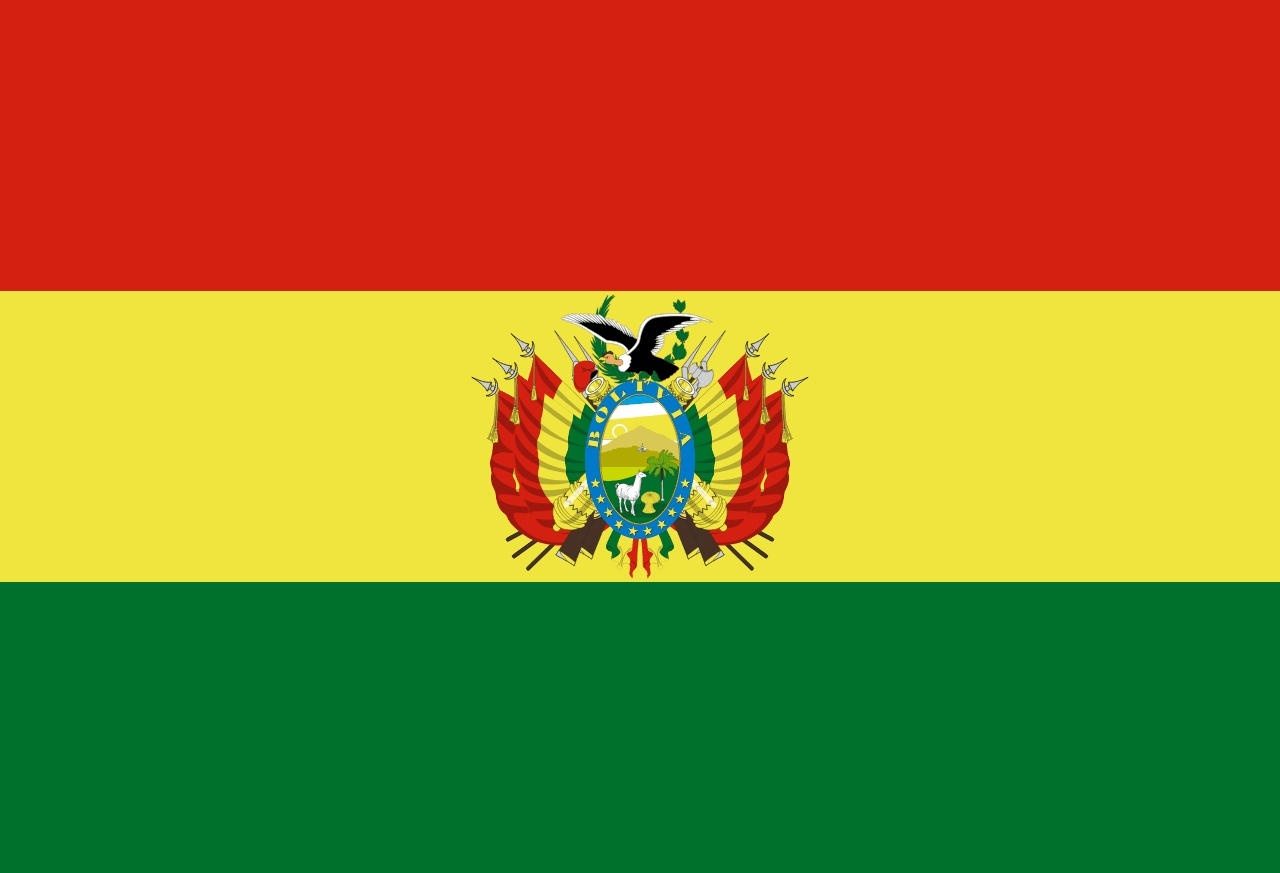
Stretched across the high plateaus of the Andes and the lowland jungles that spill toward the Amazon, the flag of Bolivia is one of South America's most recognizable banners: three bold horizontal bands of red, yellow, and green. Though it looks deceptively simple, this tricolor carries the weight of a young republic's founding struggle, the promise of immense natural wealth, and a landscape that ranges from snow-capped peaks to fertile valleys. For Bolivians, the colors are not decorative choices but a compact biography of the nation itself.
A Tricolor Born From Independence
Bolivia's national colors were established in the wake of its independence, and the horizontal triband as we know it today was settled in 1851. The country had broken away from Spanish rule earlier in the nineteenth century, taking its name from the liberator Simón Bolívar, and like many newly free states it needed a visual identity to rally its people. Early Bolivian banners experimented with different arrangements and proportions before the red-yellow-green sequence became fixed.
The settling of the design in 1851 gave Bolivia a stable emblem that has endured for well over a century and a half. That longevity matters: while governments, constitutions, and borders shifted dramatically over the decades, the tricolor remained a constant thread connecting generations of citizens to the original ideals of the independence era.
What the Colors Mean
Each of the three bands carries a distinct and deliberate meaning, and together they tell a story that moves from sacrifice to abundance to renewal.
- Red sits at the top and honors the blood shed by those who fought for Bolivia's freedom. It is a tribute to the soldiers and patriots who gave their lives in the long campaigns of independence.
- Yellow occupies the central band and represents the nation's mineral wealth. This is no small symbol: Bolivia's earth has yielded silver, tin, and other minerals for centuries, and the golden stripe acknowledges the resources buried in its mountains.
- Green anchors the bottom and stands for the land's fertility, evoking the valleys, plains, and forests that sustain Bolivian agriculture and life.
Read from top to bottom, the flag traces an arc: the price paid for nationhood, the treasure the land provides, and the living, growing future that treasure makes possible.
Design and Layout
The construction of the flag is straightforward, which is part of its strength. It is a horizontal triband, three equal-width stripes running the full length of the banner, with red on top, yellow in the middle, and green at the bottom. There are no diagonal cuts, no canton, and no complicated geometry in the basic civil version.
This simplicity makes the flag instantly legible from a distance and easy to reproduce, whether stitched onto a school uniform, painted on a wall, or printed on a banner carried through a city plaza. The equal proportions give each color and the value it represents the same visual weight, a quiet statement that sacrifice, wealth, and fertility are all essential to the national story.
One Flag or Two? The State Flag and Its Coat of Arms
One detail that surprises many people is that Bolivia effectively uses more than one version of its flag. Alongside the plain tricolor flown by citizens, there is a state flag that places the national coat of arms in the center of the yellow band. This emblem-bearing version is the one typically used by government institutions and in official settings.
The coat of arms is rich with national imagery, gathering symbols of Bolivia's geography, history, and resources into a single crest. The existence of these two variants—one bare and one adorned—lets the flag serve both as an everyday popular symbol and as a formal mark of the state, depending on the context in which it flies.
How It Compares to Similar Flags
Red, yellow, and green is a popular palette around the world, so Bolivia's tricolor naturally invites comparison with other banners. Many people first think of the green-yellow-red flags common across Africa, but Bolivia's arrangement and meaning are entirely its own, with red on top rather than green and a symbolism rooted in Andean history rather than Pan-African ideals.
Closer to home, Bolivia shares its broad color family and its South American identity with several neighbors, yet its specific stacking order—red, yellow, green from top to bottom—sets it apart at a glance. The plain civil version can resemble other horizontal tricolors, but the moment the state coat of arms appears in the yellow band, there is no mistaking it for any other nation's flag. If you want to understand the country behind the banner more fully, our bolivia country guide explores its geography and culture in depth.
Cultural Significance and Modern Life
The tricolor is woven into the rhythm of Bolivian public life. It appears at civic ceremonies, on national holidays, and in classrooms where children learn the meaning of each stripe. During patriotic celebrations and independence commemorations, streets and balconies fill with red, yellow, and green, turning entire neighborhoods into expressions of shared identity.
The flag also travels with Bolivia's athletes. When the national football team or other competitors take the field internationally, supporters wave the tricolor as a banner of belonging, and the colors become a portable piece of home. In a country known for its cultural diversity—home to many Indigenous languages and traditions—the flag offers a common symbol that citizens of every background can rally around.
Interesting Facts About the Flag of Bolivia
- The current horizontal arrangement of red, yellow, and green was fixed in 1851, giving Bolivia one of South America's long-standing flag designs.
- Bolivia is located in South America, landlocked between several neighboring nations high in the Andes and across lowland plains.
- There is an official variant that adds the national coat of arms to the center of the yellow band for state use.
- The colors form a narrative sequence—blood, wealth, and fertility—rather than being chosen purely for appearance.
- The plain tricolor's equal stripes make it simple to reproduce and unmistakable from a distance.
Frequently Asked Questions
When was the flag of Bolivia adopted?
The horizontal tricolor in its present form was established in 1851. Bolivia's national colors trace back to the era of its independence, but the familiar red-yellow-green triband layout became fixed in the mid-nineteenth century.
What do the colors of the Bolivian flag mean?
Red represents the blood shed by those who fought for the nation's freedom, yellow symbolizes Bolivia's mineral wealth, and green stands for the fertility of its land. Together they move from sacrifice to abundance to growth.
What continent is Bolivia on?
Bolivia is in South America. It is a landlocked country whose territory spans the high Andes mountains and lower-lying plains, which helps explain the green stripe's emphasis on fertile land.
How is Bolivia's flag different from similar red, yellow, and green flags?
While the red-yellow-green palette appears on flags around the world, Bolivia's order is red on top, yellow in the middle, and green at the bottom, with meanings tied to its independence and Andean resources. The state version adds the national coat of arms to the yellow band, making it distinct from any look-alike tricolor.
