
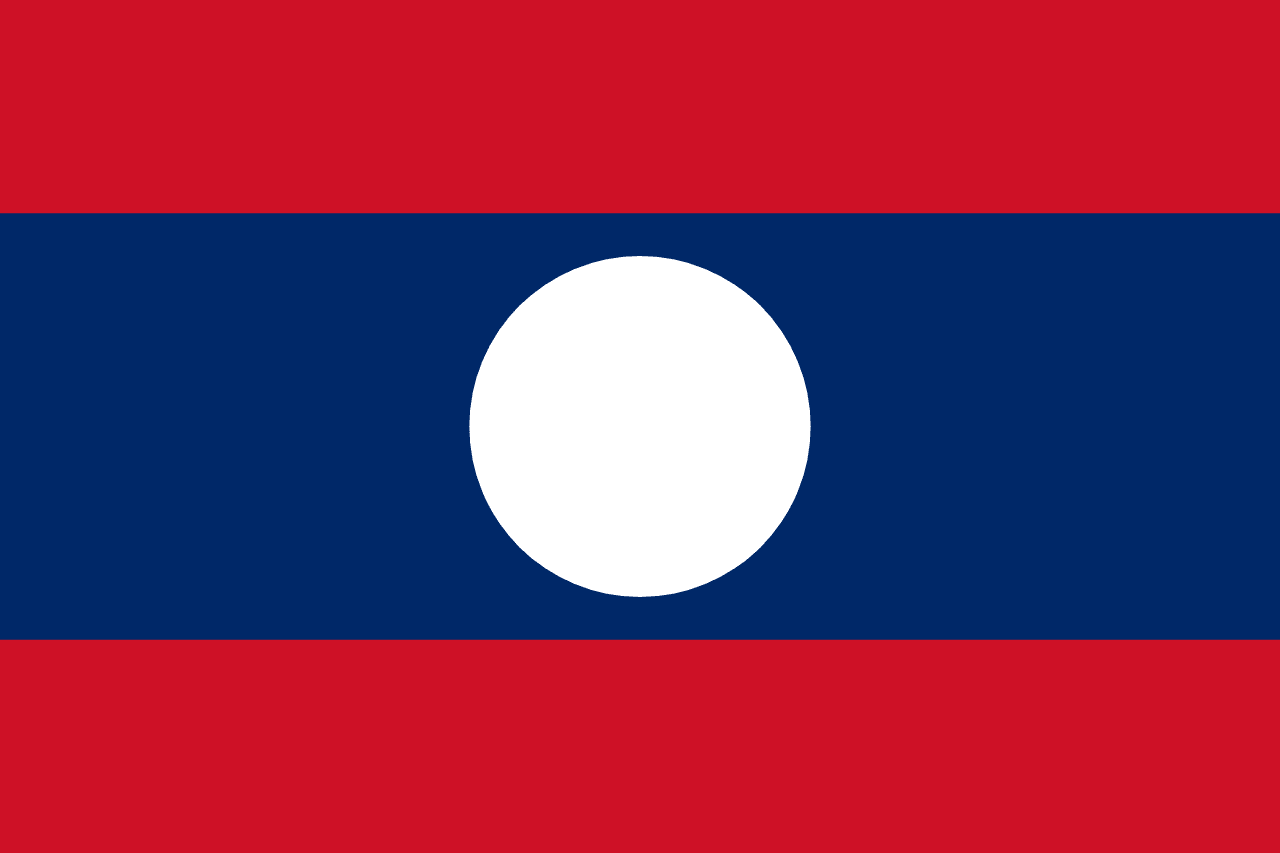
Among the flags of Southeast Asia, the banner of Laos stands out for its quiet confidence. There is no clutter, no crowded heraldry, no array of stars or stripes competing for attention. Instead, a single luminous white disc floats at the center of a deep blue field, framed above and below by bands of red. It is a design that reads almost like a landscape painting: the river, the moon, and the surrounding earth distilled into three simple colors. Adopted in 1975, the flag tells a story about a nation that emerged from monarchy into a new political era, and it carries that history with an unusual elegance.
What makes the Lao flag especially intriguing is the way it breaks from the conventions of its political neighbors. While many states that share its ideological roots reach for the five-pointed star, Laos chose a different emblem entirely. That decision, and the symbolism behind it, makes this one of the most distinctive national flags anywhere in the world.
A River, a Moon, and the Colors of a Nation
The Lao flag uses three colors, and each carries a clear meaning. The two outer bands are red, traditionally understood to represent the blood shed by the Lao people in their long struggle for independence and unity. It is a somber, earnest color, a reminder that nationhood was not handed over freely but fought for across generations.
The broad central band is blue, a color tied to prosperity and the wealth of the land. In a country defined by fertile river valleys, forested highlands, and the great waterway that runs through its heart, blue speaks to abundance, the natural riches that sustain the population and promise a brighter future.
At the very center sits a white disc. This is the flag's most poetic element: it is meant to evoke the full moon glowing over the Mekong River. The image is unmistakably local, rooted in the geography that shapes daily life in Laos. The whiteness of the disc also suggests unity and the bright prospect of the nation moving forward together. Few flags manage to compress a specific scene, a riverside moonrise, into pure geometry quite so gracefully.
Reading the Design
Structurally, the flag is a horizontal triband with a centered disc. The layout is straightforward but precise. Two red stripes sit at the top and bottom, with a wider blue band running between them; the central blue band is notably deeper than the red ones, giving the design a balanced, weighted appearance. Resting in the middle is the solid white circle.
This arrangement creates a strong sense of symmetry. Whether the flag hangs vertically or flies horizontally in the wind, the eye is drawn immediately to the white disc, which acts as a focal point against the dark blue. The absence of any text, ornamentation, or additional figures keeps the composition clean and instantly recognizable. It is a flag built on contrast: the cool blue field, the warm red borders, and the bright neutral circle that ties them together.
From Kingdom to Republic
The current flag came into official use in 1975, the year the political landscape of Laos changed dramatically. Before that, the country had flown a very different banner during the era of the monarchy, an emblem dominated by red with a three-headed white elephant, a creature drawn from royal and Buddhist tradition. That older flag represented the kingdom and its dynastic heritage.
When the communist movement took power and the monarchy was dissolved, the elephant banner was retired and the red-blue-white triband was raised in its place. Interestingly, this design was not entirely new. It had been associated with the Lao resistance and independence movement during earlier decades, so its adoption in 1975 was less an invention than an elevation: a flag that had symbolized a cause now became the flag of the entire state. To understand how that political transformation reshaped the country's identity, geography, and culture, the laos country guide offers a fuller portrait of the nation behind the banner.
How It Compares to Similar Flags
Place the Lao flag beside others in the region and its individuality becomes obvious. Many flags born from twentieth-century revolutionary movements feature a prominent star, and several Southeast Asian neighbors lean on red as a base color with bold central emblems. Laos shares that revolutionary lineage but deliberately avoided the star.
The red-white-blue palette also invites quick comparison with a long list of national flags that use the same three colors, from European tricolors to flags across the Americas. Yet none of them are likely to be confused with the Lao banner, because the combination of a horizontal triband and a single centered white disc is highly unusual. The closest visual cousins are flags that feature a central circle, but those typically use different color schemes or place the disc on a single solid field rather than between contrasting stripes.
Perhaps the most telling comparison is ideological rather than visual. Among the world's communist-governed nations, flags almost universally incorporate a star as a defining motif. Laos is the standout exception, and that distinction is precisely what gives its flag such a memorable identity.
A Symbol of Identity and Everyday Pride
For the people of Laos, the flag is woven into national life. It appears on government buildings, at schools, and during official ceremonies, where the white disc serves as a shared point of reference for citizens across a country of diverse ethnic communities and mountainous terrain. The imagery of the moon over the Mekong resonates because the river is central to Lao life, supplying water, food, transport, and a sense of continuity that predates any modern government.
On national days and during civic celebrations, the flag is displayed widely, and it accompanies Lao athletes when they compete internationally, carried into stadiums as a compact statement of who they are. Because the design is so clean and distinctive, it travels well: it is easy to recognize at a glance on a uniform, a passport, or a diplomatic banner. In this sense the flag does exactly what a national emblem should, projecting a clear and dignified identity both at home and abroad.
Quick Facts Worth Knowing
- The Lao flag is famously the only flag of a communist-governed country that does not feature a star, choosing a moon disc instead.
- The white circle represents the full moon over the Mekong River, tying the flag directly to the nation's defining geography.
- Laos sits in Southeast Asia, on the continent of Asia, as a landlocked country bordered by several neighbors.
- The design was raised as the official national flag in 1975, replacing the earlier royal flag with its three-headed elephant.
- The central blue band is wider than the two red bands, giving the flag a deliberately weighted, balanced look.
- Red stands for sacrifice and blood shed, blue for prosperity and wealth, and white for unity and the moonlight.
Frequently Asked Questions
When was the flag of Laos adopted?
The current flag was adopted in 1975, the year the monarchy was dissolved and a new government took power. Although the red, blue, and white triband had earlier roots in the independence and resistance movement, 1975 marks the point at which it became the official national flag of the country.
What do the colors of the Lao flag mean?
The two red bands symbolize the blood shed by the Lao people in their struggle for freedom and unity. The blue band represents prosperity and the wealth of the land, while the white disc at the center stands for the full moon shining over the Mekong River and for national unity.
Why does the flag have a circle instead of a star?
Unlike most flags associated with communist movements, which feature a five-pointed star, Laos chose a white disc representing the moon over the Mekong. This makes it the only such flag without a star, a deliberate choice that gives the banner a uniquely local and recognizable identity.
What continent is Laos on, and what flags look similar?
Laos is located in Southeast Asia, on the continent of Asia. Its red-white-blue color scheme is shared by many national flags worldwide, but the combination of a horizontal triband with a single centered white disc is rare, so the Lao flag is rarely mistaken for any other.
