
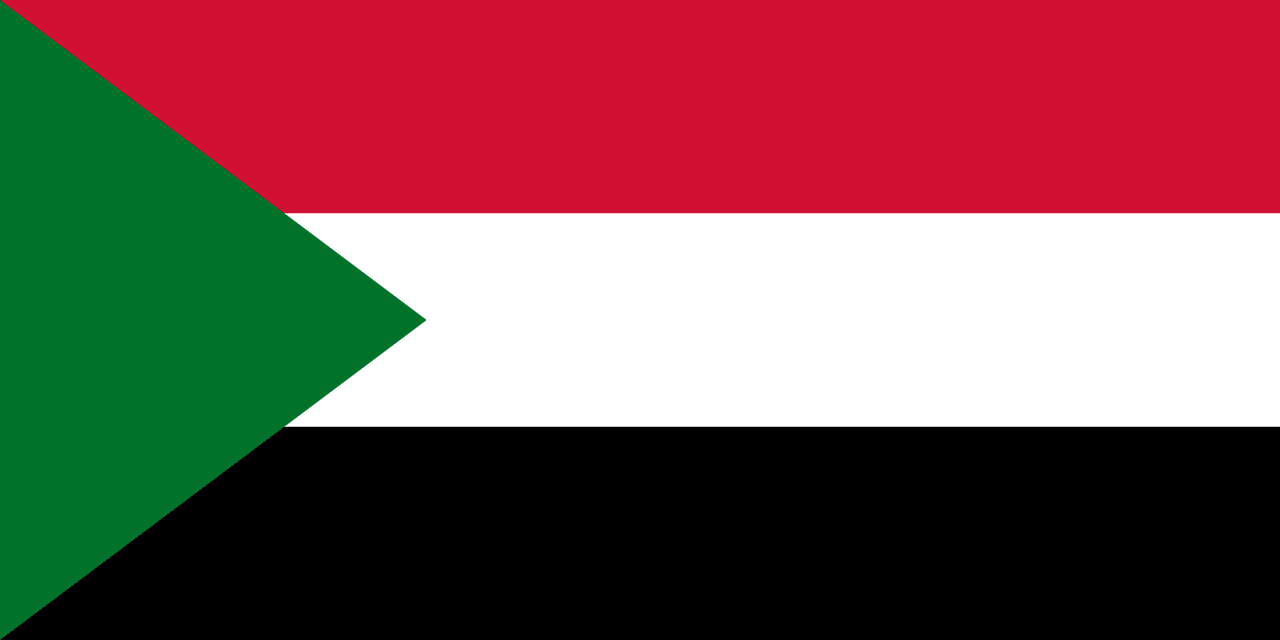
Few flags speak the visual language of the Arab world as fluently as the flag of Sudan. With its bold horizontal bands of red, white, and black anchored by a single green triangle at the staff, it belongs to a family of banners born from twentieth-century aspirations toward unity and self-determination. Yet behind its clean geometry lies a specifically Sudanese story, one shaped by revolution, by the search for national identity, and by a deliberate choice to align with a broader regional movement. This is a flag that means to be read at a glance and understood on reflection.
A Quick Portrait of the Design
The flag of Sudan is a horizontal triband. Three equal stripes run across the field from top to bottom in red, white, and black, and a green isosceles triangle juts inward from the hoist, its point reaching toward the center of the flag. The arrangement is sometimes described as a tricolor with a triangle, and that description captures both halves of its character: a steady, balanced sequence of stripes interrupted by a single dynamic shape that gives the whole design forward motion. The triangle pulls the eye toward the flagpole, while the stripes lend the banner a calm horizontal sweep.
That combination is no accident of taste. It places Sudan firmly within a recognizable visual tradition, and the four colors it uses are the ones that tradition holds dear.
What the Colors Stand For
Each color on the Sudanese flag carries a meaning that the country has consciously assigned to it. The red stands for struggle, a nod to the sacrifices and the fights for freedom that mark the nation's path. The white represents peace, light, and optimism, the aspiration that follows hardship. The black is a direct emblem of Sudan itself; the country's very name derives from an Arabic phrase meaning "land of the Blacks," so the color is both literal and proud. The green triangle signifies Islam, as well as prosperity and the agricultural richness of the land.
Read together, the palette tells a compact narrative: a people who struggled (red), who seek peace (white), who claim their own identity (black), and who draw on faith and the fertility of their soil for the future (green). It is a flag designed to be a small constitution of values.
The Pan-Arab Colors and the Arab Liberation Tradition
Red, white, black, and green are famous well beyond Sudan. They are the classic Pan-Arab colors, a palette associated with Arab unity and revival, and they recur across the banners of the region. Sudan's flag in particular descends from the so-called Arab Liberation flag tradition, the design language popularized in the mid-twentieth century during a wave of revolutionary and nationalist movements across the Arab-speaking world.
This shared heritage explains why visitors sometimes mistake one regional flag for another. Several countries draw on the same four-color vocabulary, arranging the stripes and adding distinguishing emblems in their own ways. Sudan's contribution to that family is the green hoist triangle, which sets it apart from neighbors and cousins that use stars, eagles, or differently ordered bands. For a fuller picture of the nation that flies this banner, the sudan country guide offers helpful context on its geography and culture.
How the Flag Came to Be
Sudan adopted its current flag in 1970, replacing an earlier design that had flown since independence in the 1950s. That first post-independence flag used a different scheme of blue, yellow, and green, intended to avoid associations with any single political faction at a moment when the new state was finding its footing.
The shift to the red-white-black-green design followed a change in the country's political direction, as Sudan moved toward closer alignment with the Pan-Arab revolutionary movements of the era. Choosing the Arab Liberation colors was a statement of allegiance and aspiration, a way of declaring where the nation saw its future and its kinship. Since 1970, the flag has remained Sudan's national emblem through decades of dramatic change, outlasting governments and surviving the upheavals that have repeatedly tested the country.
Cultural Weight and National Identity
For Sudanese people, the flag is more than the sum of its colors. It is a fixture of civic life, raised over government buildings, schools, and embassies, and carried in moments of both celebration and protest. Because the black band quite literally names the country, citizens can point to their flag and find themselves represented in it in a way that is unusually direct.
The flag's meaning has also been contested and reaffirmed in public life. During periods of mass demonstration, Sudanese flags have appeared in crowds as a rallying emblem, a shared symbol that transcends region and faction. That a single piece of cloth can serve simultaneously as an instrument of the state and a banner of popular hope says a great deal about how deeply it is woven into the national imagination.
The Flag in Everyday and Modern Life
Beyond the solemn occasions, the flag appears in the ordinary texture of Sudanese life. It flies on national holidays and independence commemorations. It is worn, painted, and waved by supporters when Sudanese athletes and football teams compete internationally, lending a splash of red, white, black, and green to stadiums far from home. Diaspora communities around the world raise it at cultural festivals, keeping a tie to the homeland visible across continents.
In each of these settings the flag does quiet work, signaling belonging and continuity. Its design is simple enough to reproduce easily on a banner, a lapel pin, or a face-painted cheek, which is part of why it travels so well into popular use.
Interesting Facts at a Glance
- The flag uses the four Pan-Arab colors, the same family of red, white, black, and green found across the region.
- The black stripe directly references the country's name; "Sudan" comes from an Arabic phrase meaning "land of the Blacks."
- It was adopted in 1970, replacing a blue, yellow, and green flag used since independence.
- The green triangle at the hoist is the feature that most distinguishes Sudan's flag from other Arab Liberation designs.
- It belongs to the Arab Liberation flag tradition, a design lineage shared by several countries in the region.
- Sudan sits in northeastern Africa, on the African continent, while its flag's symbolism leans toward its Arab cultural ties.
Frequently Asked Questions
When was the flag of Sudan adopted?
Sudan adopted its current flag in 1970. It replaced the earlier blue, yellow, and green flag that had been in use since the country gained independence in the 1950s, marking a shift toward the Pan-Arab visual tradition.
What do the colors of the Sudanese flag mean?
Red represents struggle, white stands for peace, black symbolizes Sudan itself, and the green triangle signifies Islam as well as prosperity. Together the four colors summarize the nation's values, history, and hopes.
What continent is Sudan on?
Sudan is located in northeastern Africa, on the African continent. Although it lies in Africa, its flag draws on the Pan-Arab color tradition, reflecting the country's strong cultural and historical ties to the Arab world.
Why does Sudan's flag look like other Arab flags?
Sudan's flag shares the red, white, black, and green Pan-Arab colors and belongs to the Arab Liberation flag tradition, which several countries draw from. Sudan distinguishes its version with a green triangle at the hoist rather than stars or other emblems used by its neighbors.
