

Soufrière Hills is an active stratovolcano on the Caribbean island of Montserrat, a British Overseas Territory in the Lesser Antilles. Before 1995, the volcano had not erupted in recorded history and was not considered a significant threat. That changed on July 18, 1995, when Soufrière Hills began an eruption that would last over a decade, bury the capital city of Plymouth under meters of volcanic debris, kill 19 people, and force two-thirds of Montserrat's 11,000 residents to leave the island permanently.
Introduction
The Soufrière Hills eruption is one of the most studied volcanic crises of the modern era and a stark case study in how a volcanic eruption can transform an entire nation. The southern two-thirds of Montserrat remains an exclusion zone to this day, and Plymouth stands as the only ghost-town capital in the modern world — a Caribbean Pompeii buried not by a single cataclysm but by years of relentless volcanic activity.
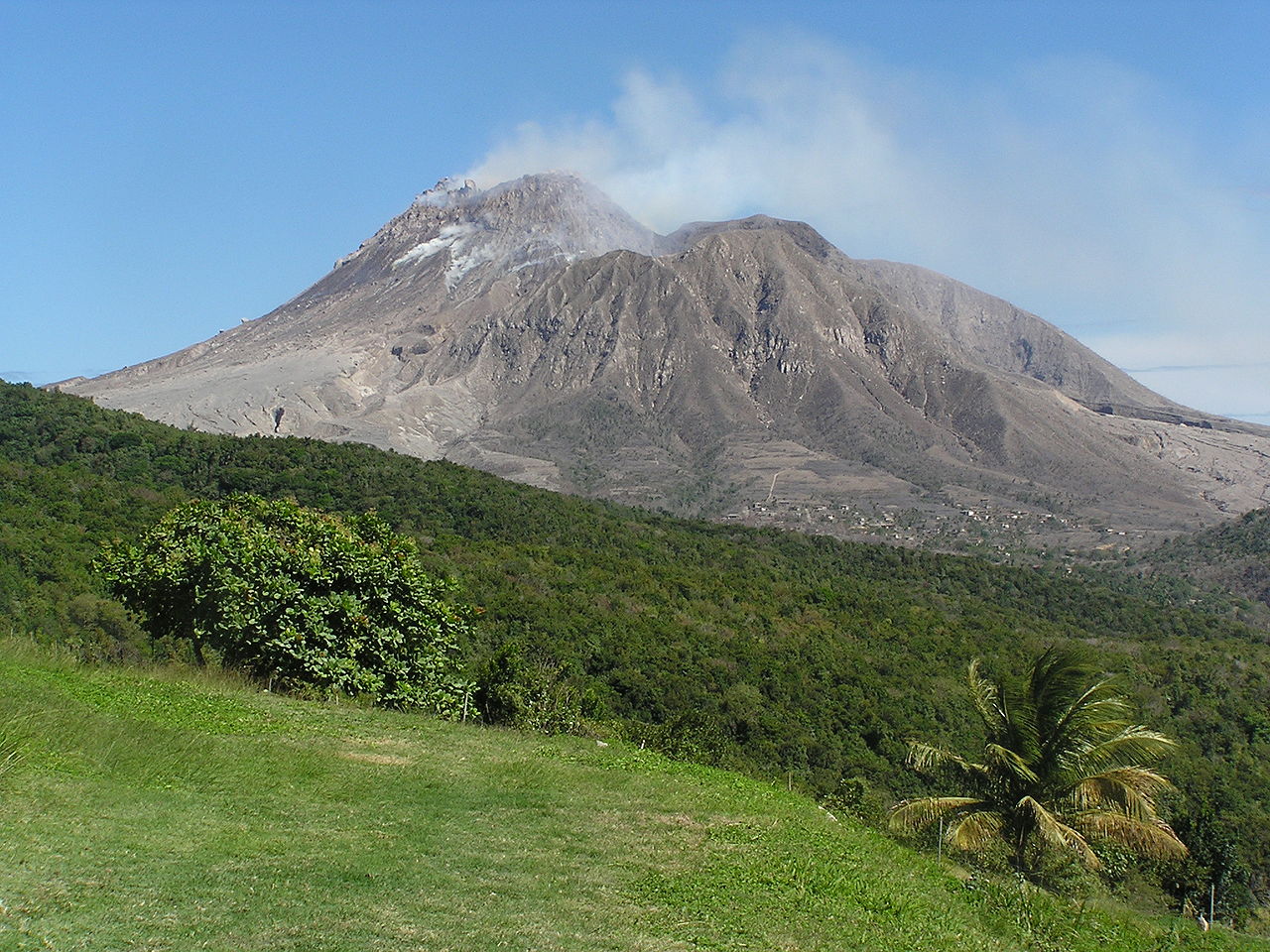
Geology & Setting
- Elevation: 1,050 m (Chance's Peak, pre-eruption); dome has reached ~1,150 m
- Type: Stratovolcano (andesitic)
- Location: Montserrat, Lesser Antilles, Caribbean
- Tectonic Setting: Atlantic Plate subducting beneath Caribbean Plate
- Pre-1995 Status: No historical eruptions; geothermal activity only
Soufrière Hills sits on the Lesser Antilles volcanic arc, formed by the subduction of the Atlantic portion of the South American Plate beneath the Caribbean Plate. The volcano is composed of several lava domes of various ages, reflecting a history of dome-building eruptions over at least 170,000 years. Before 1995, the most recent eruption was approximately 350 years ago, identified only through geological deposits.
Montserrat is a small island of just 102 km², and the volcano dominates its southern half. The proximity of the capital Plymouth (population ~4,000) to the volcano — just 4 km from the summit — meant that even moderate eruptive activity would have severe consequences. The island's infrastructure, airport, and main port were all concentrated in the southern lowlands directly in the path of potential pyroclastic flows and lahars.
The 1995-2010 Eruption
- Start Date: July 18, 1995
- Major Phase: 1995-2003, with renewed activity 2006-2010
- Eruption Style: Andesitic dome growth with periodic collapse
- Deadliest Event: June 25, 1997 — 19 killed by pyroclastic flows
- Plymouth Buried: Capital covered by 4-12 m of volcanic material
The eruption began with phreatic (steam) explosions in July 1995, escalating to magmatic activity by late 1995 with the growth of a lava dome in English's Crater. The dome repeatedly grew and collapsed, generating pyroclastic flows that swept down valleys toward populated areas. Evacuations began almost immediately, with the southern half of the island progressively abandoned.
The deadliest event occurred on June 25, 1997, when a massive dome collapse sent pyroclastic flows into areas where some residents had returned to check on farms and property despite warnings. Nineteen people were killed. The flows and subsequent lahars buried Plymouth under 4-12 meters of volcanic debris, destroyed the airport, and rendered the southern two-thirds of the island uninhabitable. The volcano continued erupting intermittently until 2010, with major dome collapses in 2003 and 2006-2007.
Impact on Montserrat
- Population Before: ~11,000 (1995)
- Population After: ~4,500 (stable since ~2005)
- Exclusion Zone: Southern 2/3 of the island
- Economic Impact: Total destruction of the capital and main economic centers
- New Capital: Brades (de facto), Little Bay (planned)
The eruption transformed Montserrat from a prosperous Caribbean island into a disaster zone. Two-thirds of the population — approximately 7,000 people — left the island permanently, many emigrating to the UK, Antigua, or other Caribbean islands. The loss of Plymouth meant the destruction of the government headquarters, hospital, main port, airport, and most commercial infrastructure.
Life on Montserrat continues in the northern third of the island, centered around the villages of Brades, St. John's, and Salem. A new airport opened in 2005 at Gerald's in the north. A new capital is planned at Little Bay, with construction slowly proceeding. The British government has provided hundreds of millions of pounds in aid. Despite the devastation, the remaining population has shown remarkable resilience, building a new community while living in the constant shadow of the volcano.
Scientific Significance
- Research Output: One of the most intensively studied eruptions in history
- MVO: Montserrat Volcano Observatory established 1995
- Key Contributions: Dome collapse dynamics, pyroclastic flow modeling
- Real-Time Monitoring: Pioneered integrated multi-parameter monitoring
The Soufrière Hills eruption became a natural laboratory for studying dome-building volcanic eruptions. The Montserrat Volcano Observatory (MVO), established rapidly in 1995 with international support, pioneered techniques for monitoring dome growth, predicting collapses, and forecasting pyroclastic flow runout distances. The data collected at Soufrière Hills has been used to improve hazard assessments at similar volcanoes worldwide.
The eruption also provided critical lessons in volcanic crisis management, risk communication, and the social impacts of long-duration eruptions. Unlike sudden cataclysmic events, the Soufrière Hills eruption lasted years, creating "eruption fatigue" among the population and making sustained evacuation compliance enormously challenging. The Montserrat experience has become a standard case study in disaster management education.
Key Facts
- Soufrière Hills began erupting in July 1995 after no recorded historical eruptions.
- Plymouth, the capital, was buried under 4-12 meters of volcanic deposits — the only modern ghost-town capital.
- The June 25, 1997 pyroclastic flows killed 19 people.
- Two-thirds of Montserrat's population (~7,000 people) left the island permanently.
- The southern two-thirds of the island remains an exclusion zone to this day.
Fun Facts
- Plymouth is sometimes called the "Pompeii of the Caribbean" — you can still see church steeples and building rooftops poking above the volcanic deposits.
- Before the eruption, Montserrat was nicknamed "the Emerald Isle of the Caribbean" for its Irish heritage and green hills.
- The former airport terminal is now buried under meters of pyroclastic debris, with only the control tower partially visible.
- George Martin's famous AIR Studios, where The Rolling Stones and Dire Straits recorded albums, was destroyed by Hurricane Hugo in 1989 and the site was later overrun by volcanic flows.
Final Thoughts
Soufrière Hills is a volcano that destroyed a nation's capital, scattered its people, and continues to hold half an island hostage. Yet it has also generated invaluable scientific knowledge about how dome-building volcanoes behave and how societies can adapt to prolonged volcanic crises. Montserrat's story is one of loss and resilience — a small island community that refused to disappear even as their volcano buried their past.
Test Your Knowledge!
Think you know the world's volcanoes? Try our interactive geography quiz!
Play Geography Games →