
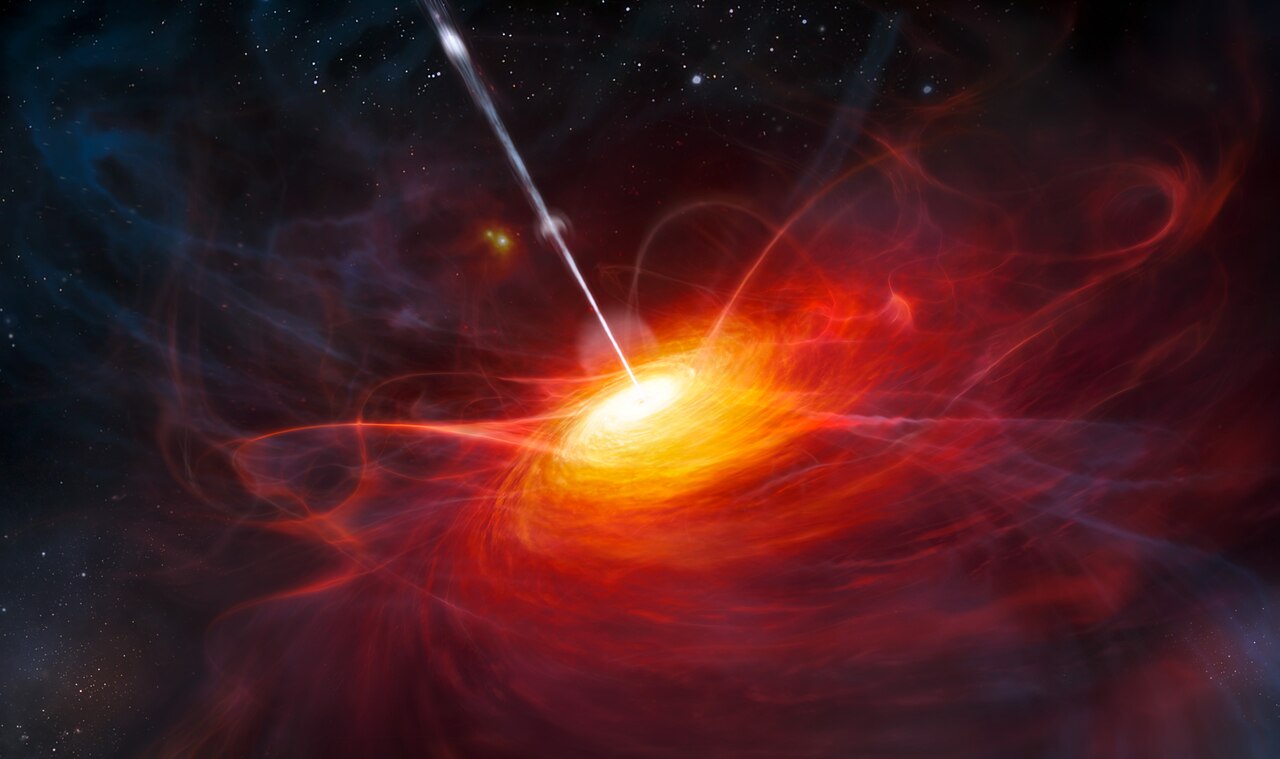
In the early 1960s, astronomers found mysterious objects in the sky — point sources of light that looked like stars but had bizarre spectra. They emitted enormous amounts of radio waves and visible light, yet appeared as small as stars. The distance measurements were stunning: these objects were billions of light-years away, meaning they had to be unimaginably bright to be visible at all. They were named "quasars" — short for "quasi-stellar radio sources" — and they turned out to be some of the most luminous and distant objects in the universe, powered by supermassive black holes consuming matter at extraordinary rates.
The Short Answer
A quasar is an extremely luminous active galactic nucleus (AGN) — a region at the center of a distant galaxy where a supermassive black hole is rapidly consuming surrounding matter. The infalling matter forms an accretion disk that heats to extraordinary temperatures and emits enormous amounts of radiation across the electromagnetic spectrum. Quasars are among the most distant and luminous objects in the universe, often outshining their entire host galaxies and visible across billions of light-years.
The Discovery
Quasars were discovered in 1963 by astronomer Maarten Schmidt, who identified the redshift of one object (3C 273) and realized it was at a previously unimagined distance. The redshift indicated the object was receding at a substantial fraction of the speed of light, placing it at about 2.4 billion light-years away. For an object that distant to appear bright enough to see, it had to be emitting tremendous amounts of energy. Subsequent observations of other "quasi-stellar" objects revealed similar properties. By the 1970s, astronomers realized these were supermassive black holes consuming material at the centers of distant galaxies.
How Quasars Work
A quasar requires several components: a supermassive black hole (typically millions to billions of solar masses at the center of a galaxy); an accretion disk (a swirling disk of gas, dust, and stellar debris falling toward the black hole); heated matter where friction in the disk heats material to millions of degrees, producing intense radiation; magnetic fields that channel some material into powerful jets perpendicular to the disk; and a host galaxy that provides the gas and dust feeding the black hole.
The Power of Quasars
Quasars produce energy on a truly cosmic scale. A typical quasar can outshine its entire host galaxy of hundreds of billions of stars combined. Some quasars emit thousands of times more energy than the Milky Way. The most luminous quasars produce over 10^41 watts — comparable to trillions of Suns. This energy comes from the gravitational potential energy of matter falling into the black hole, converted to radiation through complex processes in the accretion disk. The efficiency of this conversion — roughly 10% — vastly exceeds nuclear fusion in stars (less than 1%).
Why Quasars Are Distant
Quasars are mostly found at great distances from Earth. The closest known quasar is about 600 million light-years away; many are billions of light-years distant. This isn't coincidence. Quasars were much more common in the early universe, when galaxies contained more gas to feed their central black holes. As the universe aged, galaxies used up their available gas, and supermassive black holes had less fuel for quasar activity. Today, most galaxies have relatively quiet central black holes. The Milky Way's central black hole, Sagittarius A*, is largely dormant — it would need to consume far more matter to become an active quasar.
Looking Back in Time
Because quasars are so distant, observing them is essentially looking back in time. We see the most distant quasars as they were when their light left them — over 13 billion years ago, when the universe was just a few hundred million years old. The most distant known quasar (ULAS J1342+0928) is at redshift 7.54, with light that left when the universe was only 690 million years old. This raises a puzzle: how did supermassive black holes (some with billions of solar masses) form so early in the universe's history? The mechanism remains debated.
The Jets
Many quasars have powerful jets — narrow streams of matter and energy shooting outward perpendicular to the accretion disk. These jets travel at nearly the speed of light and extend for hundreds of thousands or even millions of light-years from the galaxy. The jets carry massive amounts of energy and material. When a quasar's jets point toward Earth, we see "blazars" — particularly extreme objects. The energy and direction of these jets has profound effects on surrounding galaxies and intergalactic gas.
Types of Active Galactic Nuclei
Quasars are one type of AGN. The broader family includes Seyfert galaxies (active spirals with bright central regions, including narrow and broad spectral lines), radio galaxies (active galaxies emitting powerful radio waves from giant jets), blazars (AGN with jets pointed nearly toward Earth, including BL Lacertae objects), and low-luminosity AGN (weakly accreting black holes, including the Milky Way's). Each type represents different aspects or viewing angles of similar underlying physics.
The Most Distant Quasars
Discoveries of distant quasars continue. Notable examples include ULAS J1342+0928 at 13.1 billion light-years away, J0313–1806 (discovered 2021) at 13 billion light-years away with a 1.6 billion solar mass black hole, SDSS J1148+5251 at 12.8 billion light-years with similarly massive black hole, and 3C 273, the first quasar discovered in 1963, at 2.4 billion light-years away. The continuing search for ever-more-distant quasars pushes the boundaries of cosmology.
Black Hole Masses
The black holes powering quasars range from millions to billions of solar masses. The largest known quasar black holes exceed 10 billion solar masses. They contain so much mass concentrated in such a small space that they're comparable to the mass of small galaxies but compressed into regions smaller than our solar system. The mass of the central black hole strongly correlates with its host galaxy's properties, suggesting deep connections between galaxy formation and central black hole growth.
Quasars and Galaxy Evolution
Quasars play important roles in galaxy evolution. Their massive energy output can blow gas out of host galaxies, slowing star formation. The presence of an active quasar correlates with various galaxy properties. Periods of intense quasar activity ("AGN feedback") may have shaped galaxy evolution throughout cosmic history. The "M-sigma relation" — connecting black hole mass to host galaxy properties — suggests deep, co-evolutionary connections between black holes and their galaxies.
Detection Methods
Quasars are detected and studied through various means: optical surveys looking for point-like sources with unusual colors and spectra; radio surveys (many quasars are strong radio emitters); X-ray observations (accretion disks emit in X-rays); spectroscopic confirmation (measuring redshifts confirms distances); variability studies (many quasars change brightness over time); and multi-wavelength campaigns combining observations across the spectrum.
How Many Quasars Exist?
The Sloan Digital Sky Survey and other large surveys have catalogued over 750,000 quasars. The actual number in the universe is much higher — these are just those bright enough to detect. Quasars were most common in the early universe; the universe today has fewer active ones. Future surveys will identify many more. The total number ever observed might increase by orders of magnitude with next-generation telescopes. Each represents a window into early black hole growth and galaxy evolution.
The Quasar Era
Quasars were most numerous during the "quasar era" — roughly 8-12 billion years ago, when the universe was 2-6 billion years old. During this period, galaxies were rich in gas, supermassive black holes were rapidly growing, and quasar activity was widespread. Many of today's quiet galaxies were once active quasars. The transition from active to dormant happened gradually as available gas became depleted. Some galaxies still have quasar-like activity today, but at lower rates than the cosmic peak.
Quasars and Cosmic Reionization
Quasars contributed to cosmic reionization — the period when the early universe's neutral hydrogen was re-ionized. After the Big Bang, the universe consisted of a fog of neutral hydrogen. Eventually, intense ultraviolet radiation (mostly from young galaxies and quasars) ionized this hydrogen, allowing light to travel freely. Quasars provided substantial ionizing radiation during this critical phase. Detecting and counting early quasars helps understand reionization history.
Gravitational Lensing of Quasars
Some quasars are gravitationally lensed by intervening galaxies, producing multiple images or "Einstein rings." The Twin Quasar (1979) was the first observed gravitational lens, showing two images of the same quasar separated by 6 arcseconds. Lensed quasars provide opportunities to measure cosmological parameters and study the universe's expansion. They also reveal the dark matter distribution in lensing galaxies. Hundreds of gravitationally lensed quasars are now known, providing valuable astronomical resources.
Variability and Light Curves
Quasars often vary in brightness over timescales from days to years. This variability provides information about the central black hole and accretion disk. Some quasars show extreme variations — brightening or dimming by factors of 10 or more. The timescales of variations constrain the size of the emitting region: variations on monthly timescales suggest the emitting region is no larger than a few light-months across — remarkably compact given the enormous energy output. Monitoring quasar light curves provides ongoing scientific information.
Recent Discoveries
Recent quasar research has produced major findings. The James Webb Space Telescope has identified surprising numbers of massive quasars in the early universe, challenging models of black hole growth. The TON 618 quasar may have a black hole of 66 billion solar masses. Some "changing-look" quasars dramatically alter their spectra over years — possibly due to changes in their accretion. The Event Horizon Telescope has imaged the central regions near some supermassive black holes. Each new observation refines our understanding of these extreme objects.
Cultural Impact
The discovery of quasars transformed astronomy and cosmology. It revealed that the universe contained objects unimaginably more powerful than stars or even galaxies. It connected black hole physics to cosmic evolution. Popular interest in quasars helped fund astronomy research. The famous photograph of 3C 273 — looking like a star but with a faint jet — became iconic. Today, quasars remain among the most studied astronomical objects, providing windows into the most extreme physics in the universe.
Key Facts
A quasar is an extremely luminous active galactic nucleus powered by a supermassive black hole. They're among the brightest objects in the universe, often outshining their host galaxies. Most quasars are billions of light-years away. The first quasar was discovered in 1963. Quasars were more common in the early universe. The most distant known quasars are at redshifts above 7. Powerful jets often emerge perpendicular to the accretion disk.
Fun Facts
The name "quasar" comes from "quasi-stellar radio source." The first quasar (3C 273) appeared to be a star, but with strange properties. Quasars produce more energy than entire galaxies of hundreds of billions of stars. TON 618 may have one of the largest known black holes at 66 billion solar masses. Most galaxies have central black holes that aren't currently active enough to be quasars. The brightest known quasar emits the energy of about 600 trillion Suns. Some quasars have lasted as active phenomena for millions of years.
The Bottom Line
A quasar is one of the most luminous and energetic objects in the universe — a supermassive black hole at the center of a distant galaxy actively consuming matter and emitting enormous amounts of radiation. Discovered in 1963, quasars revealed that the universe contains phenomena far more extreme than stars or normal galaxies. The supermassive black holes powering quasars are millions to billions of times the Sun's mass. Quasars are particularly common in the early universe, providing crucial information about cosmic evolution, galaxy formation, and the growth of supermassive black holes throughout cosmic history.