
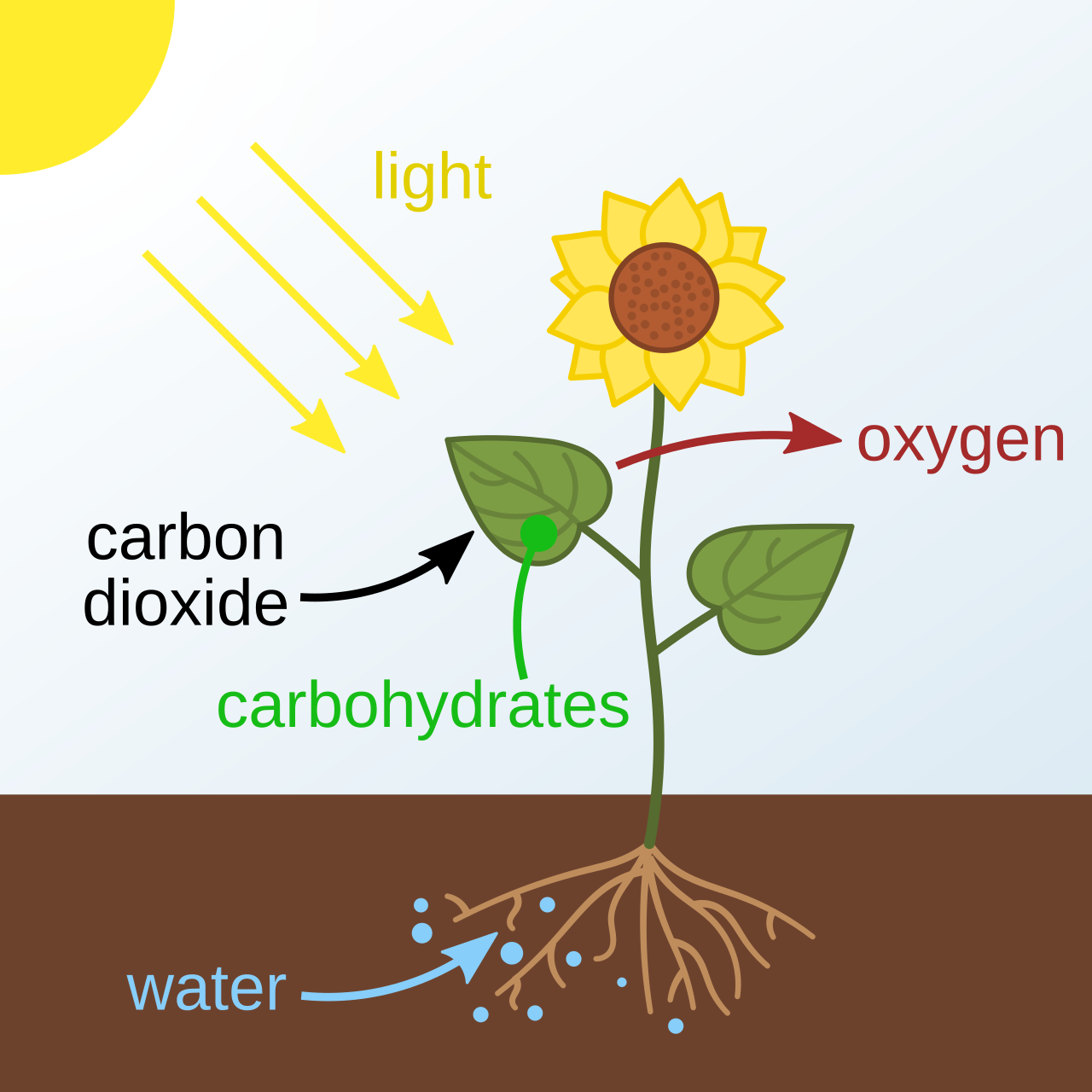
Photosynthesis is the foundation of life on Earth. Through this process, plants, algae, and some bacteria transform light energy from the Sun into chemical energy stored in sugar molecules. This stored energy powers nearly every food chain, produces the oxygen we breathe, and shapes Earth's atmosphere and climate. Yet the actual biochemistry is one of the most elegant processes in all of biology.
The Short Answer
Photosynthesis is the process by which plants, algae, and some bacteria convert sunlight, water (H₂O), and carbon dioxide (CO₂) into glucose (C₆H₁₂O₆) and oxygen (O₂). The overall reaction is: 6CO₂ + 6H₂O + light energy → C₆H₁₂O₆ + 6O₂. This converts solar energy into chemical energy that powers the organism and is stored as carbohydrates.
The Equation
The fundamental equation of photosynthesis:
- 6CO₂ + 6H₂O + light → C₆H₁₂O₆ + 6O₂
- Six carbon dioxide molecules plus six water molecules plus light
- Produces one glucose molecule plus six oxygen molecules
- The energy is captured in the chemical bonds of glucose
Where It Happens
Photosynthesis occurs in chloroplasts:
- Chloroplasts are organelles in plant cells
- Most concentrated in plant leaves
- Contain chlorophyll, the green pigment
- Have internal membranes (thylakoids) where light reactions occur
- Have a fluid (stroma) where dark reactions occur
- Each leaf cell can have hundreds of chloroplasts
Two Stages of Photosynthesis
The process has two parts:
- Light-dependent reactions: Capture light energy. Make ATP and NADPH. Split water, releasing oxygen. Occur in thylakoid membranes.
- Light-independent reactions (Calvin cycle): Use ATP and NADPH to fix carbon dioxide into glucose. Occur in stroma. Don't directly require light but use products of light reactions.
Light-Dependent Reactions
The first stage:
- Chlorophyll absorbs photons of light.
- Excited electrons enter electron transport chain.
- Energy is used to pump hydrogen ions across thylakoid membrane.
- Hydrogen ion gradient drives ATP synthase to make ATP.
- Water is split (photolysis), releasing electrons, hydrogen, and oxygen.
- Oxygen is released as byproduct (essential for animal respiration).
- NADPH is produced for use in dark reactions.
The Calvin Cycle
The second stage, named after Melvin Calvin who described it:
- CO₂ enters through leaf stomata.
- Enzyme RuBisCO captures CO₂.
- CO₂ is added to a 5-carbon sugar.
- The resulting unstable 6-carbon molecule splits into two 3-carbon molecules.
- ATP and NADPH from light reactions provide energy.
- Through several steps, glucose is eventually built.
- Most molecules return to start the cycle again.
RuBisCO
Perhaps Earth's most important enzyme:
- Catalyzes CO₂ fixation in Calvin cycle
- Most abundant protein on Earth
- Slow and inefficient compared to most enzymes
- Plants produce massive amounts to compensate
- Despite limitations, central to life on Earth
Different Types of Photosynthesis
- C₃ photosynthesis: Most common. Used by ~85% of plants. Less efficient in hot weather.
- C₄ photosynthesis: Used by ~3% of plants (corn, sugarcane). More efficient in hot, sunny climates.
- CAM photosynthesis: Used by succulents and desert plants. Open stomata at night to conserve water.
Photosynthesis in Bacteria
Not just plants do photosynthesis:
- Cyanobacteria: First photosynthesizers, 3+ billion years old.
- Purple bacteria: Use different pigments, different wavelengths.
- Green bacteria: Yet other variants.
- Some don't produce oxygen — earlier evolutionary versions.
Photosynthesis and Oxygen
The oxygen-producing variant changed Earth:
- Cyanobacteria evolved oxygen-producing photosynthesis 2.4+ billion years ago
- "Great Oxidation Event" filled atmosphere with oxygen
- Made aerobic respiration possible
- Allowed evolution of complex animal life
- All oxygen in Earth's atmosphere comes from photosynthesis
How Plants Get the Ingredients
Plants source materials:
- Light: From the Sun, captured by leaves
- Water: Absorbed by roots from soil, transported to leaves
- Carbon dioxide: From atmosphere, enters through stomata in leaves
- Nutrients: Nitrogen, phosphorus, etc. from soil
- Plants use these for various roles beyond just photosynthesis
What Plants Do With Glucose
Photosynthesis products used for:
- Energy: Cellular respiration breaks down glucose for ATP
- Structural materials: Cellulose, lignin in cell walls
- Storage: Starch for later use
- Growth: Building new plant tissues
- Reproduction: Fruit, seeds, flowers
- Defense: Various chemical compounds
Photosynthesis Efficiency
How well plants convert light:
- Theoretical maximum: about 11% conversion efficiency
- Most crops: 1-2% conversion
- Best crops in best conditions: 6-8%
- Algae can be more efficient than land plants
- Compare to commercial solar panels: 15-22%
Photosynthesis and Climate
The carbon-cycle connection:
- Photosynthesis removes CO₂ from atmosphere
- Stores carbon in plant tissues
- When plants die or are eaten, much of carbon released back
- Some carbon stored long-term (forests, soils)
- Critical part of carbon cycle
- Important in climate change discussions
Photosynthesis and Food Chains
The base of the food web:
- Producers (plants, algae) make food through photosynthesis
- Primary consumers (herbivores) eat producers
- Secondary consumers (carnivores) eat primary consumers
- All energy in food chains originates from photosynthesis
- Even oil and natural gas come from ancient photosynthesis
Discovery and History
Understanding photosynthesis took centuries:
- 1779: Jan Ingenhousz discovered plants release oxygen in light
- 1840s: Julius von Mayer recognized energy conservation
- 1882: Theodor Engelmann showed chloroplasts produce oxygen
- 1940s-50s: Melvin Calvin worked out the Calvin cycle
- Continued research today on details and improvements
Artificial Photosynthesis
Scientists are trying to mimic plant photosynthesis:
- Create devices that convert sunlight + water + CO₂ to fuel
- Could produce hydrogen fuel sustainably
- Active research area
- Better understanding of natural photosynthesis informs research
- Could be key for sustainable energy future
Photosynthesis in Practice
Practical implications:
- Crop yields depend on photosynthesis efficiency
- Greenhouse growers manipulate light, CO₂, temperature
- Genetic engineering aimed at improving photosynthesis
- Forest management affects global carbon balance
- Algae farming for fuel and food
Photosynthesis vs Respiration
Opposite processes:
- Photosynthesis: Builds glucose using light energy, releases oxygen.
- Respiration: Breaks down glucose for energy, uses oxygen, releases CO₂.
- Photosynthesis only in chlorophyll-containing organisms.
- Respiration in all living things.
- Plants do both — net producers of oxygen.
Photosynthesis on Other Planets
Speculative astrobiology:
- Photosynthesis depends on appropriate light spectrum
- Different stars would support different pigments
- Mars may have once supported simple photosynthesizers
- Cyanobacteria-like life is plausible elsewhere
- Astrobiology actively studies these possibilities
Loss of Photosynthesis
Some plants have lost the ability:
- Parasitic plants like Indian pipe (Monotropa)
- Live by taking nutrients from other plants
- Lack chlorophyll, appear white or pale
- Show that photosynthesis isn't universal in plants
- Demonstrates evolution's flexibility
Key Facts
- Photosynthesis converts sunlight, water, and CO₂ to glucose and oxygen.
- It occurs in chloroplasts containing chlorophyll.
- Two stages: light-dependent and Calvin cycle.
- It produces all of Earth's atmospheric oxygen.
- It supports virtually all life on Earth.
Fun Facts
- All Earth's atmospheric oxygen comes from photosynthesis.
- RuBisCO is the most abundant protein on Earth.
- Cyanobacteria invented photosynthesis 3+ billion years ago.
- Without photosynthesis, animal life couldn't exist.
- Some plants (like Indian pipe) have lost photosynthesis and are parasitic.
Photosynthesis on Other Worlds
Could photosynthesis exist elsewhere? Mars probably had conditions for early simple photosynthesis. Some scientists speculate that subsurface life on icy moons might use chemosynthesis instead. Exoplanets around different stars would likely evolve photosynthesis using different wavelengths. Around red dwarf stars (most common in the galaxy), plants might absorb infrared and appear black. Around hotter blue stars, plants might absorb different wavelengths. The search for biosignatures on other worlds includes looking for the spectral signatures of photosynthesis. The fundamental process of converting light to chemical energy may be widespread in the universe.
Photosynthesis Research Today
Modern photosynthesis research continues advancing. Scientists are working to make photosynthesis more efficient — current rates of converting solar energy to plant biomass are only 1-3%. Genetic engineering targets the C3 vs C4 distinction, trying to give C3 crops (like rice and wheat) the C4 advantage of corn. Some research aims to extend photosynthesis to non-photosynthesizing crops. Other work explores how photosynthesis evolved and operates at the molecular level. The Krebs cycle and Calvin cycle are studied in unprecedented detail. Climate change research examines how photosynthesis will respond to elevated CO₂ and warming. This fundamental process remains an active research frontier.
Photosynthesis and Future Food Security
As Earth's population grows toward 10 billion, improving photosynthesis efficiency could help. Even small percentage improvements in crop photosynthesis could feed millions more. Various research projects target this goal. The C4 Rice Project aims to engineer rice with more efficient C4 photosynthesis. Other efforts focus on improving Rubisco, the inefficient but essential enzyme. Some scientists explore radically different photosynthesis systems — perhaps using more efficient pigments. Sustainable agriculture combines improvements in photosynthesis with other techniques. The next decades will be crucial for feeding humanity sustainably.
The Bottom Line
Photosynthesis is the foundational process that transforms light energy into the chemical energy supporting nearly all life on Earth. Through photosynthesis, plants, algae, and some bacteria convert sunlight, water, and carbon dioxide into glucose and oxygen — feeding food chains, producing the oxygen we breathe, and shaping Earth's atmosphere. Despite being studied for centuries, photosynthesis continues to inspire scientific inquiry, including efforts to create artificial photosynthesis systems that could provide sustainable energy for human civilization.