
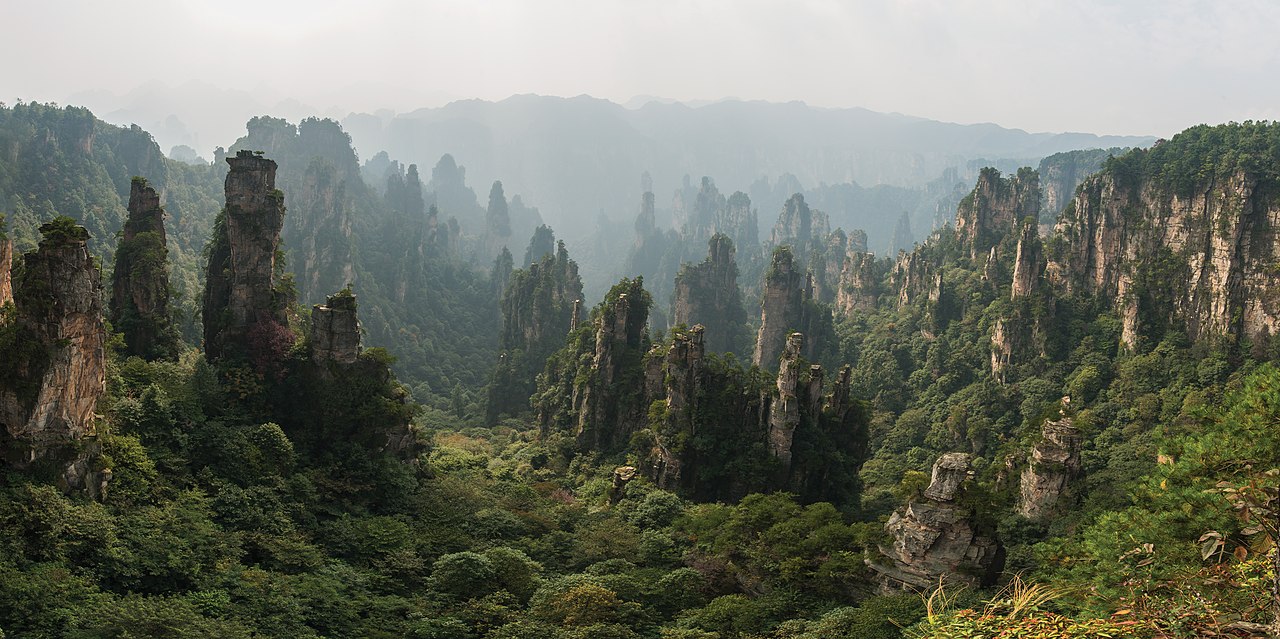
Zhangjiajie National Forest Park in northwestern Hunan Province was China's first national forest park (established 1982) and is the centerpiece of the Wulingyuan Scenic Area, a UNESCO World Heritage Site. The park is famous for its more than 3,000 narrow sandstone pillars, many rising over 200 meters above the forested valleys — a surreal landscape that inspired the "Hallelujah Mountains" in James Cameron's film Avatar (2009).
Introduction
The Wulingyuan area covers 397 square kilometers and contains over 3,000 quartz-sandstone pillars and peaks, more than 40 caves, two natural bridges, and over 800 species of plants. The pillars were formed by millions of years of erosion on a thick sandstone plateau, creating a landscape unlike any other on Earth.
Geography & Geology
- Area: 397 km² (Wulingyuan Scenic Area)
- Sandstone Pillars: Over 3,000
- Tallest Pillar: Over 350 m
- Formation: 300+ million years of erosion on Devonian sandstone
The sandstone pillars of Zhangjiajie were formed from a thick deposit of quartz sandstone laid down during the Devonian period, over 380 million years ago, when the area was covered by a shallow sea. Tectonic uplift raised the sandstone plateau, and millions of years of physical and chemical weathering — driven by subtropical rainfall, freeze-thaw cycles, and plant root growth — carved the pillars from the once-continuous rock.
The pillars are tallest and most dramatic in the Yuanjiajie area, where the "Avatar Hallelujah Mountain" (officially renamed from "Southern Sky Column" after the film) rises to 1,080 meters above sea level. Mist and cloud frequently swirl around the bases and middles of the pillars, creating the ethereal "floating mountain" effect.
UNESCO Inscription
- Year Inscribed: 1992
- Site: Wulingyuan Scenic and Historic Interest Area
- Criteria: Natural (vii)
- Significance: Unparalleled sandstone pillar landscape
The Wulingyuan Scenic Area was inscribed for its outstanding natural beauty and unique geological formations. UNESCO described the area as "an extraordinary natural beauty of towering sandstone pillars, natural bridges, deep ravines, magnificent waterfalls, and karst caves."
The inscription recognized Wulingyuan as containing the most spectacular collection of quartz-sandstone pillar formations in the world, with a concentration and scale found nowhere else on the planet. The subtropical biodiversity within the forest adds additional scientific value.
Key Attractions
- Avatar Hallelujah Mountain: Renamed pillar that inspired the film
- Zhangjiajie Glass Bridge: 430 m long, 300 m above the canyon
- Bailong Elevator: 326 m outdoor elevator — world's tallest
- Golden Whip Stream: 7.5 km scenic valley walk
The Bailong Elevator (Hundred Dragons Elevator) is a glass-fronted outdoor elevator rising 326 meters up the side of a cliff — the tallest outdoor elevator in the world. It carries visitors from the valley floor to the Yuanjiajie plateau in less than two minutes, providing breathtaking views of the pillar forests during the ascent.
The Zhangjiajie Grand Canyon Glass Bridge, opened in 2016, spans 430 meters across a canyon at a height of 300 meters. The transparent glass floor allows visitors to look straight down to the valley floor below. Golden Whip Stream, a 7.5-kilometer walk along a forested creek, offers a ground-level perspective of the pillars and is popular with visitors seeking a less crowded experience.
Wildlife & Flora
- Plant Species: Over 800, including ancient species
- Animals: Rhesus macaques, giant salamanders, civets
- Forest Type: Subtropical evergreen broadleaf and mixed forest
- Rare Species: Chinese giant salamander (world's largest amphibian)
The forests of Zhangjiajie support over 800 plant species, including the dove tree (Davidia involucrata), a living fossil from the Tertiary period. The subtropical forests provide habitat for rhesus macaques, which are commonly seen along trails and at viewpoints, as well as civets, wild boar, and numerous bird species.
The streams and caves harbor the critically endangered Chinese giant salamander, the world's largest amphibian, which can reach 1.8 meters in length. Conservation programs within the park aim to protect this ancient species, which has survived largely unchanged for 170 million years.
Visitor Guide
- Best Season: April to October; autumn colors in November
- Getting There: Fly to Zhangjiajie Hehua Airport or train
- Time Needed: 2-3 full days recommended
- Crowds: Extremely popular; visit early morning
Zhangjiajie is one of China's most visited national parks, drawing millions of visitors annually. The park is divided into several areas, with Yuanjiajie (Avatar area) and Tianzi Mountain being the most popular. A combination of the Bailong Elevator, cable cars, and mountain-top monorail provides access to various viewpoints.
Two to three days is recommended to explore the main areas without rushing. The park is located in northwestern Hunan Province, accessible by flights to Zhangjiajie Hehua Airport from most major Chinese cities or by high-speed train. Early morning arrival at popular viewpoints avoids the worst crowds and offers the best chance of misty, atmospheric conditions.
Key Facts
- Over 3,000 sandstone pillars rise above the forested valleys, many exceeding 200 meters.
- The pillars inspired the floating Hallelujah Mountains in James Cameron's Avatar.
- The Bailong Elevator rises 326 meters — the world's tallest outdoor elevator.
- The Zhangjiajie Glass Bridge is 430 meters long, suspended 300 meters above a canyon.
- The pillars formed from quartz sandstone deposited over 380 million years ago.
Fun Facts
- After Avatar's release, the "Southern Sky Column" pillar was officially renamed "Avatar Hallelujah Mountain" — one of the few natural features renamed after a fictional world.
- The Chinese giant salamander in the park's streams has survived essentially unchanged for 170 million years — making the dinosaurs relative newcomers.
- The park's rhesus macaques have become bold enough to snatch food from tourists — visitors are warned to keep bags closed.
- The Bailong Elevator was controversial when built because of its visual impact on the natural landscape, but it dramatically improved access for elderly and disabled visitors.
Final Thoughts
Zhangjiajie is where geology becomes art — a landscape so surreal that a science fiction film had to borrow it because no imagination could create something so extraordinary from scratch. The sandstone pillars, draped in subtropical greenery and veiled in mist, create a world that feels genuinely otherworldly, proving that reality can outdo even Hollywood's most ambitious visual effects.
Test Your Knowledge!
Think you know your national parks? Try our interactive quiz!
Play Geography Games →