
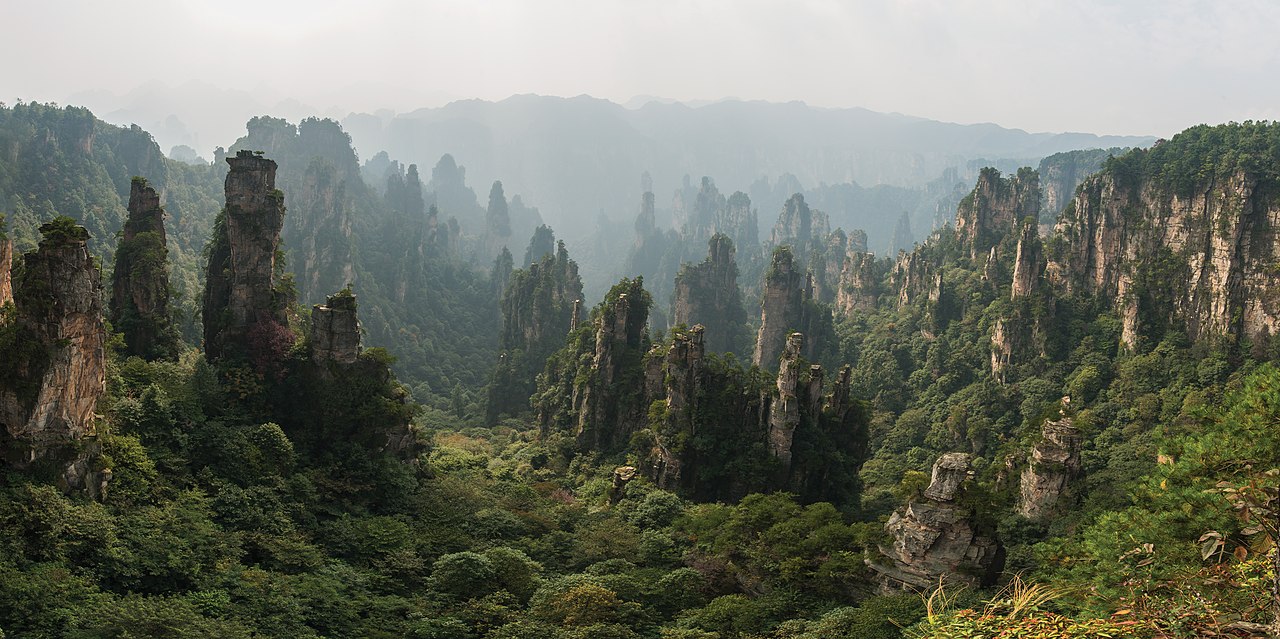
Zhangjiajie National Forest Park is a 130-square-kilometre reserve in Hunan Province, south-central China, famous for its thousands of towering quartzite sandstone pillars that rise straight out of subtropical forest. Established in 1982 as China's first national forest park, it is the centrepiece of the larger Wulingyuan Scenic Area, a UNESCO World Heritage Site, and its gravity-defying spires inspired the floating Hallelujah Mountains in James Cameron's 2009 film Avatar.
For students of geography and curious travellers alike, Zhangjiajie offers one of the clearest examples on Earth of how time, water, and tectonics can sculpt ordinary rock into something that looks almost unreal. This guide covers where the park is, how its pillars formed, what lives there, its most famous attractions, and everything you need to plan a visit.

Where Is Zhangjiajie?
Zhangjiajie National Forest Park lies in the northwest of Hunan Province in south-central China, at the junction of the Yunnan-Guizhou Plateau and the Dongting Lake Plain. The park itself covers 130 square kilometres, while the surrounding Wulingyuan Scenic Area, of which it forms a part, spans 397 square kilometres of protected mountains, gorges, caves, and rivers.
Elevations within the park range from roughly 426 metres in the valley floors to 1,262 metres at the highest peaks. More than 3,000 sandstone pillars, columns, and pinnacles rise from densely forested ravines, many of them topped with flat crowns where ancient pine trees cling to the rock. This combination of vertical stone and clinging greenery gives Zhangjiajie its distinctive, almost painted-scroll appearance.
How the Pillars Formed
The pillars of Zhangjiajie are not volcanic and were not pushed up as solid spires. Instead, they are the leftover cores of a once-continuous layer of quartzite sandstone. Around 380 to 300 million years ago, the region lay beneath an ancient sea, where thick beds of quartz-rich sand accumulated and hardened into stone.
Tectonic uplift later raised this rock far above sea level. Over millions of years, rainwater, frost, and flowing streams exploited vertical cracks and joints in the sandstone, slowly widening them into deep gullies. The harder, more resistant blocks between the cracks survived as freestanding columns, while the softer surrounding rock was washed away. Because quartzite is durable, the pillars can stand for enormous spans of geological time, and many are narrower at the base than the top, heightening the illusion that they hover above the mist. This long, patient process of weathering and erosion is why geologists treat Zhangjiajie as a textbook landscape.
Wildlife and Ecosystems
Beneath the stone forest lies a rich subtropical ecosystem. Forest covers roughly 98 percent of the park, and botanists have recorded more than 3,000 plant species here, including relict trees such as ginkgo and the rare dove tree, whose white bracts resemble fluttering handkerchiefs in spring.
The park supports around 116 vertebrate species. Its clear streams are home to the Chinese giant salamander, the world's largest amphibian, which can reach 1.8 metres in length, live more than 50 years, and has remained largely unchanged for some 170 million years. Rhesus macaques are the most visible animals, often gathering boldly along trails and stream banks. More elusive residents include clouded leopards, civets, and pangolins in the remote interior, while over 150 bird species have been logged, among them silver pheasants and several kinds of laughingthrush.
Notable Features and Attractions
- Avatar Hallelujah Mountain: A roughly 1,080-metre pillar, originally the Southern Sky Column, officially renamed after the 2009 film.
- Zhangjiajie Glass Bridge: A 430-metre glass-bottom bridge suspended 300 metres above a canyon, opened in 2016.
- Bailong Elevator: The world's tallest outdoor elevator, lifting visitors 326 metres up a cliff face in under two minutes.
- Golden Whip Stream: A gentle 7.5-kilometre walk along a clear stream winding beneath the pillars.
The Bailong Elevator, built directly into a cliff and recognised by Guinness World Records, delivers panoramic views over the pillar forest with almost no effort from the visitor. The glass bridge, certified to hold up to 800 people at once and stress-tested by driving a car across it, briefly held the record as the longest glass-bottomed bridge in the world. For those who prefer to stay at ground level, Golden Whip Stream offers a tranquil route where towering spires are mirrored in the water and macaques are a near-constant companion.
The Avatar Connection
Zhangjiajie reached global audiences after the 2009 release of Avatar, whose floating Hallelujah Mountains were widely reported to draw on the park's pillars. Local authorities embraced the link, officially renaming the Southern Sky Column as "Avatar Hallelujah Mountain" and marketing the park heavily to international tourists. Whether or not the film's designers used Zhangjiajie as their sole reference, the association transformed a regional Chinese park into a worldwide bucket-list destination and helped push annual visitor numbers toward three million.
Visiting Zhangjiajie
- Best time to visit: April to October, with spring and autumn offering the most atmospheric mist.
- Getting there: Fly into Zhangjiajie Hehua Airport, or take high-speed rail to Zhangjiajie West Station.
- How long to stay: Two to three days to cover the main scenic zones without rushing.
- Getting around: Shuttle buses, cable cars, and the Bailong Elevator connect the major viewpoints.
The park is well-developed for visitors, with trails ranging from easy valley strolls to strenuous climbs up to pillar summits. Mist blankets the spires on roughly 200 days a year, so genuinely clear skies are relatively rare. Many travellers consider the swirling cloud an asset rather than a drawback, since the pillars appearing and vanishing in the fog produce the park's most memorable views. Visitors heading deeper into the region often pair Zhangjiajie with the wider attractions of China, from the karst hills of the south to the historic cities of the east.
Key Facts
- Location: Hunan Province, south-central China
- Park area: 130 km² (Wulingyuan Scenic Area: 397 km²)
- Established: 1982, China's first national forest park
- UNESCO status: Part of Wulingyuan, World Heritage Site since 1992
- Pillar count: Over 3,000, many exceeding 200 metres
- Tallest outdoor elevator: Bailong Elevator, 326 metres
- Annual visitors: Around 3 million
Frequently Asked Questions
Is Zhangjiajie really the inspiration for Avatar?
Zhangjiajie's sandstone pillars are widely credited as a key inspiration for the floating Hallelujah Mountains in James Cameron's Avatar. The local government officially renamed one pillar "Avatar Hallelujah Mountain" after the film's success, cementing the connection in the public imagination, even though several Chinese landscapes have been cited as influences.
How were the Zhangjiajie pillars formed?
The pillars are eroded remnants of an ancient quartzite sandstone layer laid down beneath a sea hundreds of millions of years ago. Tectonic uplift raised the rock, and water, frost, and wind then widened vertical cracks over millions of years, carving away the softer rock and leaving thousands of durable freestanding columns behind.
When is the best time to visit Zhangjiajie?
April to October offers the most comfortable weather, with spring and autumn especially rewarding because the frequent morning mist drifting between the pillars creates the park's signature dreamlike scenery. Summer is lush but busy and humid, while winter can dust the spires with snow.
How many days do you need at Zhangjiajie?
Two to three days is the usual recommendation, allowing time to explore the main scenic zones, ride the Bailong Elevator and cable cars, walk Golden Whip Stream, and, for the adventurous, cross the Zhangjiajie Glass Bridge without feeling rushed.
