
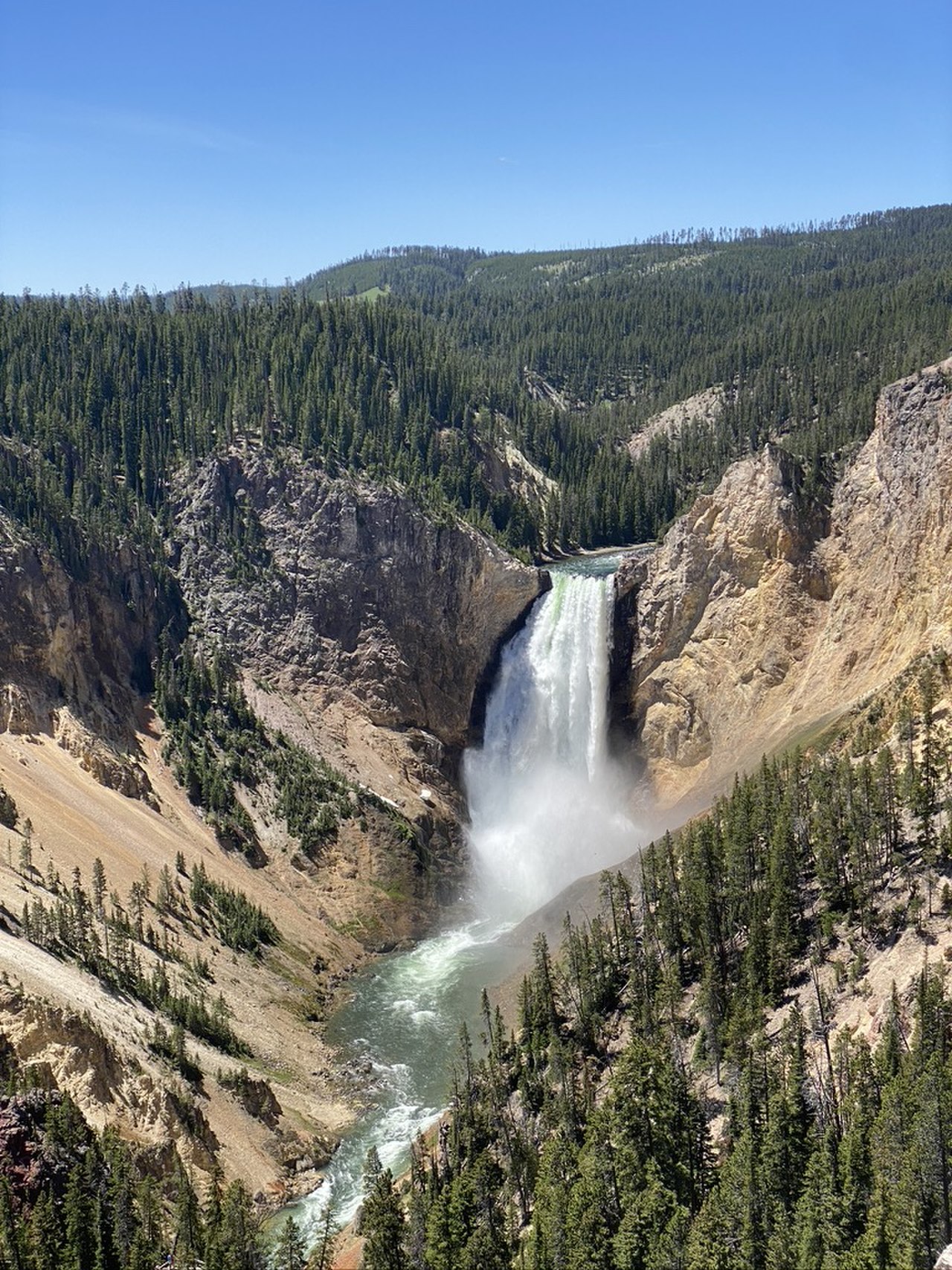
Yellowstone National Park covers 8,983 km² across Wyoming (96%), Montana (3%), and Idaho (1%) — making it America's first national park (established 1872, two months before the entire National Park System concept existed). The park sits atop the Yellowstone Caldera, one of the world's largest active volcanic systems — the Yellowstone Hotspot supercaldera created the park's extraordinary geothermal features. Yellowstone hosts approximately half of all the world's geysers (500+ active geysers, more than the rest of the world combined), more hot springs than anywhere else on Earth, and the most diverse megafauna concentration in the contiguous United States — the famous grizzly bears, black bears, gray wolves (successfully reintroduced 1995, with thriving packs since), American bison (the world's largest free-ranging herd at 5,500+ animals), elk, moose, pronghorn, mountain lions, bobcats, lynx, otters, beavers, and 280+ bird species. The park's signature attractions include Old Faithful (the famous predictable geyser erupting every 60-110 minutes, with eruptions averaging 60-100 m tall), the Grand Prismatic Spring (the third-largest hot spring in the world, with extraordinary rainbow-colored bacterial mats), the Mammoth Hot Springs travertine terraces, Norris Geyser Basin (the park's hottest), the West Thumb Geyser Basin on Yellowstone Lake, the Grand Canyon of the Yellowstone (with the 94 m Lower Falls), Lamar Valley (the "American Serengeti" — premier wolf and bison viewing), and Hayden Valley (premier bear and bison viewing). Most park roads close November-mid-April; the Mammoth-to-Cooke City northern corridor remains plowed year-round.
Quick verdict
Best for full park access (all entrances and roads open): Late May-September.
Best for wildlife photography (spring babies, bears emerging): Mid-April-May.
Best for wildlife (elk rut, fall colors): Mid-September-October.
Best for solitude and snow photography: Mid-December-March (snowcoach/snowmobile only).
Best for wolf-watching (Lamar Valley): Late January-March (snow makes wolves visible) and May-June.
Best for Old Faithful eruption photography: Year-round; sunset eruptions in golden light optimal.
Best for the Grand Prismatic Spring overlook: Mid-day with bright sun (the famous rainbow colors require direct overhead light).
Best for budget travelers: Late April-mid-May and October.
Avoid if you can: July weekends without arriving at Old Faithful by 7 AM (parking fills 9-10 AM with 2-4 hour waits common); attempting Yellowstone in October-May expecting full road access; entering without bear spray (legally required for backcountry; strongly recommended for all walks).
Summer (June-August) — Yellowstone's tourism peak
Full park access. Daytime in lower elevations 18-27 °C; higher elevations 12-22 °C; nights cool 5-12 °C; occasional summer thunderstorms with lightning being a serious hazard at higher elevations. All five park entrances open: West Yellowstone (Montana), North (Gardiner, Montana, the only year-round entrance), Northeast (Cooke City, Montana, accessed via the famous Beartooth Highway), East (Cody, Wyoming), and South (toward Grand Teton/Jackson).
Old Faithful — the park's most famous attraction — erupts every 60-110 minutes with predictions posted at the visitor center. The famous Upper Geyser Basin around Old Faithful contains the world's highest concentration of geysers (150+ in a 2 km² area), including Castle Geyser, Grand Geyser (the world's tallest predictable geyser, eruptions reaching 60 m), Riverside Geyser, and Daisy Geyser. The famous walking boardwalk between geysers provides 4-hour comprehensive exploration.
The Grand Prismatic Spring — the famous rainbow-edged hot spring in the Midway Geyser Basin — is the third-largest hot spring in the world (110 m diameter, 50 m deep). The boardwalk-level view provides limited rainbow color appreciation; the famous "Fairy Falls Trail" overlook (a 1.6 km hike to elevated viewing) provides the iconic aerial perspective. Visit midday with bright sun for maximum color saturation.
The Lamar Valley in the park's northeast — accessed via the famous Northern Corridor road — is the famous "American Serengeti." Bison herds of hundreds graze the valley; gray wolves are reliably visible from roadside pullouts (gather with wildlife watchers at Slough Creek pullouts at dawn for telescope-equipped wolf viewing); grizzly bears, black bears, and pronghorn are common. The famous Lamar Valley provides the best Yellowstone wildlife viewing year-round.
The Hayden Valley — between Canyon Village and Yellowstone Lake — provides similar wildlife concentration. The Mud Volcano area, the famous Dragon's Mouth Spring, and the famous Sulphur Caldron provide the park's most active geothermal features alongside extensive bison herds.
The Grand Canyon of the Yellowstone — the famous 32 km canyon — contains the Upper Falls (33 m) and Lower Falls (94 m, nearly twice the height of Niagara). The famous Artist Point viewpoint provides the iconic photographic perspective; the famous Uncle Tom's Trail (308 stairs descending into the canyon) and Brink of the Lower Falls trail provide closer access.
The Mammoth Hot Springs travertine terraces in the park's north — uniquely accessible year-round (the Northern Corridor stays plowed throughout winter) — provide the famous "frozen waterfall" thermal features. Algae and bacteria create extraordinary color variation across the white travertine.
Wildlife seasonality
Each season provides different wildlife experiences:
April-May: Bears emerge from hibernation; bison calves born (the famous "red dogs" with reddish-brown coats); elk migrate to summer pastures; wolves still in winter pack behavior. Limited road access (many interior roads still closed).
June-mid-August: Full wildlife activity at higher elevations; bears more dispersed across the park; wolves harder to spot due to dispersed pack behavior; bison rut begins late July.
Mid-August-September: Bison rut (the famous July-August bull bison fighting); elk rut begins (the famous September-October bull elk bugling); bears feeding heavily for hibernation (often visible on hillsides eating berries and roots).
October: Elk rut peak; first heavy snows possible; some park roads begin closing late October; remarkable autumn aspen color along the Northern Corridor.
November-March: Winter wildlife concentration around geothermal basins (Norris, Mammoth, Old Faithful) where snow melts; wolves visible against snow; bison powdered with snow create iconic winter photographs.
Winter (mid-December-mid-March)
Yellowstone transforms. Daytime -15 to -3 °C with regular -25 °C cold snaps; nights commonly -25 to -35 °C; 3-5 m of snow accumulation. Most park roads close to wheeled vehicles November-mid-April. Access is by snowcoach (the famous heated tracked vehicles) or guided snowmobile tours from West Yellowstone, Mammoth, or Flagg Ranch. Old Faithful, Mammoth, and Snow Lodge stay open with limited winter operations.
Winter wildlife viewing is genuinely extraordinary — bison powdered in snow, wolves silhouetted against white landscapes, the famous Mammoth Hot Springs steaming dramatically against frozen surroundings. The Lamar Valley wolf-watching peaks January-March when snow makes wolves more visible against the landscape. Old Faithful in winter — erupting through frigid air to create extraordinary steam plumes against blue sky — provides one of the world's most dramatic photographic conditions.
Cross-country skiing and snowshoeing operate on park trails. The Mammoth Hot Springs area and the Old Faithful area provide accessible winter recreation.
Yellowstone reservation considerations
The park does not currently require timed-entry reservations (as of 2024) but accommodation booking is essential. The park's nine in-park lodges (Old Faithful Inn, Old Faithful Snow Lodge, Lake Yellowstone Hotel, Roosevelt Lodge Cabins, Mammoth Hot Springs Hotel, Canyon Lodge, Grant Village, and Lake Lodge Cabins) require booking 12-18 months ahead for summer dates. Backcountry permits required for overnight wilderness trips.
Festivals & cultural events
Yellowstone Centennial events (various years): Major park anniversary celebrations.
Junior Ranger Programs (year-round): Major family education programming.
Ranger-led talks (May-September): Extensive park interpretive programs.
Yellowstone Spring Wildlife Symposium (May, Old Faithful): Major wildlife conservation event.
Winter Carnival activities (varies): Park ranger winter programs.
Cultural and practical notes
English is the primary language. US Dollar is the currency. Tipping 18-22%. Driving on the right side. Yellowstone entrance fee ($35/vehicle for 7 days) or the America the Beautiful pass ($80 annual, covers all NPS sites). Bear awareness is essential — store food in vehicles or bear boxes (never in tents); maintain 100 m distance from bears and wolves; 25 m from other wildlife; carry bear spray for any backcountry hiking.
Practical considerations
Bozeman Yellowstone International Airport (BZN, Montana, 90 minutes from north entrance), Jackson Hole Airport (JAC, Wyoming, in Grand Teton, 60 minutes from south entrance), Cody Yellowstone Regional Airport (COD, Wyoming, 90 minutes from east entrance), and West Yellowstone Airport (WYS, summer-only) provide aviation access. Internal travel by personal vehicle essential — the park's road network is the only way to access major sites. The famous Grand Loop Road forms a 233 km figure-eight connecting all major attractions. Driving the entire Grand Loop without stops takes 5-6 hours — most visitors spend 4-7 days.
Traveler-type advice
First-time visitors: Late May-September for full access.
Photographers: Mid-September-early October for elk rut and fall foliage; January-March for winter wildlife and snow scenes.
Wildlife enthusiasts: Spring (April-May) for babies; September-October for elk rut; winter for wolves and bison.
Wolf-watchers: Lamar Valley year-round at dawn; January-March optimal.
Family travelers: June-August for full attractions and Junior Ranger programs.
Winter adventurers (snowmobile, snowcoach): Mid-December-mid-March.
Budget travelers: Late April-mid-May and October.
Combined Wyoming travelers: Yellowstone + Grand Teton + Jackson typically 7-10 days; late May-September optimal.
Bottom line
Yellowstone rewards careful seasonal timing for fundamentally different experiences. Late May-September provides full park access; April-May and September-October provide best wildlife with smaller crowds; December-March provides snowcoach/snowmobile-only access to a near-empty park. Book in-park accommodation 12-18 months ahead for summer dates. Allow 4-7 days minimum to experience the park's major attractions.