
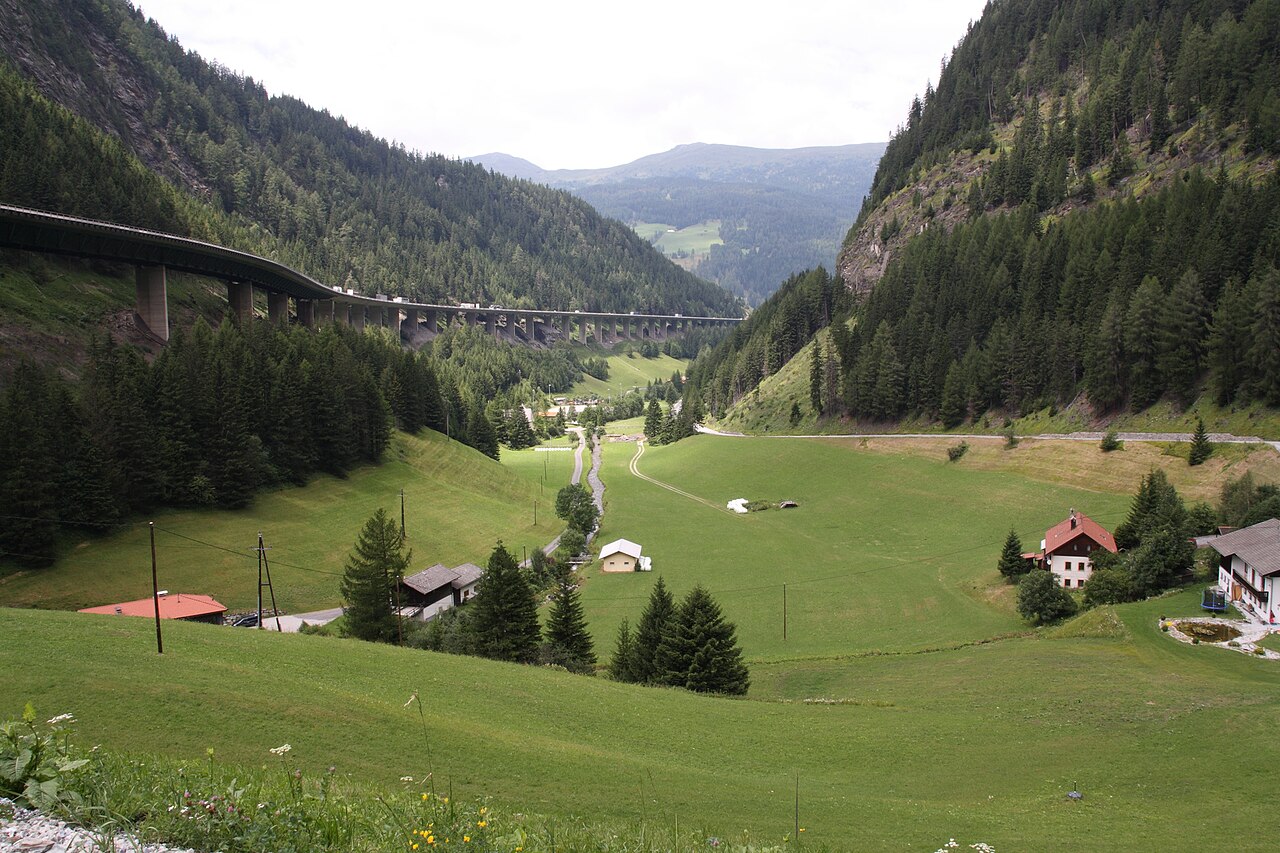
The Brenner Pass (German: Brennerpass; Italian: Passo del Brennero) is a mountain pass at 1,370 meters elevation in the Eastern Alps, on the border between Austria and Italy. As the lowest of the major central Alpine passes, it has been the principal route between Italy and northern Europe for at least 2,000 years and remains the single busiest Alpine freight crossing today, handling nearly 2.5 million heavy trucks per year.
Introduction
While the Alps boast many higher and more dramatic passes — the Stelvio at 2,757 m, the Great St. Bernard at 2,469 m — the Brenner's modest 1,370 m elevation is precisely what makes it strategically dominant. Its low altitude means it remains snow-free for much of the year, manageable in winter, and accessible to wheeled traffic where higher passes are not. Roman armies, medieval German emperors traveling to Rome for coronation, the Habsburg trade networks of central Europe, and the modern European freight economy all converged on the Brenner because no other crossing in the central Alps offers the same combination of low elevation and direct north-south alignment.

Geography & Path
- Elevation: 1,370 m at the saddle
- Connects: Innsbruck, Austria (north) to Bolzano/Bozen, Italy (south)
- Range: Eastern Alps (Tux Alps to the west, Zillertal Alps to the east)
- Watershed: Divides the Inn (Danube) and Adige (Adriatic) river basins
- Border: Italy-Austria international frontier
The Brenner saddle sits at the head of the Wipp Valley to the north (which drains into the Inn River and ultimately the Danube) and the Eisack/Isarco Valley to the south (which drains into the Adige River and ultimately the Adriatic Sea at Venice). The pass is so geographically distinctive that the Romans considered it a major orographic boundary; today it marks the border between Austria's Tyrol and Italy's South Tyrol/Alto Adige region. South Tyrol's German-speaking majority — about 70% of the regional population — reflects the cultural reach of the Tyrolean Alpine world that the Brenner once stitched together politically as well as geographically.
Historical Importance
- Roman road: Via Claudia Augusta, 47 CE — first paved crossing
- Medieval coronations: Holy Roman Emperors crossed for papal coronation in Rome
- Brenner Railway: Opened 1867 — the first standard-gauge transalpine railway
- WWI Italian Front: Brenner became the Italy-Austria border after 1918
- 1944 partition: Pass was a key Nazi-Italian connection
The Romans built the Via Claudia Augusta over the Brenner in 47 CE under Emperor Claudius, the first paved road across the Alps. Throughout the Middle Ages, the Brenner was the principal route used by German and Holy Roman Emperors traveling to Rome — Charlemagne, Frederick Barbarossa, and Frederick II all crossed it for papal business. The pass became politically dominant during the Habsburg period as the link between Innsbruck (the Tyrolean capital) and the Adriatic ports.
The Brenner Railway, opened by Austria in 1867, was the first standard-gauge railway across the Alpine main ridge — a transformative engineering achievement that connected Munich to Verona. The railway descends through the Inn Valley to Innsbruck, climbs gently to the Brenner summit, then descends through the Eisack Valley to Bolzano without requiring tunnels through the Alpine main ridge — a route only possible because of the low elevation.
The Brenner Border
- Treaty of Saint-Germain (1919): Transferred South Tyrol to Italy after WWI
- Italianization: Mussolini's policies to suppress German culture in South Tyrol
- 1992 Autonomy: South Tyrol became one of the most autonomous regions in Europe
- Schengen abolition: Border controls removed 1998
- 2015 migration crisis: Border controls partially restored amid European migration debates
For most of its history, the Brenner sat in the middle of a single political space — the Tyrolean territories of the Habsburg monarchy. After World War I, the 1919 Treaty of Saint-Germain transferred the South Tyrol to Italy as a war reward, splitting the German-speaking Tyrolean population across two countries. The 20th century saw repeated attempts to suppress and then accommodate this cultural division: Mussolini's forced Italianization in the 1920s and 1930s, post-war South Tyrolean autonomy negotiations, terrorist bombings by South Tyrolean separatists in the 1960s, and finally the comprehensive 1992 autonomy agreement that made South Tyrol one of the most autonomous regions in Europe.
Today the Brenner is part of the Schengen Area's open internal border, though Austria temporarily restored controls during the 2015 migration crisis. Both governments are active partners in Brenner Base Tunnel construction.
The Brenner Base Tunnel
- Length: 64 km — the world's longest underground rail connection (when complete)
- Construction: Begun 2007, expected completion 2032
- Purpose: Move freight traffic from highway to rail through the Alps
- Cost: Estimated €10 billion+
The Brenner Base Tunnel, currently under construction, will be the world's longest underground rail connection at 64 km from Innsbruck to Fortezza on the Italian side. When opened (currently projected for 2032 after multiple delays), it will reduce transit times for freight by 40%+ and allow much heavier trains to operate through the Alps. The aim is to shift freight from the heavily congested A22 Brenner Autobahn — which carries about 2.5 million trucks per year — onto rail, reducing emissions and the famous Brenner truck queues that sometimes stretch for tens of kilometers.
Modern Traffic & Environmental Pressure
- Brenner Autobahn (A13/A22): Opened 1972; carries 2.5+ million trucks per year
- Brenner Railway: Carries about 35% of freight; remainder by road
- Air pollution: Inn Valley experiences some of Europe's worst NOx levels from diesel trucks
- Noise pollution: Residents in Wipp Valley and Eisack Valley report severe quality-of-life impacts
The Brenner Autobahn has been a victim of its own importance. Routes through the Brenner now carry roughly 50 million tons of freight per year — more than any other Alpine crossing. Local Tyrolean residents have organized repeated protests demanding traffic restrictions; Austria has periodically imposed weekend and night-time truck bans. The Brenner Base Tunnel is the long-term mitigation, but its 2032+ opening means Brenner Valley residents face another decade of heavy road traffic.
Key Facts
- The Brenner Pass is 1,370 m above sea level — the lowest of the major central Alpine passes
- It has been the principal route between Italy and northern Europe since Roman times
- The Brenner Railway, opened 1867, was the first standard-gauge railway across the Alpine main ridge
- The pass became the Italy-Austria border after World War I and the Treaty of Saint-Germain in 1919
- The Brenner Autobahn carries about 2.5 million heavy trucks per year — the busiest Alpine freight crossing
Frequently Asked Questions
Where is the Brenner Pass?
The Brenner Pass is in the Eastern Alps on the border between Austria and Italy. The summit at 1,370 m sits between the Wipp Valley to the north (Austrian Tyrol, leading to Innsbruck) and the Eisack/Isarco Valley to the south (Italian South Tyrol/Alto Adige, leading to Bolzano). The Italy-Austria international border runs through the pass.
Why is the Brenner Pass important?
The Brenner is the lowest of the major central Alpine passes at just 1,370 m, making it the easiest year-round crossing of the Alpine main ridge. For 2,000 years it has been the primary route between Italy and northern Europe — used by Roman armies, medieval emperors, and modern freight traffic alike. It is currently the single busiest Alpine freight crossing in Europe.
What is the Brenner Base Tunnel?
The Brenner Base Tunnel is a 64-kilometer underground rail connection currently under construction beneath the Brenner Pass. When complete (projected 2032), it will be the world's longest underground rail connection, allowing freight traffic to bypass the surface road and rail crossings, reduce transit times by 40%+, and substantially cut emissions in the Inn and Eisack valleys.
Why is South Tyrol Italian when most people speak German?
South Tyrol (Alto Adige) was transferred from Austria to Italy by the Treaty of Saint-Germain in 1919, as a reward for Italian participation on the Allied side in World War I. The transfer ignored the German-speaking population's cultural identity, creating a contested ethnic situation that took most of the 20th century to resolve. Today South Tyrol has extensive autonomy under a 1992 agreement, with German, Italian, and Ladin all official languages.
What's the difference between the Brenner Pass and the Brenner Tunnel?
The Brenner Pass is the natural mountain saddle at 1,370 m through which the Brenner Autobahn (highway) and the historic Brenner Railway run. The Brenner Base Tunnel (under construction) is a 64-km railway tunnel deep underneath the pass, designed to allow much faster and heavier freight trains. The pass crossing remains for highway traffic; the tunnel will replace the surface railway for freight.
Final Thoughts
The Brenner Pass is one of those geographic features whose modesty is the point — a low, easy crossing of an otherwise formidable mountain barrier, and therefore one of the most consequential transit corridors in European history. From Roman roads to medieval pilgrim routes to the modern A22 freight artery, the Brenner has channeled the movement of armies, ideas, and goods between the Mediterranean and northern Europe for two millennia.
Test Your Geography Knowledge!
Think you know the world's mountains, passes, and borderlands? Try our games.
Play Geography Games →