
Few national banners can claim the antiquity of Austria's. A clean horizontal stripe of red over white over red, it carries no crest, no star, and no elaborate emblem in its everyday civil form, yet it is widely counted among the oldest national flag designs still in use. The story behind those three bands stretches back to the medieval dukes of Austria, weaving together battlefield legend and centuries of heraldic tradition into one of Europe's most instantly recognizable color schemes. Below, we unpack what the red and white mean, how the triband is built, where it came from, and why Austrians still feel a quiet pride whenever it climbs a flagpole.
A Banner of Two Colors
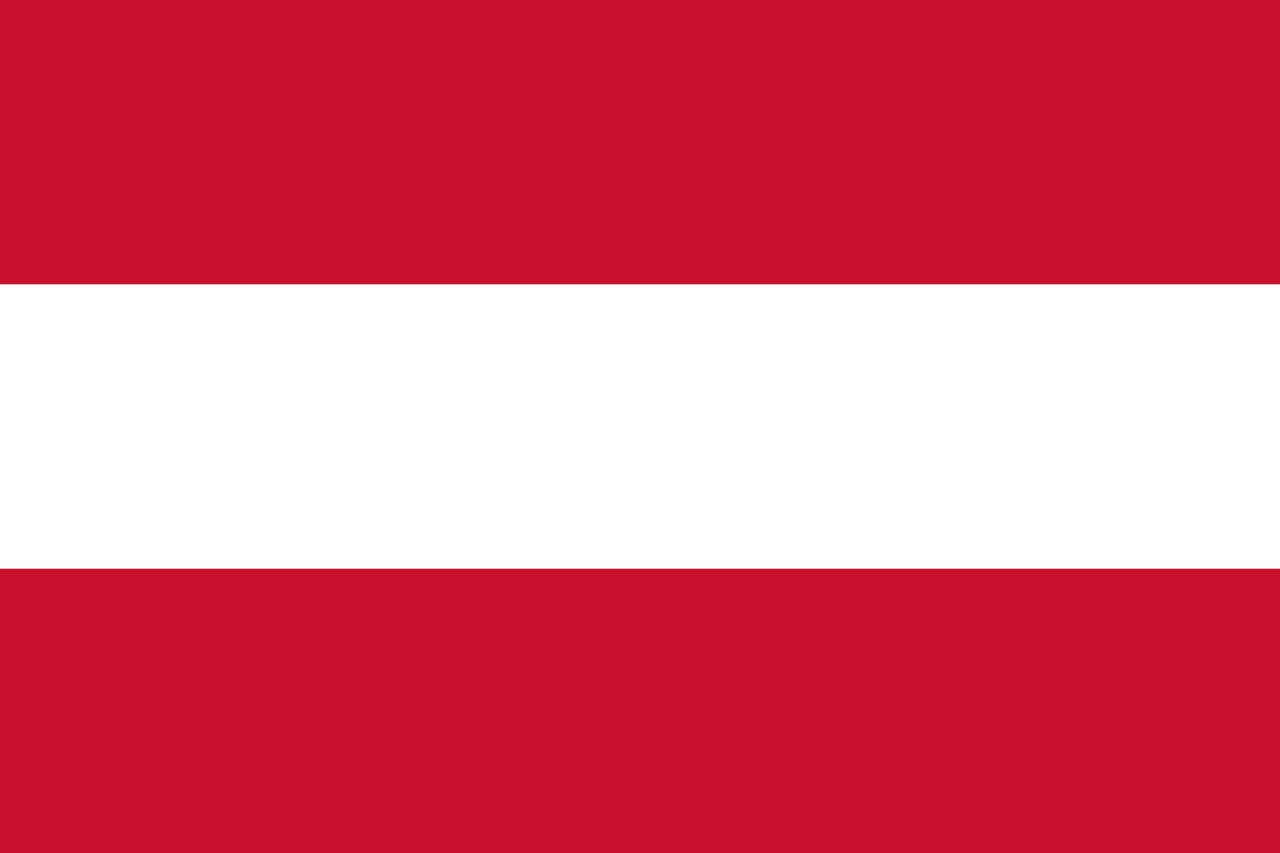
The Austrian flag is austere by design, and that restraint is exactly what makes it memorable. Only two colors appear: red and white. There is no blue, no gold, no green crowding the field. This economy of palette is unusual among modern flags, many of which juggle three or four hues, and it gives the Austrian standard a striking, almost graphic boldness. When you see it snapping in an Alpine breeze, the contrast reads cleanly from a great distance, which was precisely the point in an age when banners had to be identified across a battlefield or a tournament ground.
That spare red-and-white pairing has become a kind of visual shorthand for the country itself. It appears on sports jerseys, customs posts, ski-race finish gates, and the packaging of countless Austrian products. The simplicity is not a lack of imagination but a deliberate inheritance, a color combination that the Austrian people have carried forward for the better part of a millennium.
What the Red and White Mean
The most beloved explanation of the colors comes wrapped in legend. The story tells of a medieval Austrian duke who returned from battle with his white surcoat so thoroughly soaked in blood that the entire garment had turned crimson. Only the strip of cloth beneath his wide belt remained untouched, a clean white band running across the red. When he removed the belt, the pattern revealed itself: red, white, red. Taken with the design, the tale goes, he adopted it as his colors.
Whether or not the duke and his bloodied tunic ever existed, the legend has fused permanently to the flag, and it neatly explains the layout: the red bands are the bloodstained cloth, the white stripe the sheltered ground beneath the belt. Beyond the romance of the tale, the colors have come to stand for valor, sacrifice, and the steadfastness of the Austrian people, with the white center read as a band of peace and honesty held between them.
How the Triband Is Built
Structurally, the design could hardly be simpler. The flag is a horizontal triband, divided into three equal horizontal stripes of identical height. The top and bottom bands are red; the central band is white. This three-into-equal-thirds arrangement is the defining feature, and it scales perfectly to any size of cloth, from a tiny lapel pin to a banner draped across a stadium.
It is worth distinguishing two versions that Austrians use. The plain red-white-red triband is the civil flag, the one ordinary citizens fly. A separate state flag places the national coat of arms, a black eagle, in the center for official government use. The everyday flag most people picture, however, is the unadorned triband, and that purity of form is a large part of its charm and its longevity.
From Medieval Dukes to a Modern Republic
The red-white-red combination first rose to prominence under the Babenberg and later Habsburg rulers of the medieval duchy of Austria, used as a dynastic and territorial color scheme long before the concept of a "national flag" existed. Through the centuries of Habsburg power, those colors traveled across Central Europe as a mark of Austrian identity, even as the larger empire flew other banners alongside them.
The modern flag's status crystallized at a pivotal moment. In 1918, as the Austro-Hungarian Empire dissolved at the close of the First World War and Austria reorganized itself as a republic, the red-white-red triband was carried forward as the flag of the new state. So while the design itself is ancient, its adoption as the banner of the Republic of Austria dates to that turning point. The flag thus bridges two eras: the medieval heraldry of the dukes and the democratic republic that emerged from the empire's collapse. To explore how that long history shaped the country itself, see our austria country guide.
Cousins and Look-Alikes
A red-and-white horizontal scheme is not unique to Austria, and the flag is occasionally confused with relatives that share its palette. The closest visual cousin is the flag of Latvia, which also uses red bands above and below a white stripe, but the resemblance is only superficial. Latvia's red is a darker carmine, and crucially its central white band is much narrower than the red bands rather than being equal to them. Austria's clean, even thirds are the giveaway.
Other red-and-white flags, such as those of Poland (white over red), Indonesia and Monaco (red over white), and Singapore, use horizontal bicolor or additional emblems rather than the symmetric red-white-red triband. The symmetry is what sets Austria apart: flip it upside down and it looks identical, a small but satisfying feature of a perfectly mirrored design. Among nations with comparably old color traditions, Austria sits in a small and distinguished club.
The Flag in Everyday Austrian Life
For a flag rooted in medieval legend, the Austrian triband is thoroughly alive in the present. It flies over the Hofburg and government buildings in Vienna, snaps above town halls in mountain villages, and turns up in dense forests of waving cloth whenever the national ski team rockets down a World Cup course, an event that borders on civic religion in this Alpine nation. Football matches, the Vienna New Year traditions, and national commemorations all bring the red and white into the streets.
Because the colors are so simple and so recognizable, they double as a marketing emblem of Austrian quality, stamped on everything from foodstuffs to ski equipment. The flag is woven into national identity not through complexity but through ubiquity and age: it is the visual constant that has accompanied Austrians through dukes, emperors, and the modern republic alike.
Interesting Facts at a Glance
- It is widely regarded as one of the oldest national flag designs in continuous use, with roots in the medieval duchy.
- The popular origin legend involves a duke whose white tunic was stained red with blood except beneath his belt.
- The civil flag is the plain triband; the state flag adds a black eagle coat of arms in the center.
- Because the three stripes are equal and the colors mirror each other, the flag looks the same upside down.
- Its closest look-alike, the Latvian flag, differs by using a darker red and a thinner white stripe.
- The current flag was carried forward in 1918 when Austria became a republic after the fall of Austria-Hungary.
Frequently Asked Questions
When was the Austrian flag adopted?
The red-white-red color scheme dates back to the medieval period, but the flag was adopted in its modern role as the banner of the Republic of Austria in 1918, when the country reorganized as a republic following the dissolution of the Austro-Hungarian Empire.
What do the colors of the Austrian flag mean?
The flag uses only red and white. According to the famous legend, the red represents a duke's blood-soaked tunic and the white the clean band of cloth that lay protected beneath his belt. More broadly the colors are associated with valor and sacrifice (red) and peace and honesty (white).
Who designed the Austrian flag?
There is no single named designer. The red-white-red scheme emerged from medieval Austrian heraldry under the Babenberg and Habsburg dukes, evolving through centuries of use rather than being created by one person, which is part of why it ranks among the oldest flag designs.
What continent is Austria on, and how does its flag compare to similar ones?
Austria is a landlocked country in Central Europe. Its flag most resembles Latvia's, which also uses red and white horizontal bands, but Austria's stripes are equal thirds while Latvia's white band is narrower and its red is darker, making the two easy to tell apart once you know what to look for.