

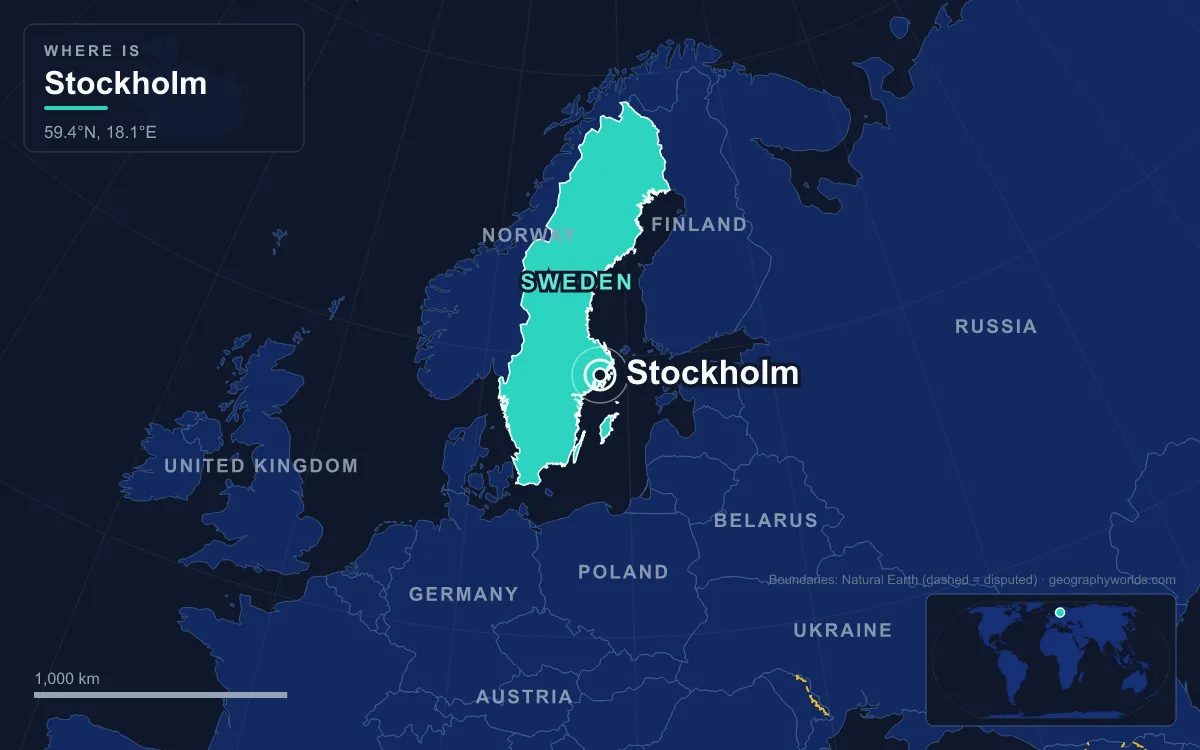
Stockholm became Sweden's official capital in 1634, but it had been the kingdom's political centre and royal seat since the late 13th century, and its rise came from one thing: it sits on the channel where Lake Mälaren, Sweden's third-largest lake, drains into the Baltic Sea. Spread over fourteen islands on the country's east coast at about 59 degrees north, it is Sweden's largest city, with 996,264 people in the municipality in 2025, about 1.6 million in the urban area and some 2.5 million in the metropolitan region. It holds the parliament, the government, the supreme courts and the royal palace, and the Stockholm region produces more than a third of Sweden's GDP.
Before Stockholm: Birka, Sigtuna and the Raid of 1187
Stockholm was not Sweden's first centre of power, and it helps to see it as the latest in a series of capitals of the Mälaren region, a seat of power that simply moved several times. In the Viking Age the leading trading town was Birka, on an island in the lake, active from about 790 to 975. It was followed by Sigtuna, on a northern arm of Mälaren, which dominated the region from about 1000 to 1240.
Both had the same weakness: they lay inside the lake, and anyone who controlled its single outlet to the sea could reach them. According to the medieval Erik's Chronicle, Stockholm was founded by the statesman Birger Jarl to protect Sweden from sea raids after Karelian raiders sailed in and pillaged Sigtuna in the summer of 1187. The outlet was a narrow strait between small islands, and dendrochronology has dated logs driven into the strait north of today's Old Town to around the year 1000. The name probably comes from them: stock, log, and holm, islet, thought to refer to Helgeandsholmen, the islet where the parliament now stands.
The name Stockholm first appears in two letters written by Birger Jarl and King Valdemar in 1252. German merchants invited by Birger Jarl played a large part in the new town, and by the end of the 13th century it had become the largest city in Sweden and the de facto political centre and royal residence. It also had an economic reason to exist: iron from the mines of Bergslagen, west of the lake, came down through Mälaren and left for Lübeck, Hamburg, Danzig, Visby, Reval and Riga through Stockholm's harbour. Sweden's trade faced east and south across the Baltic, and Stockholm sat at the door.
Holding the Mälaren Lock: Stockholm Against the Kalmar Union Kings, 1397–1523
A city that controls the entrance to the kingdom's heartland becomes the prize in every struggle for power, and Stockholm's medieval history is a string of sieges. Under the Kalmar Union of 1397, which joined Denmark, Norway and Sweden under one monarch, controlling Stockholm was essential for anyone who wanted to rule Sweden. On 1 May 1436 the Privy Council rewarded the city's loyalty with a letter of privilege, Stockholm's oldest preserved charter, which is often taken as the start of its status as de facto capital.
A Danish fleet attacked in 1452 and failed. In 1471 the Swedish regent Sten Sture the Elder beat Christian I of Denmark at the Battle of Brunkeberg, only to lose the city to King Hans of Denmark in 1497. When Sten Sture seized power again in 1501, the Danes answered with a blockade that lasted from 1502 to 1509. Finally Christian II took the city in 1520, and on 8 November his men seized the anti-unionist nobles gathered at the royal palace; in the Stockholm Bloodbath that followed, bishops, noblemen, burgomasters and ordinary citizens were beheaded or hanged, 82 people by the executioner's own count. The massacre set off the revolt that ended the union: when Gustav Vasa captured Stockholm in 1523, he noted that every second building was abandoned.
The town at the end of the Middle Ages was small. Around 1500 it had perhaps 5,000 to 7,000 inhabitants, many of them Germans and Finns, yet it was already the largest town in Sweden. Gustav Vasa restored its privileges but brought it firmly under royal control, reinforcing its fortifications, creating Vaxholm in the archipelago to guard the sea approach, and using the city's pulpits to drive the Reformation, with sermons in Swedish from 1525. Even so, Stockholm was not yet a capital in the modern sense. Under his sons Eric XIV and John III, the government often travelled with the king, and the royal castle of Tre Kronor was the city's biggest employer.

1634 and Oxenstierna's Great-Power Capital
What turned the royal town into a formal capital was Sweden's sudden rise as a European power in the Thirty Years' War. When King Gustav II Adolf was killed at Lützen in 1632, his daughter Christina was five years old, and the regency was run by the Lord High Chancellor, Axel Oxenstierna. In 1634 the Riksdag adopted his Instrument of Government, a detailed description of how the state and its central offices were to work, and 1634 is also the year Stockholm is recorded as becoming the official capital of the Swedish Empire. Trading rules gave the city what amounted to a monopoly over commerce between foreign merchants and Sweden's Baltic territories.
Oxenstierna saw the city's shabbiness as a political problem. Stockholm was still medieval in character, and after Gustav II Adolf's death there had been hesitation about inviting foreign statesmen for fear its appearance would undermine the nation's authority. In a letter of 1636 he wrote that building up the capital was a precondition for the power of the state. New plans laid wide, straight streets across the ridges of Norrmalm, Östermalm, Kungsholmen and Södermalm, many of which survive. The population multiplied sixfold between 1610 and 1680, from under 10,000 to more than 50,000 by the mid-1670s.
The great-power years ended badly. Tre Kronor burned on 7 May 1697, and the new palace designed by Nicodemus Tessin the Younger was halted in 1709 by the cost of the Great Northern War; the royal family moved in only in 1754. A plague in 1710 killed about 20,000 people, 36 percent of the population. After the Treaty of Nystad in 1721 Sweden was no longer a major power, and between about 1750 and 1850 Stockholm stagnated, with a shrinking population and high mortality. The loss of Finland to Russia in 1809 meant Stockholm was no longer the geographical centre of the kingdom, and the state began building Karlsborg Fortress on Lake Vättern in 1819 as a wartime refuge where the king, the council and the Riksdag could withdraw if the capital were attacked. It was finally completed in 1909.
Recovery came with industrialisation. In 1866 a commission under Albert Lindhagen proposed a plan of esplanades for the ridges, including Sveavägen, a boulevard 2 kilometres long and 70 metres wide, and new plans for central Stockholm were passed between 1877 and 1880. In the 1880s alone more than 2,000 buildings went up and the population rose from 168,000 to 245,000; by the end of the century fewer than 40 percent of residents had been born in the city, most newcomers arriving from the poorer Swedish countryside. How that growth compares with the country's other urban centres is shown in our list of the largest cities in Sweden.
Rosenbad, Helgeandsholmen and Stadsholmen: Stockholm's Capital Duties Today
The capital functions are still clustered around the same strait that the logs once guarded. The Riksdag sits in the Parliament House, built between 1897 and 1905 to a design by Aron Johansson on nearly half of Helgeandsholmen, replacing the old Riksdag building on Riddarholmen. Its second building originally housed the Riksbank, Sweden's central bank; after the two-chamber Riksdag was replaced by a single chamber in 1971, that building was rebuilt as the new assembly hall, and parliament met in the meantime in Kulturhuset on Sergels torg.

Across the Norrström on the north bank, the government sits in Rosenbad, an Art Nouveau block by Ferdinand Boberg completed in 1902, and the prime minister's official residence is next door at the Sager House. South of the parliament, on Stadsholmen, Stockholm Palace is the monarch's official residence and workplace, though the royal family lives at Drottningholm Palace in neighbouring Ekerö. The division of powers among these buildings is set out in our guide to the government of Sweden.
Being the capital also means hosting the country's institutions of prestige. The Nobel Prize ceremonies and banquet take place at the Stockholm Concert Hall and City Hall, the Karolinska Institute and KTH Royal Institute of Technology were founded here in the 19th century, and most of Sweden's largest banks have their headquarters in the city. The Stockholm Metro, opened in 1950, is known for station art that has earned it the nickname of the world's longest art gallery.
The water that made Stockholm the capital still defines it. More than 30 percent of the city's area is waterways and another 30 percent parks and green space, and the island chain of the archipelago runs east from the city towards open sea. The geography that let a fortified islet guard the Mälaren heartland also gave Sweden its gateway to the Baltic Sea, the trade route on which the city was built and still depends.
Quick Facts About Stockholm
- Country: Sweden
- Continent: Europe (Northern Europe)
- Country population: approximately 10.7 million
- Capital city status: Stockholm is the capital of Sweden, the seat of national government, and the location of foreign embassies, parliament, and the head of state's official residence.
Frequently Asked Questions
What is the capital of Sweden?
The capital of Sweden is Stockholm. Stockholm is the seat of national government, hosts most foreign embassies and consulates, and is typically where the head of state and parliament are located.
What continent is Stockholm in?
Stockholm, the capital of Sweden, is located in Europe, in the Northern Europe region. As Sweden's capital, Stockholm serves as the country's primary connection to the broader Europen political, economic, and cultural sphere.
Why is Stockholm the capital of Sweden?
Stockholm was chosen as the capital of Sweden for reasons that typically combine geography, history, and politics. Capital city selections often reflect a desire for centrality (being accessible from across the country), historical importance (being a longstanding seat of government or culture), or neutrality (being acceptable to multiple regions or ethnic groups within the country). The specific reasons for Stockholm's designation are detailed in the city's history above.
What is Stockholm known for?
As the capital of Sweden, Stockholm is best known for housing the country's central government institutions — parliament, presidential or royal residences, supreme court, and key ministries. It is also typically a major cultural and economic center within Sweden, hosting national museums, embassies, and signature monuments. The introduction and history sections above provide detailed coverage of the city's specific notable institutions and landmarks.
Related Pages
- Sweden Country Guide — full geography, climate, economy, and culture overview
- Flag of Sweden — meaning, history, and design of Sweden's national flag