

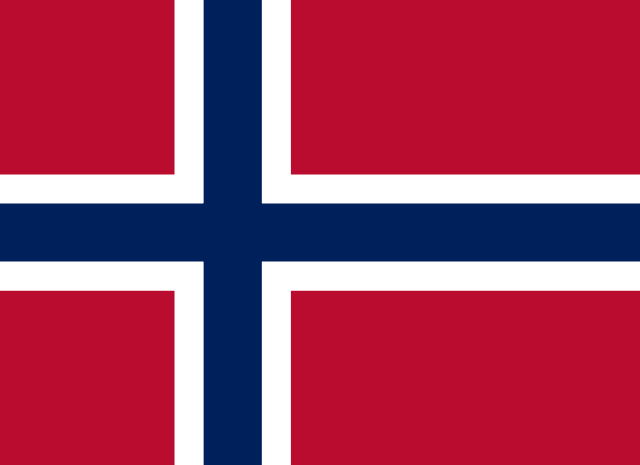
Few national emblems pack as much political history into so simple a shape as the Norwegian flag. At a glance it is a clean, confident design: a red field crossed by a white-bordered blue Scandinavian cross. But that arrangement of red, white, and blue is the result of a deliberate balancing act, born during a period when Norway was tied to its neighbors and searching for a symbol that could stand for the nation itself. Adopted in 1821, the flag has flown over a country that has changed dramatically since, yet its design has remained remarkably constant. This article walks through what the colors mean, how the cross is laid out, why it looks so much like other flags in the region, and how Norwegians use it today.
A Cross Carried Across the North
The defining feature of Norway's flag is the off-center cross, a motif shared across the Nordic countries. The vertical bar of the cross sits closer to the hoist (the side nearest the flagpole) rather than dead center, so the four rectangles it creates are not equal in size. This is the signature Scandinavian, or Nordic, cross, and it instantly places Norway within a family of northern European nations. On a deep red background, Norway lays a white cross, and inside that white cross sits a narrower blue one. The blue is bordered on every edge by white, which is why the design is often described as a blue cross with a white outline set on red.
The proportions are precise and defined by regulation, giving the flag its crisp, geometric look. Because the cross extends to all four edges of the cloth, the design reads clearly whether the flag is hanging limp against a pole or snapping in a coastal wind. That legibility is part of why the Nordic cross has endured for two centuries with so little modification.
Reading the Red, White, and Blue
The color choices were anything but arbitrary. Norway's flag combines a Danish-style cross with the red, white, and blue palette associated with liberty and with other free nations of the era. The white cross echoes the Danish flag, the Dannebrog, under which Norway had long been governed, acknowledging centuries of shared history with Denmark. The addition of blue, set inside the white, transformed that inherited shape into something new and unmistakably Norwegian.
Beyond the historical references, the red, white, and blue together were widely read in the early nineteenth century as the colors of constitutional freedom, echoing the flags of other nations that prized self-government. For Norwegians, the combination spoke to a desire for independence and a distinct identity even while the country remained in a union with Sweden. The palette therefore carries a double meaning: respect for the past and an assertion of a separate future.
How the Flag Came to Be
To understand the 1821 design, it helps to know the political moment that produced it. Norway had spent centuries linked to Denmark, but in 1814 it entered a union with Sweden instead. Within that union Norway retained considerable autonomy, including its own constitution, and the question of a national flag became a matter of real importance. Norwegians wanted a banner that represented their own nation rather than simply borrowing a neighbor's.
The flag adopted in 1821 answered that need. It took the familiar cross shape, kept the white that recalled the long Danish connection, and introduced blue to set Norway apart. As the data behind this article notes, the blue cross was specifically added to distinguish the Norwegian flag from Denmark's. The design thus threaded a careful needle: it honored heritage while drawing a clear line of separation. Over the following decades the flag's use in trade, at sea, and in civic life was shaped by the politics of the Swedish union, but the core design endured and became the flag flown by an independent Norway in the twentieth century and beyond.
Look-Alikes and Close Cousins
Anyone scanning a row of flags in northern Europe will notice how strongly Norway's resembles its neighbors. That family resemblance is intentional. Denmark's red-and-white cross is the oldest of the group and the clear ancestor of the form. Sweden uses a yellow cross on blue, Finland a blue cross on white, and Iceland a design that, like Norway's, layers a red cross with white on blue. Norway and Iceland are the closest cousins of all, because both use the same three colors in a cross-within-a-cross arrangement.
The key to telling them apart is the order of the colors. Iceland places a white-bordered red cross on a blue field, while Norway places a white-bordered blue cross on a red field. In effect, the two flags swap their background and inner-cross colors. Norway's red field and blue cross are its fingerprint within the Nordic set. For travelers planning a trip, our norway country guide offers more context on the country behind the banner, but at flag level the rule is simple: red background means Norway.
A Banner Woven Into National Life
For Norwegians the flag is more than a state emblem; it is a fixture of everyday celebration. Nowhere is this clearer than on Constitution Day, the seventeenth of May, when towns and cities fill with parades and the flag appears in countless hands, especially those of schoolchildren. The day commemorates the 1814 constitution that underpinned Norway's claim to self-rule, so the flag and the founding document are bound together in the national imagination.
The flag also turns up at family gatherings, on holidays, at sporting events, and atop public buildings on official flag days set by the calendar. Norwegian athletes carry it at international competitions, and fans wave it in the stands. Because the country has a long maritime tradition, the flag has a special history at sea as well, flown by merchant and naval vessels and treated as a mark of the nation wherever Norwegian ships travel. In all these settings the red, white, and blue cross functions as a shared shorthand for belonging.
Quick Facts Worth Knowing
- Norway sits in northern Europe, on the western side of the Scandinavian Peninsula.
- The flag was adopted in 1821, during Norway's union with Sweden.
- Its colors are red, white, and blue, arranged as a blue cross outlined in white on a red field.
- The cross design is the classic off-center Nordic cross shared across Scandinavia.
- The white element nods to Denmark's flag; the blue was added to set Norway apart.
- Norway and Iceland use the same three colors but reverse the field and inner-cross hues.
Frequently Asked Questions
When was the flag of Norway adopted?
The flag was adopted in 1821, while Norway was in a union with Sweden. Despite the many political changes Norway has experienced since, the design has remained essentially unchanged, making it one of the more stable national flags in Europe.
What do the colors of the Norwegian flag mean?
The flag uses red, white, and blue. The white cross recalls Norway's long historical tie to Denmark, while the blue was added to distinguish Norway from the Danish flag. Together the red, white, and blue were read in the era as colors of constitutional freedom and national independence.
Why does the Norwegian flag look like the Danish and Icelandic flags?
All three belong to the Nordic cross family, which traces back to Denmark's flag. Norway kept the cross shape and white color from that tradition. The easiest way to tell Norway from Iceland is the field: Norway has a blue cross on red, while Iceland has a red cross on blue.
What continent is Norway on?
Norway is in Europe, occupying the western part of the Scandinavian Peninsula in the north of the continent. Its long coastline and maritime history help explain why the flag has such a strong association with the sea as well as with land-based national celebrations.