
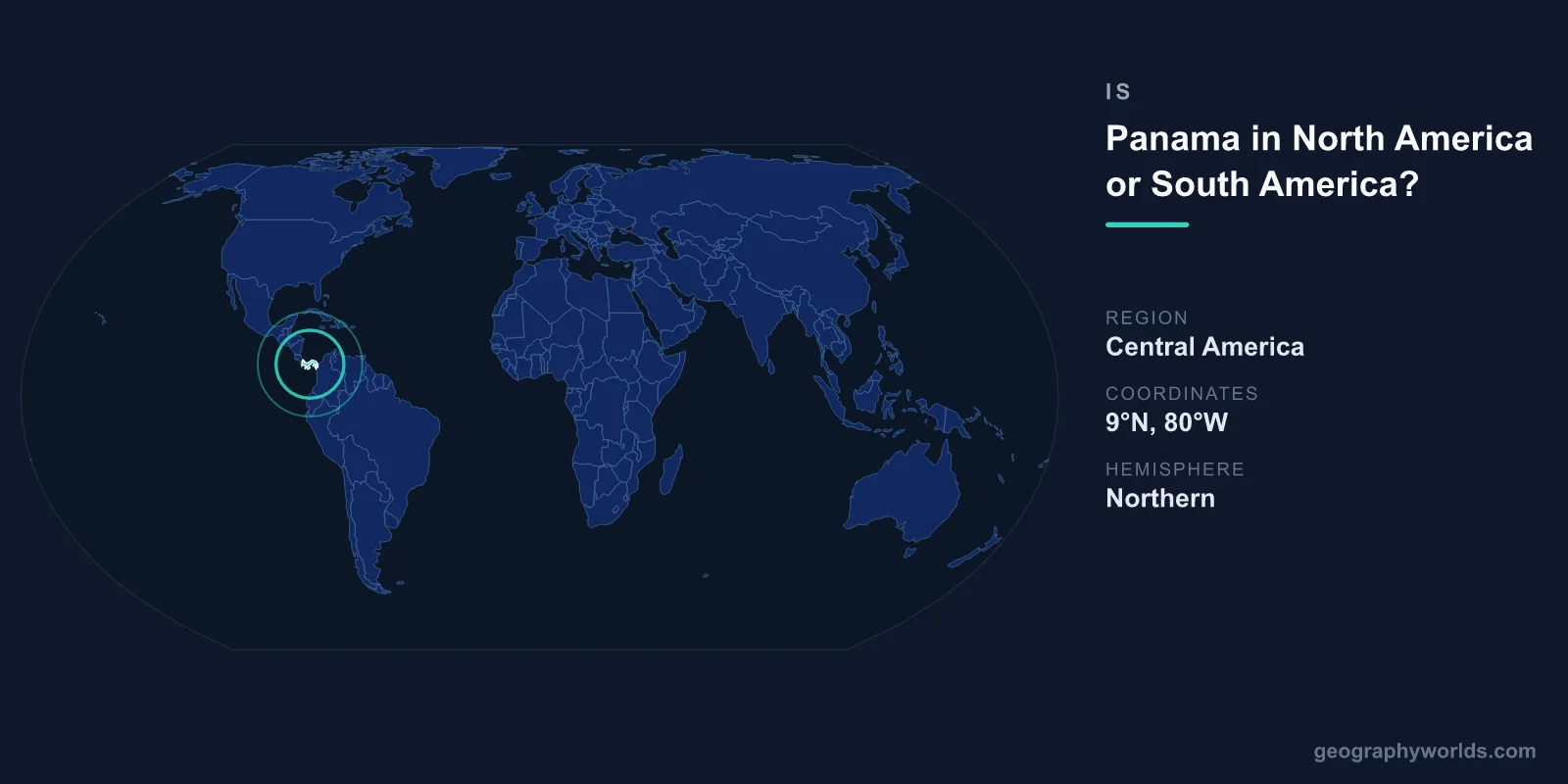
Panama is in North America. It belongs to Central America, a subregion of the North American continent, even though it sits at the very southern edge of that landmass where it meets South America. The confusion is understandable: Panama is the slender bridge of land that physically joins the two American continents, and its eastern border touches Colombia, a South American nation. But by the standard geographic convention, Panama is firmly a North American country.
The Short Answer and Why It Holds
Geographers divide the Americas into North America and South America, and Central America is treated as a southern extension of North America rather than as a separate continent. All seven Central American countries — Guatemala, Belize, Honduras, El Salvador, Nicaragua, Costa Rica, and Panama — fall on the North American side of the divide. Panama happens to be the southernmost of them, which is exactly why people second-guess where it sits.
The continental boundary is conventionally drawn at the border between Panama and Colombia. Everything north and west of that line, including all of Panama, is North America; everything south and east of it is South America. So while Panama leans against South America's doorstep, it never crosses the threshold.
Where Exactly Is Panama?
Panama occupies a narrow, S-shaped isthmus running roughly east to west, with the Caribbean Sea to the north and the Pacific Ocean to the south. It shares a land border with Costa Rica to the west and Colombia to the southeast. Because of the country's curving shape, the Pacific coast actually lies south of the Caribbean coast in many places — a quirk that produces some genuinely surprising compass directions.
The country covers about 75,417 square kilometers, making it a relatively small nation, comparable in size to Ireland or the U.S. state of South Carolina. Its capital, Panama City, sits on the Pacific coast near the southern entrance of the Panama Canal, and the population numbers roughly 4.4 million people, the overwhelming majority of whom speak Spanish.
Why So Many People Get It Wrong
Panama earns its reputation as a "land bridge" honestly. The isthmus is the thin connective tissue between two enormous continents, so it feels transitional rather than belonging to one side. A few specific factors fuel the mix-up:
- It borders South America. Sharing a frontier with Colombia makes Panama feel South American by association.
- Cultural overlap. Panama's Spanish language, Latin American culture, and history of Spanish colonization are shared with South American neighbors, blurring the mental map.
- The Darién Gap. The dense, roadless jungle along the Colombian border is the only break in the Pan-American Highway, reinforcing the sense that Panama is the threshold of South America.
- "Central" sounds separate. The label Central America leads many to assume it is a third region floating between the two continents rather than part of North America.
The Panama Canal and the Isthmus
Panama's geography is dominated by the Panama Canal, the 80-kilometer waterway that slices through the isthmus to connect the Atlantic and Pacific oceans. Completed in 1914, it remains one of the most strategically important shipping routes on Earth, sparing vessels the roughly 12,000-kilometer voyage around Cape Horn at the southern tip of South America.
The terrain beyond the canal zone ranges from tropical rainforest and mangrove coastlines to volcanic highlands in the west, where Volcán Barú rises to about 3,475 meters as the country's highest point. This strategic, narrow position has made Panama a crossroads for trade, migration, and conquest for centuries — long before the canal, Spanish treasure crossed the isthmus on its way from the Pacific to the Atlantic. To explore the country in more depth, see our panama country guide.
Continent at a Glance
- Continent: North America
- Region: Central America
- Capital: Panama City
- Area: approximately 75,417 km²
- Population: around 4.4 million
- Official language: Spanish
- Bordering South American country: Colombia
Frequently Asked Questions
Is Panama considered part of Central America?
Yes. Panama is the southernmost of the seven Central American countries. Central America is itself a subregion of North America, so saying Panama is in Central America and saying it is in North America are both correct.
Does Panama border South America?
Panama shares a land border with Colombia, which is a South American country, through the dense Darién jungle. The border itself is the conventional dividing line between the North American and South American continents, so Panama touches South America without being part of it.
Why isn't Panama in South America if it connects to Colombia?
The agreed continental boundary runs along the Panama–Colombia border. Panama lies entirely on the northern, North American side of that line, so despite the physical connection it is classified as North American.
What continent is the Panama Canal on?
The Panama Canal lies within Panama, so it is on the North American continent. It links the Atlantic and Pacific oceans across the narrow Central American isthmus.