
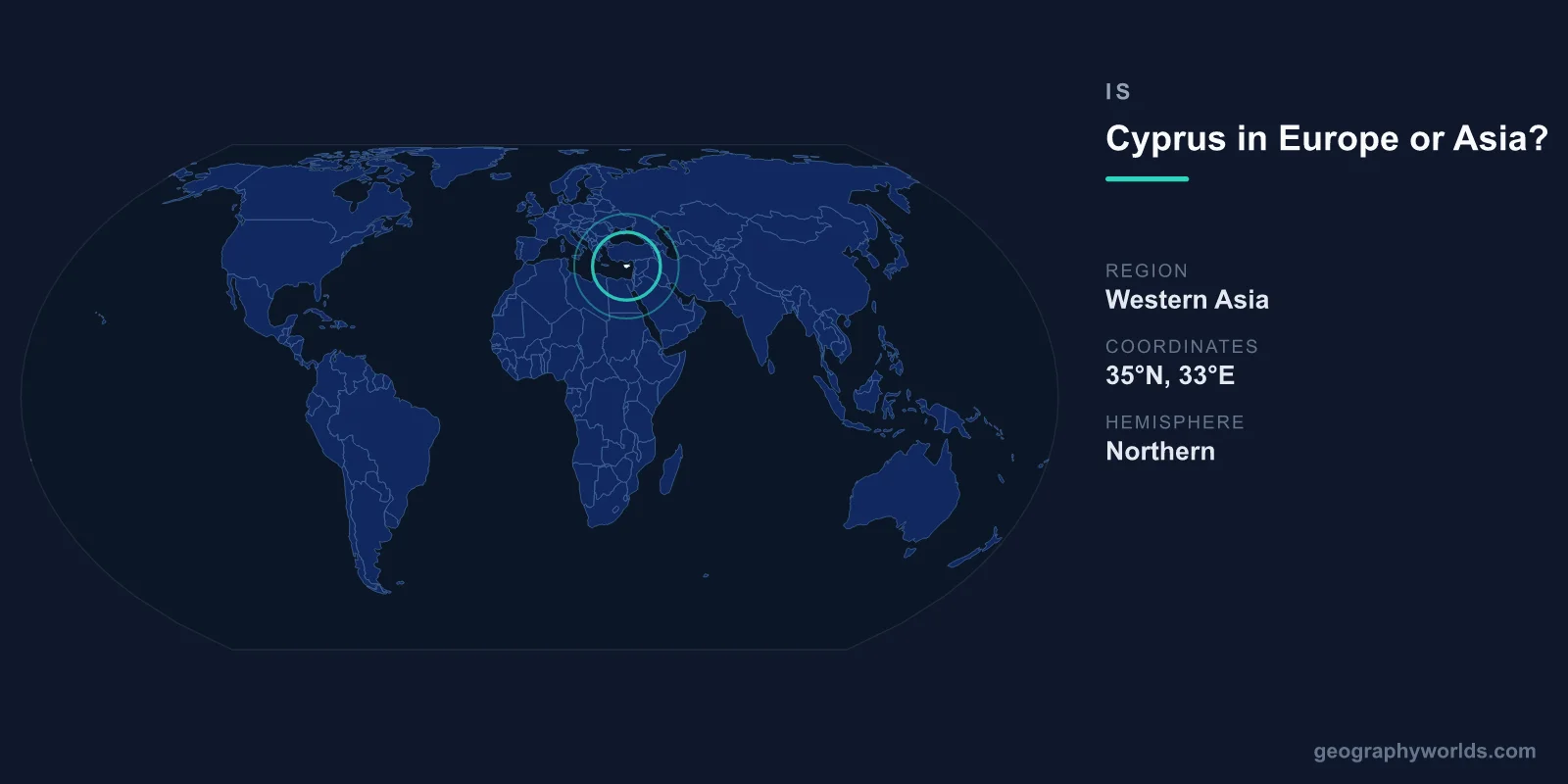
Cyprus sits physically in Asia, on the Asian continental shelf in the far eastern Mediterranean, yet it is treated as part of Europe politically and culturally — it is a member of the European Union, uses the euro, and identifies with European institutions. The short answer to a question with no perfectly clean answer is this: geographically Asian, politically and culturally European.
Geographically, Cyprus Belongs to Asia
By physical geography, Cyprus is part of Asia. The island lies in the easternmost corner of the Mediterranean, roughly 75 km south of Turkey and around 105 km west of the Syrian coast. The nearest mainland in every direction is Asian — Turkey to the north, Syria and Lebanon to the east. Cyprus rests on the Anatolian tectonic plate region rather than the European one, which is the technical reason most physical geographers and the United Nations file it under Western Asia (the Middle East). Mainland Europe, by contrast, is hundreds of kilometres away across the sea, with Greece being the closest European country at around 800 km to the northwest.
For context, Cyprus is the third-largest island in the Mediterranean after Sicily and Sardinia, covering roughly 9,251 km². Its position so close to the Asian mainland — and so far from Europe — is exactly why the continental question is genuinely ambiguous rather than a simple mistake.
Politically and Culturally, Cyprus Is European
While the rock itself is Asian, almost everything about modern Cyprus points toward Europe. The Republic of Cyprus joined the European Union in 2004 and adopted the euro in 2008. It competes in European sporting bodies such as UEFA and takes part in the Eurovision Song Contest. Its legal, educational, and political systems are modelled on European norms, and the Greek Cypriot majority shares language, religion (Greek Orthodox Christianity), and a cultural heritage stretching back to ancient Greece.
This is why Cyprus is so often listed as a European country: international organisations frequently classify nations by political and cultural alignment rather than by strict continental geography. So an atlas may place Cyprus in Asia while an EU document treats it as fully European — both are correct within their own framing.
Why the Confusion Exists
The disagreement comes down to how you define a "continent." Continents can be drawn three ways:
- Physical geography: based on landmass and tectonic plates — places Cyprus in Asia.
- Political and cultural geography: based on alliances, institutions, and identity — places Cyprus in Europe.
- Historical and civilizational ties: Cyprus's long links to Greece, Byzantium, and later Western Europe reinforce the European label.
Cyprus is far from the only country caught on a continental seam. Turkey, Russia, Georgia, Armenia, and Azerbaijan all straddle or sit near the Europe–Asia divide and are routinely described as "transcontinental" or as members of one continent for some purposes and another for others. Cyprus simply leans hard toward Europe in practice despite its Asian coordinates.
The Island's Geography and Division
Cyprus is dominated by two mountain ranges: the Troodos massif in the centre and southwest, home to Mount Olympus (the island's highest point), and the narrow Kyrenia range running along the north coast. Between them stretches the fertile Mesaoria Plain, where the capital, Nicosia, sits.
Politically the island has been divided since 1974. The internationally recognised Republic of Cyprus controls the south and is the EU member; the self-declared Turkish Republic of Northern Cyprus, recognised only by Turkey, controls the north. A United Nations Buffer Zone separates the two, cutting straight through Nicosia and making it the world's last divided capital city. This division adds yet another layer to the island's split identity between European and Middle Eastern spheres of influence.
Key Facts About Cyprus
- Continent (physical): Asia (Western Asia)
- Continent (political/cultural): Europe
- Area: approximately 9,251 km²
- Capital: Nicosia
- Population: approximately 1.2 million
- Official languages: Greek and Turkish
- Currency: Euro (Republic of Cyprus)
For a deeper look at the island, its history, and what makes it distinctive, see our cyprus country guide.
Frequently Asked Questions
Is Cyprus part of the European Union?
Yes. The Republic of Cyprus has been a full member of the European Union since 2004 and uses the euro. This EU membership is the main reason Cyprus is so frequently described as a European country despite its Asian geographic location.
Is Cyprus in the Middle East?
Geographically, yes — Cyprus lies within Western Asia, the same broad region as the Middle East, just off the coast of Turkey, Syria, and Lebanon. Culturally and politically, however, it aligns with Europe rather than the Middle East.
Why is Cyprus considered European if it is in Asia?
Because continental classification is not purely about geography. Cyprus's EU membership, Greek cultural heritage, Orthodox Christian tradition, and participation in European institutions all give it a firmly European identity, even though its physical location is on the Asian side of the Mediterranean.
How far is Cyprus from Europe and Asia?
Cyprus sits about 75 km from the Asian mainland (Turkey) and roughly 105 km from Syria, but around 800 km from Greece, its nearest European country. Its proximity to Asia and distance from Europe is precisely what makes the continental question so debated.