
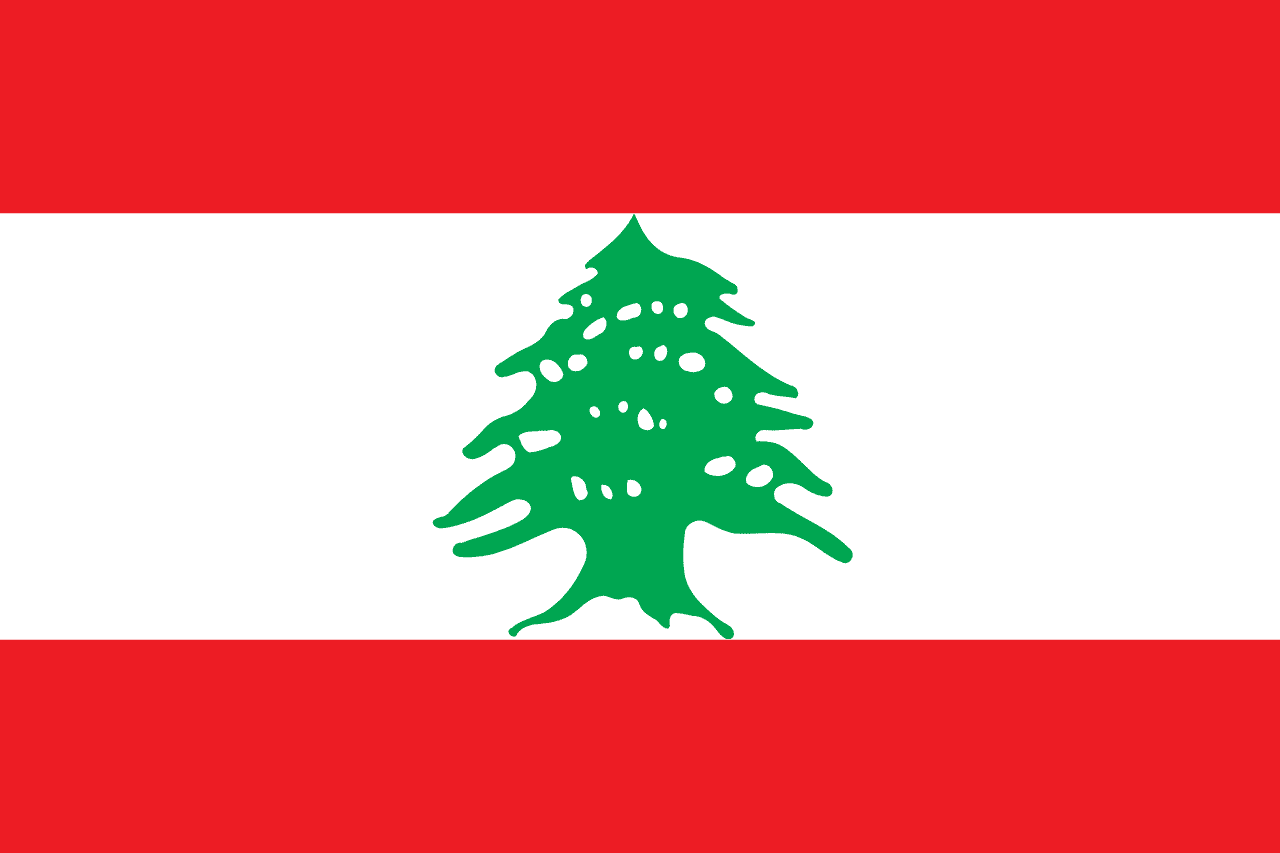

Few national flags place a single living thing at their very center and dare it to carry the weight of an entire nation's history. Lebanon does exactly that. Between two bold red bands and a wide white field stands a green cedar tree, an emblem so ancient that it predates the modern state by thousands of years. Adopted in 1943, the year Lebanon gained its independence, the flag distills a complicated story of faith, geography, and resilience into three colors and one unmistakable silhouette. It is at once one of the simplest flags in the Middle East and one of the most loaded with meaning.
A Flag Built Around a Tree
The Lebanese flag is a horizontal triband, but not in equal thirds. The top and bottom red stripes each occupy a quarter of the height, while the white band in the middle is twice as tall, stretching across the central half of the flag. Resting in that broad white space is the green cedar of Lebanon, its branches spread symmetrically so that it appears the same whether the flag flies left or right.
The proportions matter. By giving white the dominant share, the designers ensured the cedar had room to breathe and to be seen clearly from a distance. The tree's trunk touches neither red stripe; it is cradled entirely within the white, framed rather than crowded. This deliberate layout turns the flag into something closer to a coat of arms than a typical striped banner, with the central figure doing the heavy lifting of national identity.
What the Colors and the Cedar Mean
Each element of the flag carries a specific charge. The red stripes represent the sacrifice and bloodshed of those who fought and died for Lebanon's freedom. The white band stands for peace, and also evokes the snow that caps the country's mountains, a feature unusual in the region and central to how the Lebanese see their homeland.
Then there is the green cedar, the heart of the whole design. The cedar of Lebanon is the national symbol, an evergreen that signifies immortality, steadiness, and endurance. Its green color speaks to the tree's perennial life, the idea that Lebanon, like the cedar, weathers the seasons without fading. Together the three colors form a tidy moral vocabulary: sacrifice, peace, and an undying spirit rooted in the land itself.
Centuries of History Behind a Modern Banner
While the flag was formally adopted in 1943, the cedar at its center reaches back into deep antiquity. The cedar of Lebanon has been a Lebanese emblem for millennia, prized in the ancient world for its fragrant, rot-resistant wood. It appears throughout the historical and religious record, and the tree is mentioned repeatedly in the Bible, lending it a sacred resonance that few national symbols can claim.
By the time Lebanon was carving out its independence from French Mandate rule in the early 1940s, the cedar was the obvious choice to anchor the new flag. Legend holds that as the constitution was being amended during the push for independence, members of parliament sketched the design themselves, placing the cedar on a field of white between two red bands. The flag was enshrined in the constitution, making the cedar not just a decoration but a legally defined feature of the Lebanese state. From that moment the tree on the flag became inseparable from the nation it represents.
How It Compares to Other Flags
Lebanon's red-white-red horizontal arrangement immediately invites comparison with a handful of other flags, yet the cedar makes confusion almost impossible. Austria and Latvia both use red-white-red horizontal stripes, but in even thirds and without any central emblem, so a glance at the green tree settles the matter instantly.
Within its own region, Lebanon stands apart from neighbors that lean heavily on the pan-Arab palette of red, black, white, and green arranged in bands and triangles. Lebanon shares the red, white, and green, but combines them in a way no other country does, and crucially it features a tree rather than stars, crescents, or script. That botanical centerpiece puts Lebanon in a small club of nations whose flags showcase a specific plant, alongside the likes of Canada and its maple leaf. The difference is that Lebanon's cedar is a whole tree, not a single leaf, giving the design a more sculptural, almost heraldic quality.
A Symbol of Identity Across Divides
In a country known for its religious and cultural diversity, the cedar flag carries a unifying weight that few symbols manage. Where other markers might signal one community or another, the cedar belongs to all Lebanese. It appears on official seals, currency, military insignia, and the uniforms of athletes, threading a single visual identity through a famously pluralistic society.
The tree also taps into a romantic self-image: Lebanon as the land of the mountains, the home of an ancient and storied people whose roots, like the cedar's, run deep. During moments of national crisis and renewal alike, the cedar flag has surged into the streets, waved by crowds who may agree on little else but who claim the tree as common ground. To understand how this small Mediterranean nation balances such variety, the lebanon country guide offers a fuller picture of its geography and people.
The Flag in Everyday and Public Life
Today the cedar flag is everywhere in Lebanese civic life. It flies over government buildings and embassies, is raised on Independence Day each November, and accompanies the national football and basketball teams onto the field and court, where supporters wave it proudly. The cedar appears on passports and license plates, in classrooms, and across the vast Lebanese diaspora, where families far from the homeland keep the tree in view as a link to their origins.
For the millions of people of Lebanese descent living abroad, the flag functions as a portable homeland. A single green cedar on a kitchen wall in São Paulo, Sydney, or Detroit signals belonging without a word. Few national emblems travel so well or mean so much to people who may never have set foot in the country it represents.
Interesting Facts About the Lebanese Flag
- The cedar of Lebanon is mentioned in the Bible, giving the flag's central emblem a religious and historical depth stretching back thousands of years.
- The flag's design is written into the Lebanese constitution, so the cedar is legally protected as a defining feature of the state.
- The white middle band is twice the height of each red stripe, an unusual proportion that gives the cedar maximum visibility.
- The cedar must always be drawn touching neither the red stripes nor reaching beyond the white field.
- Lebanon is one of very few countries to feature an entire tree, rather than a leaf or branch, at the heart of its national flag.
Frequently Asked Questions
When was the flag of Lebanon adopted?
The flag was adopted in 1943, the same year Lebanon achieved independence. The design was written into the constitution as the nation emerged from French Mandate rule, making the cedar an official and legally defined national symbol from the start.
What do the colors of the Lebanese flag mean?
Red represents the sacrifice and bloodshed of those who fought for freedom, white stands for peace and the snow of Lebanon's mountains, and the green cedar tree symbolizes immortality, endurance, and the nation's ancient roots in the land.
Who designed the flag of Lebanon?
The flag is attributed to Lebanese parliamentarians who shaped it during the independence movement of the early 1940s, when the cedar design was enshrined in the constitution. It was a collective national choice rather than the work of a single celebrated artist.
What continent is Lebanon on, and how does its flag compare to similar ones?
Lebanon is in Asia, on the eastern Mediterranean coast. Its red-white-red bands resemble those of Austria and Latvia, but the green cedar at the center makes the Lebanese flag instantly distinct from any other in the world.