
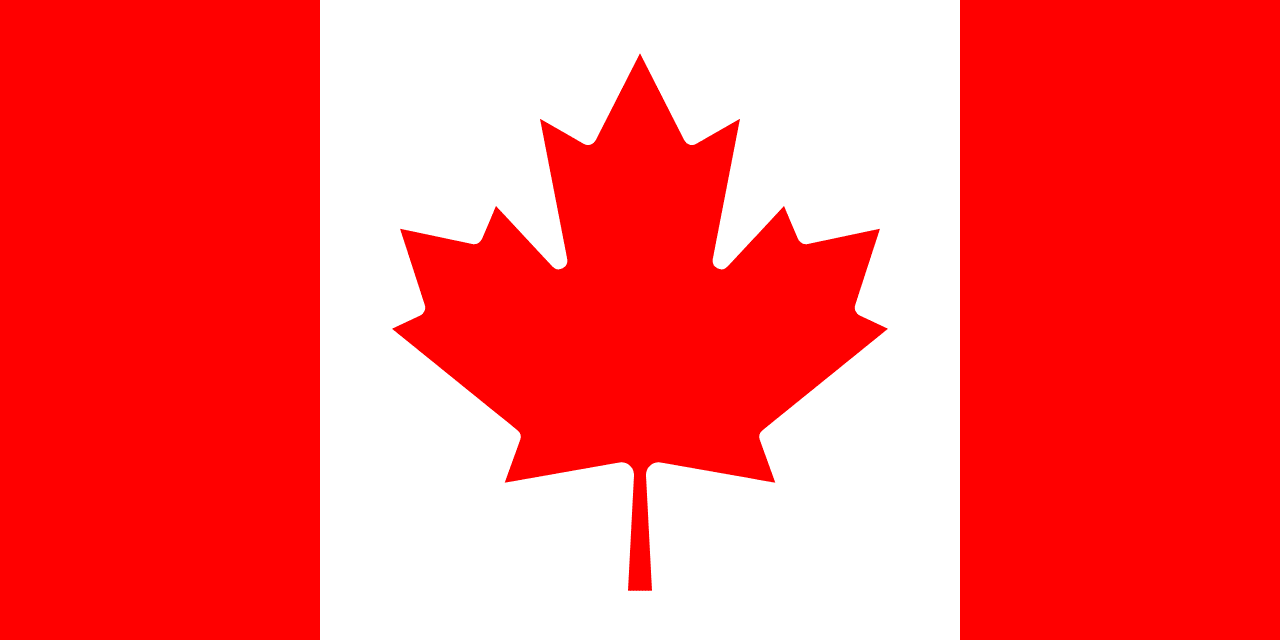

Few national emblems are as instantly legible as the red maple leaf that flies over Canada. Strip away the lettering, the borders, the cluttered heraldry of so many other banners, and you are left with two colors and a single leaf — a design so clean it reads clearly from across a stadium or a snowy field. Yet that simplicity is deceptive. The flag we now take for granted was the product of one of the most bitter political arguments in Canadian history, a months-long fight that pitted tradition against a young country's hunger for its own identity. Adopted in 1965, the Maple Leaf is barely older than many of the people who salute it, and its story is very much a modern one.
A Banner of Red and White
The Canadian flag uses only two colors: red and white. These were declared the official colors of Canada by King George V in 1921, so by the time designers sat down to create a new flag, the palette already carried decades of semi-official weight. The flag itself is built from three vertical bands — red, white, and red — but the proportions are unusual. The central white panel is twice as wide as either red band, giving a ratio of 1:2:1 across the width. This wide white square is sometimes called a "Canadian pale," borrowing a heraldic term, and it provides a clean stage for the leaf at the flag's heart.
The symbolism attached to these colors is generous and a little poetic. The two red bands are often read as the Pacific and Atlantic oceans that flank the country from west to east, while the broad white center stands for the vast Canadian heartland that lies between those coasts. The red itself is not just any red: it is specified as Pantone 032, a precise scarlet that keeps Canadian flags consistent whether they are stitched in Halifax or printed in Vancouver.
The Design Up Close
At the center of that white field sits the element everyone remembers — a single stylized maple leaf in red. Look closely and you will count exactly eleven points. That number is not symbolic; it was a practical decision. Earlier sketches used leaves with far more points and finer serrations, but testing showed that a busy, many-pointed leaf blurred into a red smear when the flag snapped in a strong wind. Simplifying down to eleven crisp points kept the leaf recognizable even in motion. The leaf is also drawn to appear balanced and symmetrical when the flag is hung or flown, so it never looks lopsided.
The flag's overall proportions are 1:2, meaning it is twice as wide as it is tall — a longer, more horizontal shape than many national flags. This emphasis on width gives the design room to breathe and lets the leaf float comfortably in its white square rather than feeling cramped.
The Great Canadian Flag Debate
For most of its early history, Canada flew the Canadian Red Ensign, a red banner carrying the British Union Jack in the corner. By the mid-twentieth century, many Canadians felt that emblem no longer reflected a country that wanted to stand apart from Britain and speak for both its English and French communities. Prime Minister Lester B. Pearson made a new, distinctly Canadian flag a personal mission, and in doing so he lit a political bonfire.
What followed in 1964 became known as the Great Canadian Flag Debate. Thousands of design proposals poured in from the public, and Parliament argued for months — roughly ten months of heated discussion — over whether to keep the old ties to Britain or strike out with something new. A parliamentary committee eventually settled on the maple leaf design, with the historian George Stanley credited for the core concept and John Matheson playing a central role in refining and championing it. The new flag was proclaimed on February 15, 1965, the day it first rose over Parliament Hill. If you want the broader story of the country behind the banner, our canada country guide offers a fuller picture.
How It Compares to Other Flags
Canada's flag shares its red-and-white palette with a surprising number of nations, which makes the comparison game instructive. Peru, for instance, uses the very same red-white-red vertical arrangement, and from a distance a plain Peruvian flag can look strikingly similar — until you spot Peru's coat of arms or, in Canada's case, the unmistakable leaf. What truly sets the Canadian flag apart is that central botanical emblem. Most national flags lean on stars, crosses, stripes, or heraldic shields; very few place a plant front and center. The maple leaf puts Canada in a tiny club of flags built around living flora.
The contrast with Canada's own past flag is just as telling. The Red Ensign it replaced was crowded with the Union Jack and a complex shield, tying Canada visually to the United Kingdom. The Maple Leaf flag deliberately swept all of that away, trading inherited British symbolism for a homegrown image that owes nothing to any other country's design.
A Symbol of National Identity
The maple leaf has stood for Canada since at least the eighteenth century, long before it landed on the flag, so the 1965 design tapped into a feeling that already ran deep. Once it became the national flag, that feeling intensified. The banner came to represent not just the land but the idea of Canada — a country independent of Britain, unified across its linguistic and regional divides, and confident in its own character.
That pride is most visible every July 1st, when Canada Day fills streets and parks with red and white. February 15 has its own place on the calendar too, now marked as National Flag of Canada Day in honor of the flag's first raising. For many Canadians the leaf is also a quiet badge of belonging, worn or stitched onto backpacks while traveling so that they are recognized abroad at a glance.
The Flag in Modern Life
Today the maple leaf turns up everywhere Canada wants to be seen. It flies over government buildings and embassies, snaps in the wind at international sporting events, and is especially beloved at hockey games, where it stands in for the whole nation's passion for the sport. Canadian astronauts wear it on their spacesuits, and athletes carry it onto Olympic podiums. It has become one of the most recognized flags on Earth, a piece of visual shorthand understood far beyond Canada's borders.
Interesting Facts
- The flag was finalized only after designers reviewed more than 3,000 proposals and ran candidates through wind tunnel tests.
- The leaf has exactly eleven points, chosen because simpler shapes stayed crisp when the flag was flying.
- Its official red is Pantone 032, locking in a precise scarlet shade nationwide.
- The design replaced the Canadian Red Ensign after roughly ten months of fierce parliamentary debate.
- It is one of only three national flags worldwide to feature a plant as its central emblem.
- February 15 is celebrated each year as National Flag of Canada Day.
Frequently Asked Questions
When was the Canadian flag adopted?
The Maple Leaf flag was officially adopted on February 15, 1965, when it was first raised over Parliament Hill. That anniversary is now observed annually as National Flag of Canada Day.
What do the colors of the Canadian flag mean?
The flag uses red and white, Canada's official colors since 1921. The two red bands are commonly read as the Atlantic and Pacific oceans bordering the country, while the wide white center represents the Canadian heartland between the coasts.
Who designed the Canadian flag?
The core concept is credited to historian George Stanley, with John Matheson playing a key role in refining the design and guiding it through Parliament. The final version emerged from a parliamentary committee during the 1964 flag debate, championed by Prime Minister Lester B. Pearson.
What continent is Canada on, and what flags look similar?
Canada sits in North America. Its red-white-red vertical layout closely resembles Peru's flag, but the central eleven-pointed maple leaf makes the Canadian banner immediately distinct from any look-alike.