
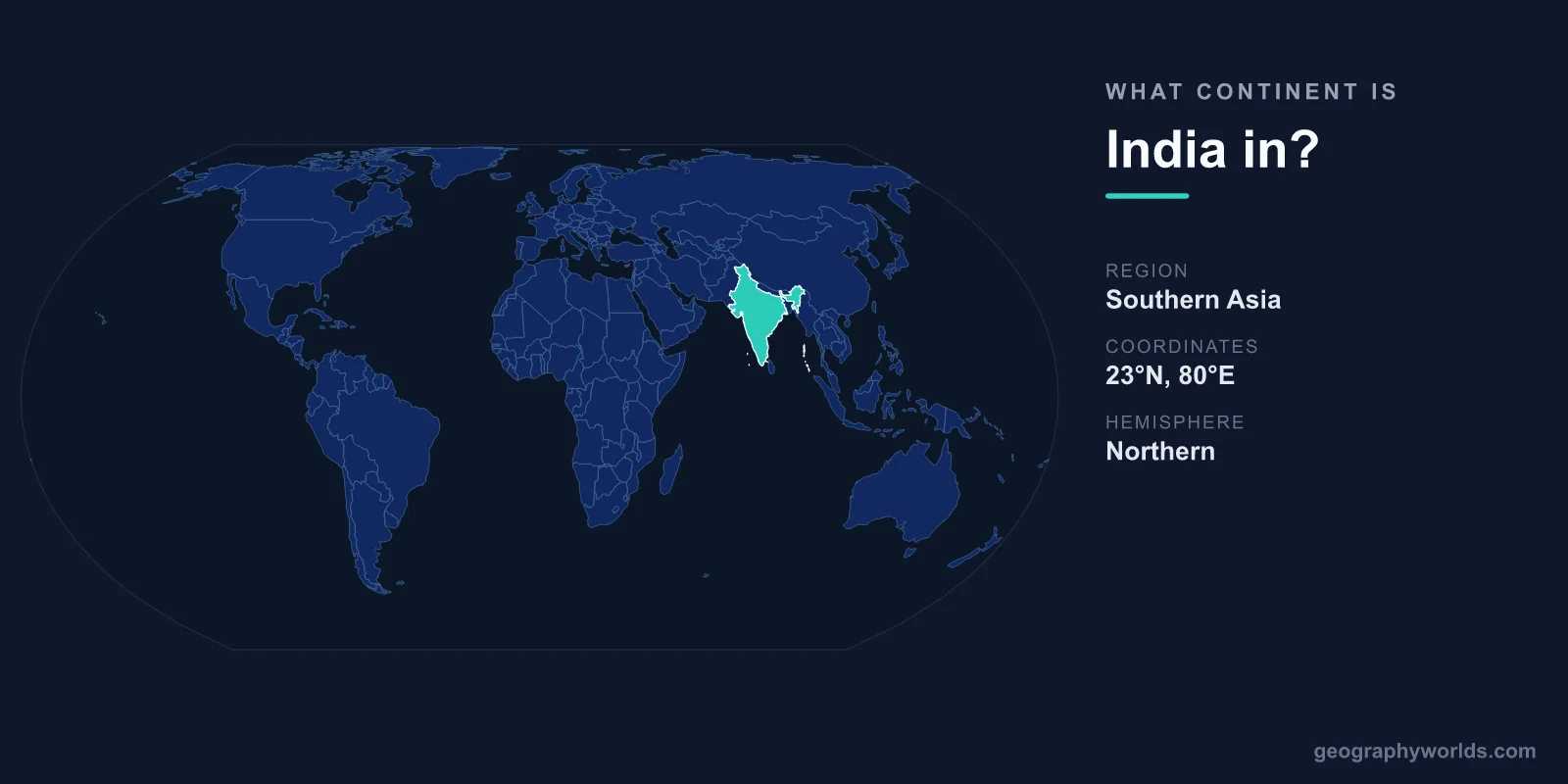
India is in Asia, located in the southern part of the continent within the region known as South Asia. It occupies the majority of the Indian subcontinent, a vast peninsula that juts southward from the main Asian landmass into the Indian Ocean. India is the seventh-largest country on Earth by land area and the most populous nation in the world, with more than 1.4 billion people.
Asia: India's Continent
There is no ambiguity about the answer: India sits firmly on the Asian continent. Geographically, geologically, culturally, and politically, India is an Asian country. Within Asia, geographers place it in South Asia, a region that also includes Pakistan, Bangladesh, Nepal, Bhutan, Sri Lanka, the Maldives, and Afghanistan. India is by far the largest and most influential country in this group, anchoring the region both economically and demographically.
Asia is the world's largest continent, spanning roughly 44 million square kilometres and home to around 60% of humanity. India alone accounts for a substantial share of that population, making it one of the continent's most significant nations. Its capital is New Delhi, situated in the north of the country on the Indo-Gangetic Plain.
The Indian Subcontinent Explained
India is often described as a "subcontinent," which sometimes causes confusion about whether it is a continent in its own right. It is not. A subcontinent is a large, geographically distinct landmass that forms part of a larger continent. The Indian subcontinent earns this label because of its enormous size, its dense population, and the way it is physically separated from the rest of Asia by formidable natural barriers — chiefly the Himalayan mountain range to the north.
The geological story is remarkable. The Indian landmass was once a separate plate that drifted northward across the ancient Tethys Ocean and collided with the Eurasian plate roughly 50 million years ago. That slow-motion collision pushed up the Himalayas, the highest mountain range on the planet, and it continues today — the Himalayas still rise by about 1 centimetre each year. So while India is part of Asia now, it literally arrived from elsewhere.
Borders and Neighbours
India's position at the heart of South Asia means it shares land borders with six countries, all of them Asian:
- Pakistan to the northwest
- China and Nepal to the north
- Bhutan to the northeast
- Bangladesh and Myanmar to the east
To the south, India tapers to a point at Kanyakumari, surrounded by ocean. The Arabian Sea lies to the southwest, the Bay of Bengal to the southeast, and the broader Indian Ocean directly south. Two island nations sit nearby in those waters: Sri Lanka, just off the southeastern tip, and the Maldives, southwest of the mainland. India's coastline stretches some 7,517 kilometres, giving it major ports on both of its flanking seas.
A Continent's Worth of Geography
One reason India feels like a world unto itself is the sheer variety packed into its 3,287,263 square kilometres. Within a single country you find snow-capped Himalayan peaks, the arid Thar Desert in the west, the fertile Indo-Gangetic Plain across the north, tropical rainforests in the northeast, and palm-fringed beaches in the south. The country's highest point is Kangchenjunga at 8,586 metres, the third-tallest mountain in the world.
India is also defined by its great rivers — the Ganges, Brahmaputra, and Indus among them — which have sustained civilisations for thousands of years. Climate ranges from alpine cold in the mountains to tropical heat near the equator. Tying it all together is the South Asian monsoon, one of Earth's most important weather systems, which delivers more than 80% of India's annual rainfall between June and September and shapes agriculture, water supply, and daily life across the entire subcontinent.
India's Place in the World
With over 1.4 billion residents, India recently became the most populous country on Earth, surpassing China. That demographic weight, combined with a fast-growing economy and a central location, makes India a pivotal player not just in Asia but globally. If you want to learn more about the country's history, culture, and regions, see our india country guide.
Frequently Asked Questions
Is India a continent or a country?
India is a country, not a continent. It is part of the continent of Asia. The term "subcontinent" is sometimes used to describe India and its neighbours because of the region's size and geographic distinctiveness, but it remains firmly within Asia.
What part of Asia is India in?
India is in South Asia, the southern region of the Asian continent. It occupies most of the Indian subcontinent, bordered by the Himalayas to the north and the Indian Ocean to the south.
Why is India called a subcontinent?
India is called a subcontinent because it is a large, geographically distinct landmass separated from the rest of Asia by the Himalayas and seas. It originated as a separate tectonic plate that collided with Eurasia about 50 million years ago.
Which oceans and seas surround India?
India is bordered by the Arabian Sea to the southwest, the Bay of Bengal to the southeast, and the Indian Ocean to the south. These waters give India a coastline of roughly 7,517 kilometres.