
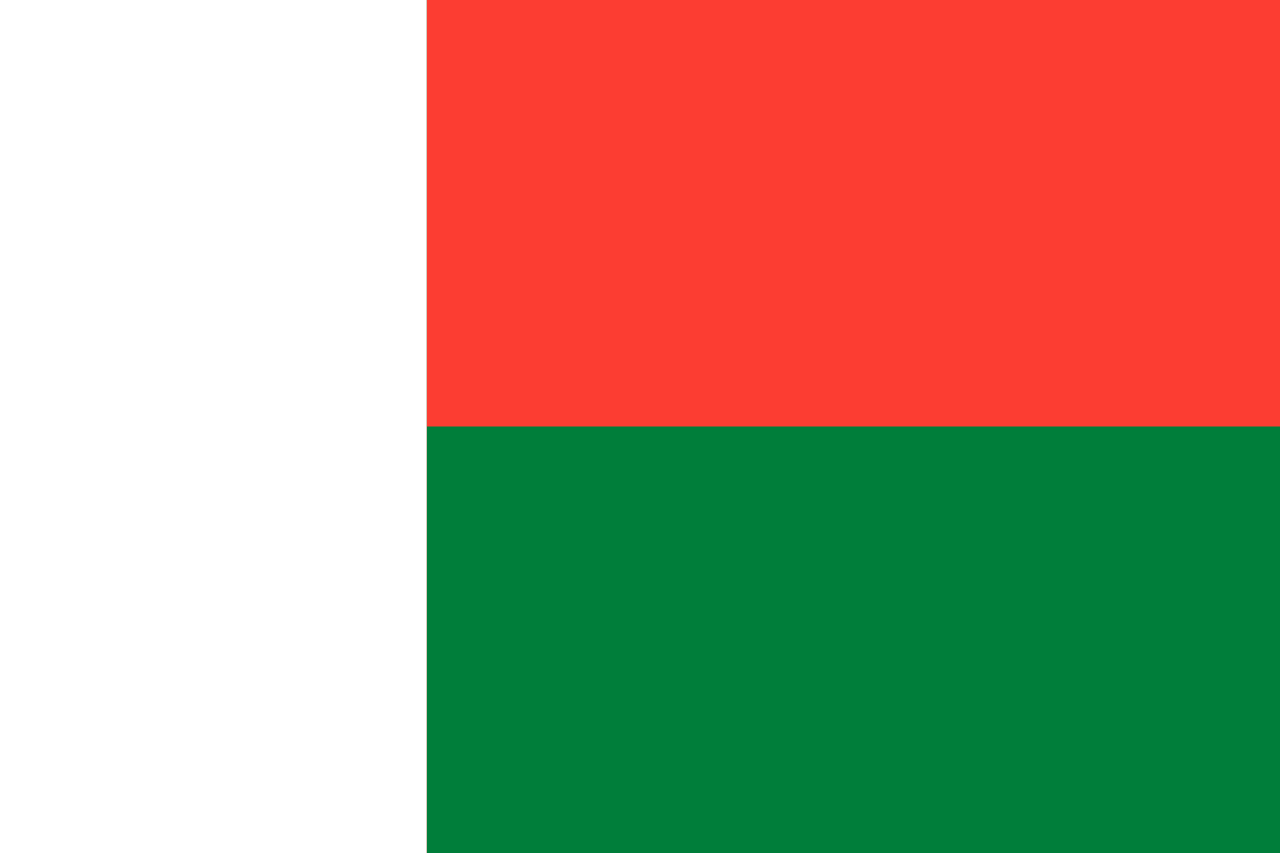
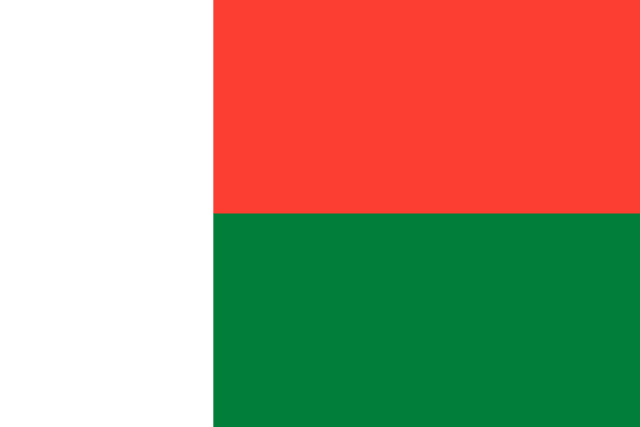
Few national flags manage to tell the story of an entire island in just three colors and two simple geometric strokes, yet Madagascar's does exactly that. A tall white band runs down the hoist, while red sits above green to its right, creating a design that feels both modern and deeply rooted in the past. For a nation that is technically the world's fourth-largest island and home to plants and animals found nowhere else, the flag is refreshingly restrained, letting its meaning speak louder than its ornamentation.
Adopted in 1958, the flag arrived at a pivotal moment, as Madagascar moved toward self-government and, ultimately, full independence from France. Its colors were chosen not at random but to weave together the many peoples of the island into a single emblem. The result is one of the more distinctive arrangements in world vexillology, instantly recognizable once you have seen it.
A Design Unlike Most Others
Most national flags fall neatly into one of two families: vertical stripes or horizontal stripes. Madagascar's flag does something cleverer by combining both. A single white vertical band occupies the hoist side, the portion nearest the flagpole. The remaining two-thirds of the field is then split into two horizontal bands, red on top and green below.
This hybrid layout is deceptively rare. The white panel anchors the design while the red and green push outward toward the fly, a composition that reads cleanly at a distance, whether flying over a government building in Antananarivo or stitched onto a small lapel pin.
In terms of proportions, the white vertical band occupies the inner third of the flag, with the red and green rectangles each filling half of the remaining two-thirds, and the banner flies in a 2:3 ratio. There is no central emblem, coat of arms, or star. That deliberate simplicity is itself a design statement: the meaning lives entirely in the colors and their placement.
What the Colors Stand For
Each of the three colors carries a meaning that ties the flag directly to the nation's character and aspirations. The official symbolism is straightforward and worth keeping in mind:
- White represents purity, a clarity of national purpose carried in that bold vertical stripe.
- Red stands for sovereignty, the hard-won right of the Malagasy people to govern themselves.
- Green signals hope, looking forward to the future of an independent nation.
What makes these choices especially resonant is their double duty. Red and white were colors associated with the historic Merina kingdom, the powerful highland monarchy that once dominated much of the island before colonial rule. Green, meanwhile, has long been linked with the coastal peoples and rural communities. By placing all three together, the flag quietly acknowledges that the modern Malagasy nation is built from many regional and ethnic threads, not a single one.
Roots in the Highland Kingdom
To understand why red and white feature so prominently, it helps to look back to the era before colonization. The Merina kingdom, centered in the central highlands around the capital of Antananarivo, used red and white as royal colors, and these hues appeared on banners and regalia of the monarchy. The kingdom unified much of the island in the nineteenth century, and its sovereigns flew red-and-white standards that became closely associated with Malagasy statehood before French forces ended the monarchy in 1896. When designers came to create a flag for an independent Madagascar, drawing on that established color palette gave the new emblem a sense of continuity and legitimacy.
The addition of green broadened the symbolism beyond the highlands. Madagascar is famously diverse, both ecologically and culturally, and the flag's creators understood that a national symbol could not represent only one kingdom or one region. The green band acknowledges the coastal and lowland communities, often grouped under the term côtiers, whose history runs parallel to that of the highland court. In this way the flag became a small act of national reconciliation rendered in fabric, an attempt to bind highland and coastal Madagascar into one shared identity.
From Colonial Rule to Independence
The flag's adoption on October 14, 1958 coincided with Madagascar becoming an autonomous republic within the French Community, a transitional status on the road to the full independence that followed on June 26, 1960. Choosing a flag was part of asserting a distinct national identity after decades under French administration and the suppression of the 1947 uprising that had cost many Malagasy lives. Notably, the design deliberately avoided echoing the French tricolor, forging its own visual language from the island's own heritage.
Remarkably, the flag has remained essentially unchanged ever since. While many newly independent nations revised their flags repeatedly through periods of political upheaval, Madagascar's banner has endured through changing governments, multiple republics, and successive constitutions. That stability has helped it become a fixed point of identity, a constant that Malagasy people across generations recognize as their own. For more on the island nation behind the banner, see our madagascar country guide.
How It Compares to Other Flags
White, red, and green is a palette shared by a surprising number of flags worldwide, from Mexico and Italy to Hungary, Bulgaria, and Iran. Yet none of those resemble Madagascar's, because they all rely on three parallel stripes, whether vertical or horizontal. Madagascar's mixed orientation is what sets it apart. The closest structural cousin is arguably the flag of Benin, which also pairs a vertical hoist band with two horizontal bands, though Benin uses Pan-African colors and places its vertical band in green. Madagascar's palette, by contrast, comes from the island's own monarchy rather than any continental color movement, so it rarely gets confused with another nation's banner.
The Flag in Everyday Life
Today the flag is woven into the rhythms of Malagasy public life. It flies prominently each year around Independence Day on June 26, when streets fill with parades, music, and celebration. Schools, government offices, and civic buildings display it as a matter of course, and citizens raise it during national festivities and commemorations.
On the international stage, the flag travels with Malagasy athletes to events such as the Olympic Games and the Indian Ocean Island Games, and it appears at diplomatic gatherings and embassies around the world. Because its color combination is uncommon among neighboring nations, it tends to stand out in a lineup of flags, helping spectators pick out Madagascar's delegation at a glance.
Interesting Facts at a Glance
- The combination of a single vertical band with two horizontal bands is unusual, making Madagascar's flag easy to distinguish from purely striped designs.
- Red and white were colors of the historic Merina monarchy, giving the flag a link to pre-colonial Madagascar.
- Green was added to represent coastal and rural communities, broadening the symbolism beyond a single region.
- The flag predates full independence, having been adopted in 1958, two years before sovereignty was formally achieved in 1960.
- It has remained unchanged since its adoption, a notable example of design stability.
- Madagascar lies in the Indian Ocean off the southeastern coast of mainland Africa, and the island is counted as part of the African continent.
Frequently Asked Questions
When was the flag of Madagascar adopted?
The flag was adopted in 1958, as Madagascar moved toward self-government within the French Community. It came shortly before the country achieved full independence in 1960, and it has remained in continuous use ever since.
What do the colors of the Madagascar flag mean?
The flag uses three colors with specific meanings: white represents purity, red stands for sovereignty, and green signals hope. The red and white also recall the historic Merina kingdom, while green is associated with the island's coastal peoples, so the colors together honor both independence and traditional kingdoms.
What continent is Madagascar on?
Madagascar is an island nation located in the Indian Ocean off the southeastern coast of mainland Africa. It is considered part of the African continent, even though it is separated from the mainland by the Mozambique Channel.
How does the Madagascar flag compare to similar flags?
Its layout is genuinely distinctive. Rather than using only vertical or only horizontal stripes, it combines a single white vertical band at the hoist with red and green horizontal bands. This mix sets it apart from the many tricolor flags built from three equal stripes and makes it easy to identify.
Does the Madagascar flag have a coat of arms or emblem?
No. The flag is purely a composition of colored bands with no central emblem, star, or coat of arms. Its meaning is carried entirely by the three colors and their unusual arrangement, which is part of what keeps the design so clean and easy to recognize at a distance.