
Few pieces of cloth have rearranged the political imagination of an entire continent the way the French Tricolore has. Three plain vertical bands, blue beside white beside red, look almost austere next to flags crowded with crests and animals, yet that very simplicity is the point. Born in the fever of revolution and later carried across Europe on the back of Napoleon's armies, the Tricolore turned three colors into a shorthand for an idea: that a nation could belong to its citizens rather than its kings. This is the story of how those stripes came to be, what they mean, and why so many other countries borrowed the formula.
What the Three Colors Stand For
The popular reading of the French flag ties its colors directly to the revolutionary motto Liberté, Égalité, Fraternité: blue for liberty, white for equality, red for fraternity. It is a tidy and inspiring association, and it is the meaning most French citizens grow up reciting. The colors also carry an older, more municipal logic. Blue and red are the historic colors of Paris, the heart of the 1789 uprising, while white was the color long associated with the French monarchy and the House of Bourbon.
That combination is what makes the Tricolore quietly clever. By placing the royal white between the red and blue of the capital, the flag staged a reconciliation in cloth, the crown literally flanked by the people. Whatever interpretation you favor, the palette has come to represent the values of the French Republic above any single dynasty or city.
Reading the Design
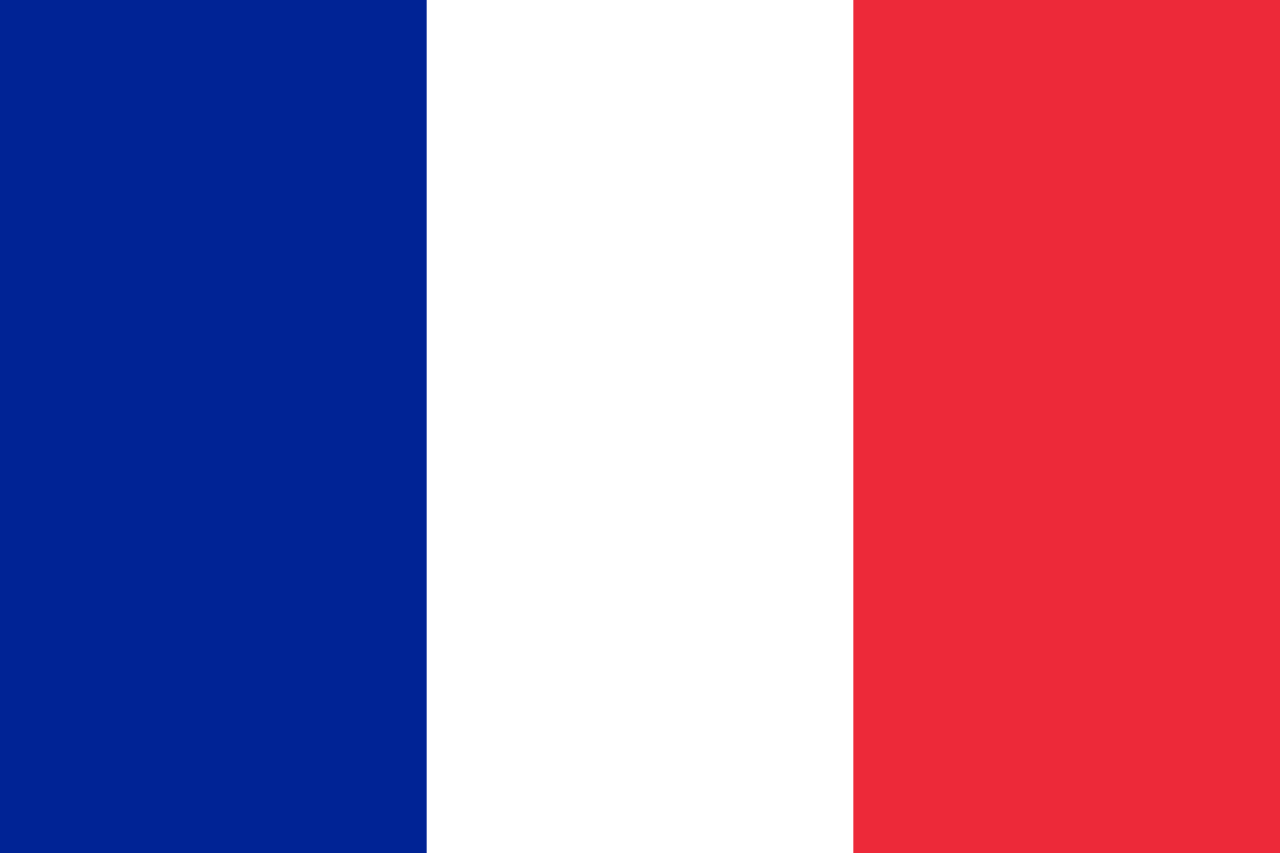
The flag's construction is about as economical as a national emblem can be. It consists of three vertical bands of equal width arranged blue, white, and red from the hoist (the side nearest the pole) outward to the fly. The standard proportions are 2:3, meaning the flag is half again as wide as it is tall. There are no charges, no emblems, no fringe, just three clean fields of color.
The exact shades have never been perfectly fixed. Current official specifications lean on navy blue, often cited as Pantone Reflex Blue, plain white, and a vivid red close to Pantone Red 032. The darker, almost inky blue carries deliberate symbolism, associated with the Revolution and the Republic rather than any modern supranational styling. That restrained design is precisely why the flag reproduces so well at any size, from a stadium banner to a lapel pin.
From Revolutionary Cockade to National Standard
The Tricolore did not arrive fully formed. It grew out of the cockade, a circular ribbon badge worn during the early days of the Revolution. In July 1789 the militia of Paris wore a blue and red cockade, and according to tradition the Marquis de Lafayette added a band of royal white to bind the city's colors to the monarchy, creating the red-white-blue cockade that became the emblem of the new order.
From that badge the colors migrated onto flags, and on February 15, 1794, the Tricolore in its familiar vertical arrangement was officially adopted as the national flag. Its path afterward was not entirely smooth. During the Bourbon Restoration between 1815 and 1830, the monarchy briefly set the Tricolore aside in favor of a plain white royal banner. The flag returned for good after the July Revolution of 1830, and it has flown over the Republic ever since. The most recent twist came in 2020, when President Emmanuel Macron quietly swapped the lighter, EU-style blue back to a darker navy, reaching toward the flag's revolutionary roots.
The Flag That Started a Family
The Tricolore's deepest legacy may be how many imitators it inspired. The idea of dividing a flag into three bold bands, each standing for a national value or region, spread rapidly through the nineteenth century as revolutionary and nationalist movements looked to France for a template. The flags of Italy, Ireland, and Belgium all adopted the three-stripe vertical pattern, swapping in their own colors while keeping the underlying grammar.
Look-alikes can cause genuine confusion. The flag of the Netherlands shares the same blue, white, and red palette but arranges them in horizontal bands rather than vertical ones. Italy and Ireland both use vertical thirds yet replace France's blue with green and shift the remaining hues, so a quick glance at the colors is usually enough to tell them apart. What distinguishes the French flag within this large family is its specific blue-white-red vertical order and its status as the original from which the others descend. If you want broader context on the country behind the banner, this france country guide is a useful companion.
A Symbol Woven Into National Identity
Within France, the Tricolore functions as more than decoration; it is the visual signature of the Republic itself. It appears beside the motto on official documents, town halls, and the backdrop of nearly every presidential address. Because it emerged from a revolution rather than a royal house, the flag carries an explicitly civic meaning, binding citizens to shared ideals rather than to a ruling family.
That emotional charge becomes most visible in moments of crisis and celebration alike. After terrorist attacks, French people have draped the Tricolore from windows and lit landmarks in its colors as a gesture of solidarity and defiance. The flag is also protected by law, with desecration treated as an offense, a sign of how seriously the Republic guards its central emblem.
The Tricolore in Modern Life
Today the flag is a constant presence in French public life. It flies from all public buildings, frames official ceremonies, and stands at the center of national holidays, above all Bastille Day on July 14th, when it lines the Champs-Élysées during the military parade. It travels with French athletes to the Olympics and World Cups, where the blue-white-red of the supporters often blurs into the colors of the national teams. Whether stitched onto a jersey, waved at a parade, or hung quietly from a balcony, the Tricolore remains the unmistakable face of France on the European stage and beyond.
Interesting Facts About the French Flag
- The French tricolor inspired the flags of Italy, Ireland, Belgium, and numerous other nations that adopted the three-band format.
- During the Vichy regime between 1940 and 1944, an axe motif was sometimes added to the flag.
- The shade of blue has been quietly altered twice, lightened in 1976 and darkened again in 2020.
- Napoleon chose the Tricolore for his armies, spreading its influence across much of Europe.
- The flag is affectionately known as le drapeau tricolore, or simply le tricolore.
Frequently Asked Questions
When was the French flag adopted?
The Tricolore was officially adopted on February 15, 1794, during the French Revolution. It was briefly set aside during the Bourbon Restoration from 1815 to 1830 but returned permanently after the July Revolution and has represented France ever since.
What do the blue, white, and red colors mean?
The colors are popularly linked to the revolutionary ideals of liberty, equality, and fraternity. Blue and red are also the traditional colors of Paris, while white was historically associated with the French monarchy, making the flag a blend of city, crown, and republican values.
Who designed the French Tricolore?
The flag grew out of the revolutionary cockade rather than a single designer's drawing. Tradition credits the Marquis de Lafayette with adding the royal white to the blue and red cockade of Paris in 1789, creating the color combination that the national flag later formalized.
What continent is France on, and how does its flag compare to similar ones?
France is located in Europe. Its flag belongs to a broad family of tricolors it helped inspire, including those of Italy, Ireland, and Belgium. The Netherlands shares the same blue, white, and red but arranges them horizontally, while Italy and Ireland use vertical bands with green in place of France's blue.