
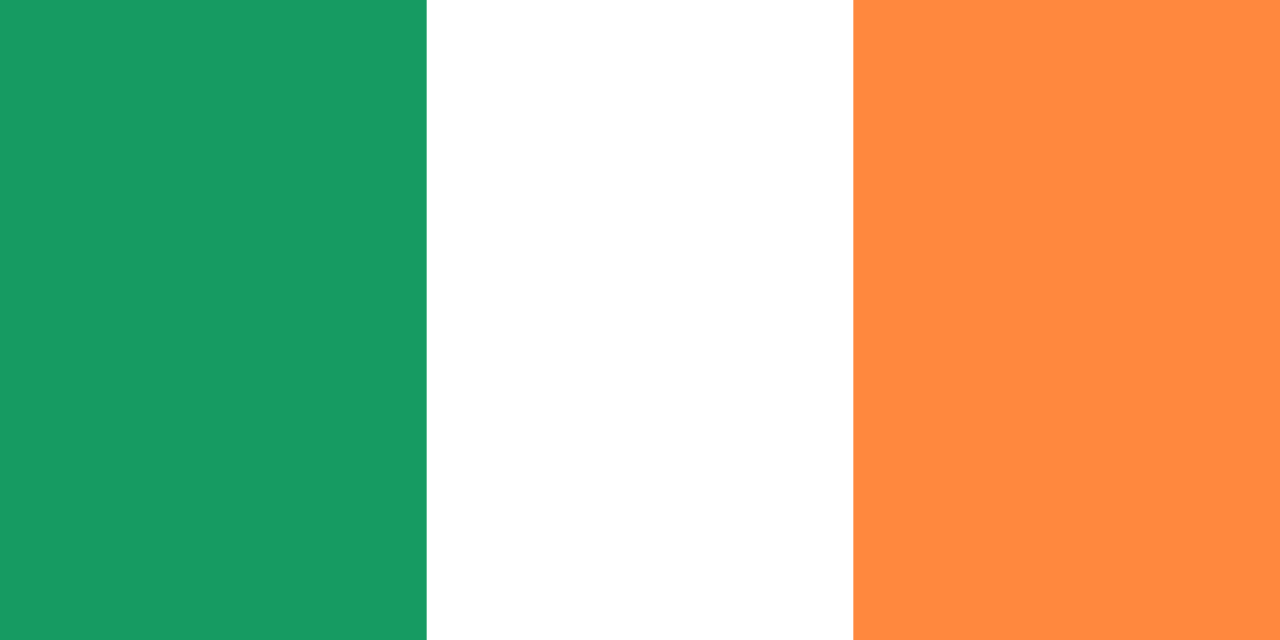
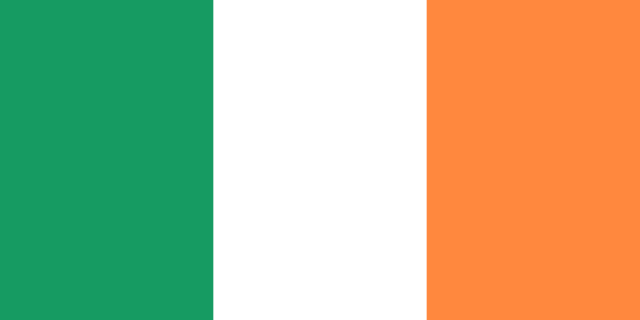
Few national emblems carry their meaning quite so openly as the flag of Ireland. Three equal vertical bands of green, white, and orange spell out an entire political philosophy in cloth: two communities side by side, and a lasting truce held between them. Adopted officially in 1919, the tricolour is at once one of the simplest flags in Europe and one of the most quietly ambitious, because its whole design is a wish rather than a boast. This article unpacks where the colours came from, how the flag rose from a revolutionary gesture to a state symbol, and why it still stirs strong feelings on a small island in the North Atlantic.
A Tricolour Built on Reconciliation
The Irish flag is a vertical triband, with the colours running top to bottom in three equal panels. From the hoist (the side nearest the pole) outward, the order is green, then white, then orange. That sequence is not decorative whim; it is a deliberate statement. Green stands for the island's Gaelic and Catholic tradition, the older nationalist current that had pushed for self-rule for generations. Orange represents the Protestant population, particularly those descended from the followers of William of Orange, the Dutch-born king whose victories in the late seventeenth century cemented Protestant ascendancy in Ireland.
Between these two stands the white band, and it is the most important panel of all. White signifies peace, a lasting truce between the green and the orange. The flag therefore reads less like a banner of conquest and more like an outstretched hand: it asks the two traditions to live together rather than to defeat one another. That aspiration, embedded in the cloth itself, is what makes the Irish tricolour unusual among national flags, many of which celebrate triumph rather than coexistence.
What Each Colour Was Meant to Say
It is worth lingering on the symbolism because it is so precise. Most tricolours assign colours to abstractions such as liberty, valour, or faith. Ireland's, by contrast, assigns them to actual communities of people. Green is the colour of nationalist Ireland, long associated with the harp, the shamrock, and the "Emerald Isle" itself. Orange is the colour of unionism and Protestantism, deliberately chosen to acknowledge a population that earlier nationalist symbols had ignored.
The white between them was never meant to be neutral filler. It is the diplomatic heart of the design, the visual promise that the green and orange need not clash. In this reading the flag is not a victory of one side, nor even a fifty-fifty compromise, but an invitation to build something shared. When you look at the tricolour, you are looking at a peace proposal that has been flying for more than a century.
From Revolutionary Gift to State Emblem
The tricolour first appeared in the middle of the nineteenth century, during an era when Europe was alive with revolutionary nationalism. Its layout was directly inspired by the French Revolutionary tricolour, whose three vertical stripes had become a template for movements seeking liberty and national identity across the continent. Irish nationalists borrowed that French model not only for its look but for its message: a banner of a free, modern, republican nation.
For decades the green-white-orange flag remained an unofficial symbol, raised at gatherings and associated with the cause of independence rather than the machinery of any government. That changed in the revolutionary years around the end of the First World War. The flag came to be flown during the struggle for independence and was adopted in 1919 as the banner of the emerging Irish state. In time it was written into the constitution of the modern Republic, completing the journey from a campaigner's emblem to the official flag of a sovereign country. Its survival is itself remarkable: many revolutionary banners are quietly retired once the cause succeeds, but Ireland kept the very flag under which it had fought.
How It Compares to Look-Alike Flags
Vertical tricolours are common, so the Irish flag has its share of near-twins, and telling them apart is a useful exercise. The most frequent confusion is with the flag of Côte d'Ivoire (Ivory Coast), which uses the same orange, white, and green palette. The crucial difference is the order: Ireland runs green-white-orange from the hoist, while Ivory Coast runs orange-white-green, the reverse arrangement. Ireland's flag is also noticeably longer in proportion than the Ivorian one.
The ancestor of them all, France's blue-white-red tricolour, shares the three-band layout but none of the colours, so it is easy to distinguish. India's flag also features saffron (a deep orange) and green with white between them, but those bands are horizontal and centred on a navy wheel, so the resemblance is only partial. What ultimately sets the Irish flag apart is intent: where many tricolours stack abstract virtues, Ireland's stacks two living communities around a band of peace. Once you know that the orange band honours the followers of William of Orange, the flag becomes unmistakable. For broader context on the country itself, see our ireland country guide.
The Flag in Everyday Irish Life
Today the tricolour is woven through Irish public and cultural life. It flies over government buildings, schools, and Garda stations, and it is hoisted with particular feeling on national occasions. It appears at sporting events, draped over the shoulders of supporters and players representing the Republic, and it travels the world wherever the Irish diaspora gathers. On St. Patrick's Day, when cities far beyond Ireland turn green for a day, the green-white-orange banner is a constant presence in parades from Dublin to New York to Sydney.
There is also an unwritten etiquette around the flag's three colours. Because the white band represents peace between the green and the orange, Irish convention holds that the colours should never be displayed as green-white-orange with the orange faded, dirtied, or omitted, since doing so would visually erase one of the two communities the flag is meant to unite. That care reflects how seriously the symbolism is taken: the flag's message of reconciliation is considered as important as the cloth itself.
Quick Facts Worth Knowing
- The flag is a vertical tricolour of green, white, and orange, in that order from the hoist.
- It was officially adopted in 1919, during Ireland's drive toward independence.
- Its layout was inspired by the French Revolutionary tricolour of the era.
- The orange band specifically honours William of Orange and the Protestant tradition.
- The white centre stands for lasting peace between the green and orange communities.
- Ireland sits in Europe, on an island in the North Atlantic to the west of Great Britain.
- The reversed colour order is the simplest way to distinguish it from Ivory Coast's flag.
Frequently Asked Questions
When was the flag of Ireland adopted?
The tricolour was officially adopted in 1919, during the period of Ireland's struggle for independence, though the green-white-orange design had circulated as a nationalist symbol since the mid-nineteenth century. It was later enshrined as the flag of the modern Irish Republic.
What do the green, white, and orange colours mean?
Green represents Ireland's Catholic and Gaelic nationalist tradition, orange represents the Protestant community descended from the followers of William of Orange, and the white band between them stands for peace and reconciliation between the two. The flag is essentially a visual call for the two communities to coexist.
Who designed the Irish flag and where did it come from?
The flag emerged from nineteenth-century Irish nationalist circles and was modelled on the French Revolutionary tricolour, which had become a popular template for nationalist movements across Europe. Rather than crediting a single designer, it is best understood as a revolutionary-era symbol that the movement gradually embraced and the state later made official.
What continent is Ireland on, and how does its flag compare to similar ones?
Ireland is in Europe, occupying most of an island in the North Atlantic. Its flag closely resembles that of Ivory Coast, which uses the same orange, white, and green colours but in the reverse order (orange at the hoist instead of green). Ireland's flag is also longer in proportion, and its meaning, tied to two specific communities and a band of peace, is entirely its own.