

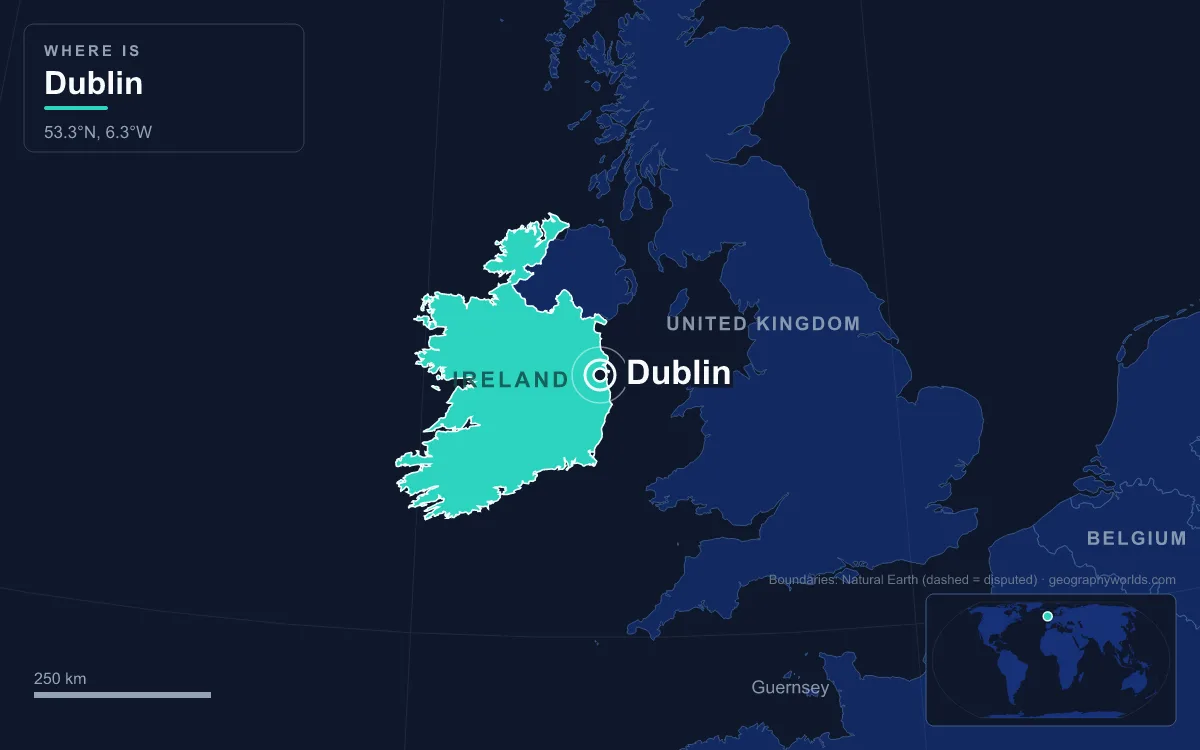
Where the River Liffey enters Dublin Bay on Ireland's east coast stands Dublin, the capital and largest city of Ireland. At the 2022 census the city council area had 592,713 residents and the city with its suburbs 1,263,219, making it the largest city on the whole island. It has been the centre of government in Ireland since the Normans took it in the 12th century and became the capital of the independent Irish state in 1922. What sets Dublin apart is how many different peoples built it: Norse traders, Gaelic neighbours, Norman lords, French Protestant refugees, brewery workers, Lithuanian Jews and, since the 1990s, newcomers from Poland to Brazil. In 2022 more than a quarter of the people in Dublin and its suburbs had been born outside Ireland.
Norsemen at Dyflin and Gaels at Áth Cliath, 841 to 1171
The city's two names record two communities. Before the Vikings came there was a Christian church settlement called Duibhlinn, "black pool", after a tidal pool on the lowest stretch of the River Poddle where ships could moor; the pool lay roughly where the garden of Dublin Castle is now and was filled in only in the early 18th century. Further up the Liffey, near today's Father Mathew Bridge, was a Gaelic settlement at Áth Cliath, the "ford of hurdles". Modern Irish still calls the city Baile Átha Cliath, "town of the hurdled ford", while English, like Old Norse Dyflin, kept the name of the pool.
In 841 Vikings built a fortified base on the Poddle, around the area now called Wood Quay. Under Olaf Guthfrithson in the mid-to-late 10th century it grew into a substantial commercial centre, and its hinterland was known in Old Norse as Dyflinnar skíði, "Dublinshire". Part of that commerce was human: slave raids in the 9th and 10th centuries brought captives from Wales, England, Normandy and beyond through the town. Despite attacks by the Irish, it stayed largely under Norse control until the Norman invasion launched from Wales in 1169.
The Norman takeover came through an Irish quarrel. Diarmait Mac Murchada, the exiled King of Leinster, enlisted Strongbow, Earl of Pembroke, to win back his kingdom. Strongbow took Dublin and declared himself King of Leinster after Mac Murchada's death, and in 1171 Henry II of England arrived with a larger force and proclaimed himself Lord of Ireland. The Norse and Gaelic town became the capital of an English lordship.

Normans, the Pale and the Irish Spoken Even in Dublin
The new rulers built for permanence. Dublin Castle was founded in 1204 on the orders of King John as the centre of Anglo-Norman power in Ireland. The first Lord Mayor was appointed in 1229, and by the end of the 13th century the walled town had about 8,000 people. Around it, Norman lords held "liberties", manors with their own jurisdiction; the most important were the Liberty of St Sepulchre, under the Archbishop of Dublin, and the Liberty of Thomas Court and Donore, held by the Abbey of St Thomas and later by the Earls of Meath. The working-class district of the Liberties, between the Liffey and St Patrick's Cathedral, is still named after them.
The town was vulnerable. Robert the Bruce of Scotland tried to take it in 1317, surrounding Gaelic clans threatened it constantly, and the Black Death killed thousands after 1348. Dublin became the heart of the Pale, a narrow strip of English settlement along the east coast. Yet the language of the countryside seeped in. In the 16th century the English administrator William Gerard complained that "All Englishe, and the most part with delight, even in Dublin, speak Irishe". Dublin was a city of two languages for centuries: in the early 18th century a circle of Irish-language poets and scribes gathered around Seán and Tadhg Ó Neachtain, and native Irish speakers still lived in County Dublin at the 1851 census.
The Tudor conquest brought a new identity. Queen Elizabeth I founded Trinity College in 1592 as a Protestant university and had both St Patrick's and Christ Church cathedrals converted to Protestant use. The city had 21,000 people in 1640, and a plague between 1649 and 1651 killed nearly half of them.
Huguenots, Weavers, Brewers and the Tenements of Henrietta Street
Recovery came through trade and through refugees. From the later 17th century French Protestants, the Huguenots, settled in Ireland, encouraged by an act of Parliament of 1662 for Protestant settlers; Huguenot regiments that fought for William of Orange in the Williamite War were rewarded with land, and many veterans settled in Dublin. For more than 150 years they held their services in the Lady Chapel of St Patrick's Cathedral, and a Huguenot cemetery survives off St Stephen's Green. D'Olier Street is named after one of their descendants, a High Sheriff and a founder of the Bank of Ireland, and the Taoiseach Seán Lemass and the writer Samuel Beckett both had Huguenot ancestry.
Textiles employed much of the city. Wool manufacture gave work to 12,000 people by 1698, and the population passed 50,000 by 1700. When English restrictions hit wool, linen, which was not restricted in the same way, became Ireland's most important export, rising from over 1.5 million yards in 1710 to almost 19 million by 1779. In the 18th century Georgian Dublin briefly became the second-largest city of the British Empire, with more than 130,000 people, and the Wide Streets Commission, set up in 1757, laid out the broad streets and squares, among them Merrion Square, that still define the south-east of the centre.

The trade that outlasted all others started on 31 December 1759, when Arthur Guinness signed a 9,000-year lease on a disused brewery at St James's Gate, on the edge of the Liberties, for £45 a year. He first shipped stout to England in 1769, six and a half barrels of it. By 1838 his brewery was the largest in Ireland and by 1886 the largest in the world, producing 1.2 million barrels a year; its site grew from about 1 acre to more than 64, and the company built streets of housing for its workers. It eventually became the largest employer in Dublin.
Politics then drained the city. The Acts of Union of 1800 moved the Irish Parliament to Westminster, and Dublin, without coal or shipbuilding, played little part in the Industrial Revolution while Belfast raced ahead. The population kept rising, to 175,319 in 1814 and 233,159 by the 1841 census, but much of it now lived in subdivided Georgian houses turned into tenements. By 1911 more than 830 people lived in just 15 houses on Henrietta Street. Infant mortality among the poor reached 142 per 1,000 births and tuberculosis spread through the tenements. Those conditions fed the Dublin Lock-out, which ran from 26 August 1913 to 18 January 1914 and pitted about 20,000 workers against 300 employers over the right to join a union. The Easter Rising of 1916 and the wars that followed wrecked much of the centre, and in 1922 Dublin became capital of the Irish Free State, renamed Ireland in 1937.
Lithuanian Jews, Italians, Poles and Brazilians: Dublin Since 1880
Newcomers kept arriving even in the poor decades. After the pogroms in the Russian Empire, Jewish immigrants, mostly from Lithuania, came to Ireland; by 1901 about 2,200 of Ireland's 3,771 Jews lived in Dublin. They opened shops, synagogues and schools, and the Irish Jewish Museum, which includes a former synagogue, now stands in Portobello. After the Second World War, Italians were by far the largest immigrant group in Dublin and became closely tied to its catering and restaurant trade, and from the 1960s arrivals from Hong Kong, Malaysia and mainland China opened restaurants of their own.
The biggest change began in the late 1990s. Economic growth drew technology and pharmaceutical companies to Dublin, among them Google, Microsoft, Amazon, Facebook, Pfizer and TikTok, many clustered around the old docks in what is nicknamed Silicon Docks. Net immigration followed, above all from the European Union, especially Poland, Lithuania and the United Kingdom, and from Pakistan, Brazil, the Philippines, China, India and Nigeria. Dublin now has a higher share of recent arrivals than anywhere else in Ireland, and 60 percent of Ireland's Asian population lives there.
The 2022 census measured the result. Of the 1,263,219 people in Dublin city and suburbs, 62.9 percent were born in Dublin, 10.5 percent in another Irish county and 26.6 percent, some 336,021 people, outside Ireland. In County Dublin, 68.0 percent identified as white Irish, 12.0 percent as other white, 5.8 percent as Asian and 2.2 percent as Black. Religion shifted too: regular Catholic church attendance in Dublin fell from over 90 percent in the mid-1970s to 14 percent in a 2011 survey.
The oldest language has not disappeared. Most Dubliners speak English, in local varieties grouped as Dublin English, but the 2016 census counted 14,903 people speaking Irish daily outside the education system, part of an urban Irish-speaking community that grew out of the Gaelic revival centred in the city at the end of the 19th century. Irish-language radio stations and agencies such as Conradh na Gaeilge are based in the capital, even though the nearest Gaeltacht, at Ráth Cairn in County Meath, is 55 kilometres away.
From the Norse slave port at Wood Quay to the offices of Silicon Docks, Dublin has always been a city of arrivals. To see how those neighbourhoods sit on either side of the Liffey, read our guide to Dublin's geography; for the raiders who founded Dyflin, follow the Viking expansion across Europe; and for the stretch of water every one of those newcomers once had to cross, see our guide to the Irish Sea.
Quick Facts About Dublin
- Country: Ireland
- Continent: Europe (Western Europe)
- Country population: approximately 5.4 million
- Capital city status: Dublin is the capital of Ireland, the seat of national government, and the location of foreign embassies, parliament, and the head of state's official residence.
Frequently Asked Questions
What is the capital of Ireland?
The capital of Ireland is Dublin. Dublin is the seat of national government, hosts most foreign embassies and consulates, and is typically where the head of state and parliament are located.
What continent is Dublin in?
Dublin, the capital of Ireland, is located in Europe, in the Western Europe region. As Ireland's capital, Dublin serves as the country's primary connection to the broader Europen political, economic, and cultural sphere.
Why is Dublin the capital of Ireland?
Dublin was chosen as the capital of Ireland for reasons that typically combine geography, history, and politics. Capital city selections often reflect a desire for centrality (being accessible from across the country), historical importance (being a longstanding seat of government or culture), or neutrality (being acceptable to multiple regions or ethnic groups within the country). The specific reasons for Dublin's designation are detailed in the city's history above.
What is Dublin known for?
As the capital of Ireland, Dublin is best known for housing the country's central government institutions — parliament, presidential or royal residences, supreme court, and key ministries. It is also typically a major cultural and economic center within Ireland, hosting national museums, embassies, and signature monuments. The introduction and history sections above provide detailed coverage of the city's specific notable institutions and landmarks.
Related Pages
- Ireland Country Guide — full geography, climate, economy, and culture overview
- Flag of Ireland — meaning, history, and design of Ireland's national flag