

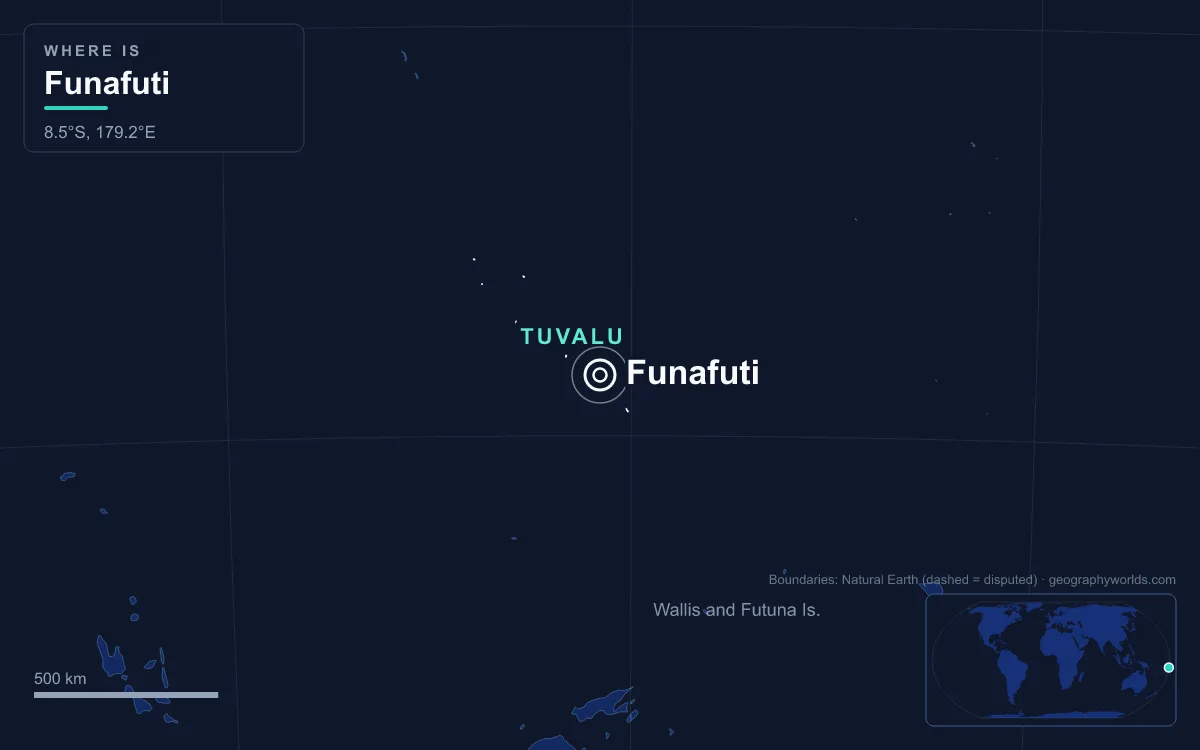
The capital of Tuvalu is Funafuti, a coral atoll in the central Pacific whose ring of islets encloses a lagoon of 275 square kilometres. The 2022 census counted 6,602 people on Funafuti, about 62 per cent of Tuvalu's 10,643 residents. Officially the whole atoll is the capital, because a single local government runs all of it. In practice, the government, the airport and nearly all the population are on Fongafale, a sliver of land about 12 kilometres long that is in places only 10 metres wide, with the administrative centre at Vaiaku. Taken together, Funafuti's 33 islets make up just 2.4 square kilometres of land, and much of it is less than a metre above sea level.
Power at the Vaiaku Maneapa
Tuvalu's parliament is called the Palamene o Tuvalu, and the place where it sits is known as the Vaiaku maneapa. On every island in Tuvalu the maneapa is the open meeting place where chiefs and elders deliberate and make decisions. Before independence the legislature was the House of Assembly, or Fale I Fono, and it was renamed the Palamene o Tuvalu in October 1978. There are sixteen members. Funafuti is one of eight constituencies and elects two of them. At the 2024 general election Funafuti re-elected Simon Kofe, elected Tuafafa Latasi and voted out the sitting prime minister, Kausea Natano. Parliament then chooses the prime minister. The ministries, the High Court, the police headquarters and jail, and the residence of the Governor-General, who represents King Charles III, are all on Fongafale.

Funafuti became a capital through a series of steps. The first recorded European sighting was in May 1819, when Arent Schuyler de Peyster, sailing the brigantine Rebecca under British colours, named the atoll Ellice's Island after the politician Edward Ellice. In 1892 Captain Herbert Gibson of HMS Curacoa declared the Ellice Islands a British protectorate. Funafuti got a resident magistrate in 1909, and in 1915 the islands were folded into the Gilbert and Ellice Islands Colony. Under the colony's 1967 constitution the Ellice Islands elected only four of the 23 elected members of its House of Representatives, and in 1974 a referendum voted to separate the two groups. The Tuvaluan Order 1975 created a separate colony on 1 October 1975, and the civil services were divided on 1 January 1976. Tuvalu became independent on 1 October 1978, with Toaripi Lauti as its first prime minister.
Choosing Funafuti was not obvious. In October 1972 Cyclone Bebe knocked down 90 per cent of the houses and trees on Fongafale and killed five people. The storm also threw up a wall of coral rubble about 16 kilometres long along the ocean side of Fongafale and Funafala. Even so, Funafuti, which already had a lagoon harbour dredged by the Americans during the war and a wartime airfield, was chosen as the capital of the new state in 1978. Local affairs are run by the Funafuti Falekaupule, the traditional assembly, and its executive, the Kaupule, which approves new houses on private land. Today the biggest decisions made in Vaiaku are about the atoll's own survival. On 10 November 2023 Tuvalu signed the Falepili Union treaty with Australia. The treaty covers security and climate change, and it opens a migration pathway for up to 280 Tuvaluans a year.
Faith at Fētu'ao Lima, the Morning Star Church
The most prominent building on the atoll is a church. Fētu'ao Lima, the Morning Star Church, belongs to the Church of Tuvalu, Te Ekalesia Kelisiano Tuvalu. The church is Congregational in origin and Reformed in theology, and at the 2022 census about 86 per cent of Tuvaluans belonged to it. It is often described as the state church, but in practice that status only gives it the privilege of holding services on major national occasions. Section 23 of the constitution guarantees freedom of religion, including the right not to take an oath against one's beliefs. Fongafale also has the Teone Church of the Catholic mission sui iuris of Funafuti.

Christianity arrived by accident. In 1861 Elekana, a Congregational deacon from Manihiki in the Cook Islands, drifted for eight weeks in a storm and came ashore on Nukulaelae, where he began preaching. He had trained at Malua Theological College, the London Missionary Society school in Samoa. In 1865 the Reverend Archibald Wright Murray of the London Missionary Society arrived as the first European missionary. Most of the pastors who followed were Samoan, and that is why the Tuvaluan language borrowed words from Samoan. Funafuti's own oral history gives it a Samoan founding ancestor. The atoll's name is said to come from funa, the Samoan word for chief, and the islet of Funafala means "the pandanus of Funa".
The church shaped the atoll's early settlement too. In December 1883 a cyclone hit Funafuti while a Samoan missionary named Tema had taken almost the whole community to Funafala to build a church. The trader George Westbrook was left as the only person on Fongafale, and he wrote down the storm as it destroyed the church and the trading stores there. Rebuilding started straight away. The church still runs Fetuvalu Secondary School on Funafuti, which reopened in 2003 after five years closed.
Trade Through .tv, Stamps and a 1,524-Metre Runway
A country of low atolls with poor soil has to earn its money in unusual ways, and the agencies that collect it have their offices on Fongafale. Government revenue comes mainly from fishing licences, sold for access to an exclusive economic zone of about 900,000 square kilometres, and from the Tuvalu Trust Fund. Leasing the ".tv" internet domain is another large source. Verisign managed the domain until 2021, and under a 2023 agreement with GoDaddy its marketing and sales were handed to a .tv unit of the Tuvalu Telecommunications Corporation. Stamps from the Tuvalu Philatelic Bureau and fees from the Tuvalu Ship Registry add more. The National Bank of Tuvalu, the country's only commercial bank, is in Vaiaku.
Almost everything comes in by air or by sea through Funafuti. The airport was built in 1943 by a Seabee detachment of the US Navy's 2nd Naval Construction Battalion. Islanders were moved to smaller islets while it was built, and coral dug from the atoll was used as fill. From the new strip, 22 B-24 Liberators bombed Nauru on 20 April 1943, and in November 1943 it became the headquarters of the US VII Bomber Command for the attack on Tarawa. Today the airport sits about 3 metres above sea level, and its single runway, 1,524 metres long, has no lighting, so it can only be used in daylight. Fiji Airways links it with Suva and Nadi using ATR 72-600 turboprops, with three flights a week on the Suva route.

Cargo and passengers for the outer islands go by sea. The Nivaga III, donated by Japan in 2015, and the new Manu Sina, funded through the Asian Development Bank, sail round the islands every three or four weeks and go to Suva a few times a year. The Manu Sina arrived at Funafuti on 2 April 2025 after a 13-day maiden voyage and replaced the ageing Manu Folau. Power comes mostly from diesel. In 2020 Funafuti had 735 kilowatts of solar capacity against 1,800 kilowatts of diesel generators.
Daily Life on Fongafale Between Lagoon and Reef
Fongafale has the open ocean and reef on its eastern side and the calm lagoon, Te Namo, on its western side. From north to south its villages are Lofeagai, Teone, Fakai Fou, Senala, Alapi, Vaiaku and Kavatoetoe, and they run together into a single urban strip of about 4,000 people. The airport takes up the widest part of the island. When no plane is due, the runway turns into the island's biggest public space, used for football, volleyball and other recreation. The Independence Day Sports Festival is held every 1 October, and the Tuvalu Games have been held every year since 2008. There are just four taxis on the island, and motorbikes can be hired.

The war left scars that people deal with every day. About half of Fongafale is reclaimed swamp, and the borrow pits dug for runway fill damaged the fresh-water aquifer under the island. At high tide seawater bubbles up through the porous coral and forms pools. In 2015 a project funded by New Zealand filled ten of these borrow pits with 365,000 square metres of lagoon sand and added about 8 per cent to Fongafale's usable land. Only Tafua Pond, a natural pond, was left open. Water comes from the sky, and a lot of it. Funafuti gets roughly 3,500 millimetres of rain a year, and no month has less than 200 millimetres. The daily mean temperature stays close to 28.5 °C all year round.
The atoll's future depends on how much land it can hold on to. Projections suggest that by 2050 around half of Funafuti's land could be flooded at high tide, and as much as 95 per cent by 2100. Under the Tuvalu Coastal Adaptation Project, launched in 2017, dredgers began work in December 2022 on a platform of lagoon sand on Fongafale. It is 780 metres long and 100 metres wide, covers about 7.8 hectares, and is designed to stay above rising seas and storm waves beyond 2100. The Princess Margaret Hospital, Tuvalu's only hospital, is also on Fongafale. Across the lagoon, the Funafuti Conservation Area, created in June 1996, protects 33 square kilometres of reef and six islets on the western rim. The atoll also matters to science. Between 1896 and 1898 the Royal Society drilled boreholes here to test Charles Darwin's theory of how atolls form, and in 2022 the International Union of Geological Sciences listed Funafuti among its first 100 geological heritage sites.
To see how Funafuti fits the wider pattern of coral islands, read our explainer on what an atoll is. The Tuvalu country guide covers the eight other islands that send their people, produce and politicians to this narrow strip of coral.
Quick Facts About Funafuti
- Country: Tuvalu
- Continent: Oceania
- Country population: approximately 9 thousand
- Capital city status: Funafuti is the capital of Tuvalu, the seat of national government, and the location of foreign embassies, parliament, and the head of state's official residence.
Frequently Asked Questions
What is the capital of Tuvalu?
The capital of Tuvalu is Funafuti. Funafuti is the seat of national government, hosts most foreign embassies and consulates, and is typically where the head of state and parliament are located.
What continent is Funafuti in?
Funafuti, the capital of Tuvalu, is located in Oceania. As Tuvalu's capital, Funafuti serves as the country's primary connection to the broader Oceanian political, economic, and cultural sphere.
Why is Funafuti the capital of Tuvalu?
Funafuti was chosen as the capital of Tuvalu for reasons that typically combine geography, history, and politics. Capital city selections often reflect a desire for centrality (being accessible from across the country), historical importance (being a longstanding seat of government or culture), or neutrality (being acceptable to multiple regions or ethnic groups within the country). The specific reasons for Funafuti's designation are detailed in the city's history above.
What is Funafuti known for?
As the capital of Tuvalu, Funafuti is best known for housing the country's central government institutions — parliament, presidential or royal residences, supreme court, and key ministries. It is also typically a major cultural and economic center within Tuvalu, hosting national museums, embassies, and signature monuments. The introduction and history sections above provide detailed coverage of the city's specific notable institutions and landmarks.
Related Pages
- Tuvalu Country Guide — full geography, climate, economy, and culture overview
- Flag of Tuvalu — meaning, history, and design of Tuvalu's national flag