

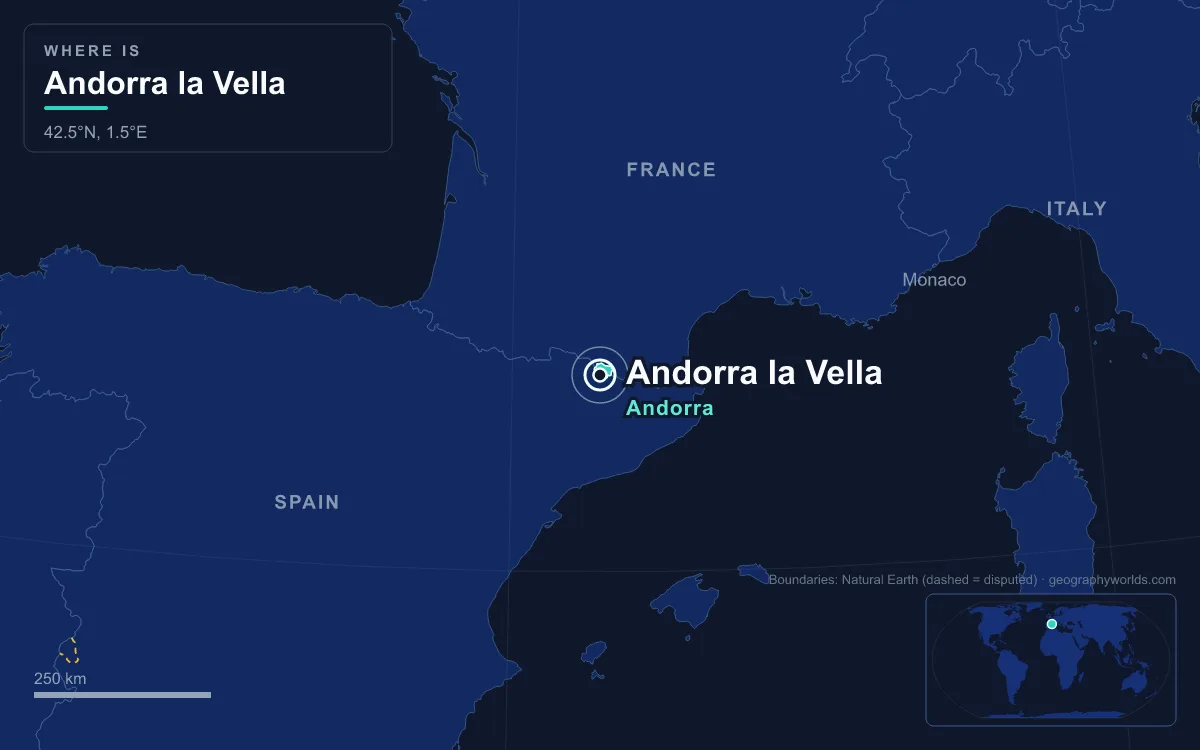
Andorra la Vella is the capital and largest city of Andorra, the small co-principality in the eastern Pyrenees between France and Spain. The city had 24,042 residents in 2023, and with neighbouring Escaldes-Engordany and nearby villages its urban area holds more than 40,000, close to half the country's roughly 90,000 people. At 1,023 metres above sea level, on the Gran Valira river where the Valira del Nord and the Valira d'Orient meet, it is the highest capital city in Europe. Its name means simply "the town of Andorra"; the Catalan vella here comes from the Latin villa, not from the word for "old". What makes the city unusual is its people. Native Andorrans are a minority in their own capital, outnumbered by Spaniards and joined by large Portuguese and French communities, and the story of Andorra la Vella is largely the story of who arrived, when, and to do what work.
Shepherds of the Valleys and the Consell de la Terra
For most of its history Andorra la Vella was the chief village of a mountain community of farmers and shepherds, Catalan in speech and Catholic in faith. People have lived in these valleys since the Neolithic; a group settled permanently in the Madriu valley, now a UNESCO World Heritage Site in Escaldes-Engordany, around 6640 BC, raising cereals and livestock. In the Middle Ages the valleys belonged to the counts of Urgell, who in 988 handed them to the bishop of Urgell. A dispute between the bishop and the count of Foix was settled in 1278 by the first paréage, a charter under which the two shared sovereignty. That arrangement survives: the bishop of Urgell, in Catalonia, and the president of France, heir to the counts of Foix through the kings of Navarre and France, are Andorra's two co-princes today. Andorra la Vella has been the principal town since that settlement.
The valley families governed themselves through a council. In 1419 the co-princes approved the Consell de la Terra, the Council of the Land, later called the General Council of the Valleys. It is described as the second-oldest parliament in Europe. In 1702 the council bought a fortified manor house in Andorra la Vella, the Casa de la Vall, built in 1580 by the Busquets family, and met there for more than three centuries.

Inside is a cupboard with a separate lock for each parish, in which the council kept its founding documents. The house also contained the court room, and the council chamber sat beside a chapel dedicated to Sant Ermengol. The building appears on Andorra's one-euro coin, and it was the seat of the General Council until 2011, when the parliament moved to a new building. The old town around it, the Barri Antic, keeps the stone lanes of this older community, and the Romanesque church of Sant Esteve, from the 11th century, stands at its centre. In the village of Santa Coloma, which belongs to the Andorra la Vella parish, the church of Santa Coloma dates from the 9th century and is probably the oldest building in the parish. The parish itself was larger until 1978, when Escaldes-Engordany split off to become Andorra's seventh parish.

Forge Workers, Tobacco Growers and Smugglers on the Valira
A mountain valley with little farmland could not live on sheep alone, and Andorrans turned early to trade. From the 12th to the 14th centuries and long after, iron was worked in local forges, the fargues, using a method similar to the Catalan forge. Tobacco arrived around 1692 and became a lasting crop; it is still grown on small plots, and cigarettes and cigars remain among the country's few manufactured products. The co-princes confirmed the Andorra la Vella fair in 1371 and again in 1448, and the fair has been the country's main commercial event ever since.
Position between two larger states also made smuggling a trade. During the Second World War, with Andorra neutral, the valleys were an important smuggling route between Vichy France and Francoist Spain. Some of that traffic was human. The Hostal Palanques escape network, in contact with British intelligence, helped almost 400 fugitives, including Allied servicemen, cross the mountains between 1941 and 1944. In Andorra la Vella, hotels such as the Mirador served as meeting places for the Free French and as waypoints for downed Allied pilots. After the war the network carried on: film societies were formed that imported films, books and music censored in Franco's Spain, and they became an anti-censorship draw for Catalan and foreign audiences.
Spanish Civil War Refugees, Bankers and the 1930s Turn
The modern city began to take shape in the 1930s, and newcomers drove it. The first professional bank, Banc Agrícol, opened in 1930, followed by Crèdit Andorrà in 1949, Banca Mora in 1952, Banca Cassany in 1957 and SOBANCA in 1960. Low taxes turned Andorra la Vella into a banking and shopping centre, and modern banking offices went up in the capital. The same decade brought one of the strangest episodes in the city's history: in July 1934 an émigré adventurer born in the Russian Empire, Boris Skossyreff, won the support of the General Council, proclaimed himself Boris I, King of Andorra, and promised to make the country a tax haven. He was arrested on 20 July by the co-prince bishop's authorities and later expelled from Spain.
More lasting were the refugees. During the Spanish Civil War, from 1936 to 1939, Andorrans took in people fleeing both sides, and many stayed permanently. Those who stayed helped drive the economic boom that followed. Ski resorts and hotels opened from the late 1930s, and after the war mass tourism and tax-free shopping pulled in workers far faster than the old families could supply them. The country grew from about 5,000 people in 1900 to an estimated 90,021 in July 2026. Tourism now brings about 8 million visitors a year, and ski areas alone support some 2,000 direct and 10,000 indirect jobs. That growth came mainly from migration rather than from births, and it turned a village on the Valira into a continuous town running into Escaldes-Engordany.
Spaniards, Portuguese and French: Andorra la Vella's Newcomers
The result is a capital where citizens are outnumbered. By country of birth in 2024, 34.3% of Andorra's residents were born in Spain and 32.1% in Andorra, followed by 10% from Portugal and 5.6% from France. The remaining 18% include British, Dutch, German and Italian residents, as well as people from Argentina, Chile, India, Morocco and Uruguay. Recent arrivals have come mainly from South America, especially Colombia and Peru, most of them young workers taking jobs in hotels, restaurants, shops and other services.
Nationality is hard to acquire, which keeps the gap wide. About two-thirds of residents do not hold Andorran nationality, so they cannot vote in communal elections, cannot become head of government, and may not own more than 33% of a privately held company. Naturalisation requires at least 20 years of permanent residence, or 10 years for someone who completed all their compulsory schooling in Andorra, and the applicant must give up any other citizenship, since Andorran law forbids dual nationality. A child born in Andorra to foreign parents qualifies only if the parents had lived there for at least 10 years. Long-settled Spanish and Portuguese families can therefore remain foreign nationals for decades while working in the capital's shops, building sites and ski resorts.
Catalan in the Schools, Spanish in the Shops: Language in the Capital
Catalan is Andorra's sole official language, and has always been; Andorra is the only country where Catalan stands alone in that role. In practice the capital runs in several languages at once. In a government survey in 2022, 44.1% of respondents named Catalan as their mother tongue and 40.3% Spanish, with Portuguese at 13.5%, French at 10.0% and English at 3.0%. As the language people actually use day to day, Catalan rose to 63.7% and Spanish to 48.6%, while Portuguese fell to 6.6% and French to 5.7%, which suggests that Portuguese and French families shift to Catalan or Spanish outside the home. Respondents rated their understanding of Catalan at 9.0 out of 10 on average.
Schools reflect the three communities that shaped the country. Families in the Andorra la Vella parish choose between the Andorran system, which teaches in Catalan, and Spanish and French public schools, whose teachers are largely paid by Spain and France. The parish has 11 schools, 10 public and 1 private, among them the Lycée Comte de Foix, named after the medieval co-lords, and Spanish schools in Santa Coloma, La Margineda and the town itself. For university, students go to the Universitat d'Andorra in Sant Julià de Lòria, about 7 kilometres away, or across the border.
Faith, by contrast, still unites most of the city. The Catholic Church's 2022 yearbook counted 98.6% of the population as baptised Catholics, and the national feast is Our Lady of Meritxell Day on 8 September. There were about 2,000 Muslims and roughly 100 Jews in the country in 2022. Getting in and out remains a mountain matter: the capital has no railway station and no airport of its own beyond a heliport, so buses link it to trains at L'Hospitalet-près-l'Andorre in France and at Lleida in Spain, and the Andorra–La Seu d'Urgell airport lies 24 kilometres south of the city, inside Spain. To see how the capital fits the country and its mountains, read our Andorra country guide, our guide to the Pyrenees mountains, and our look at the microstates of Europe.
Quick Facts About Andorra La Vella
- Country: Andorra
- Continent: Europe (Southern Europe)
- Country population: approximately 84 thousand
- Capital city status: Andorra La Vella is the capital of Andorra, the seat of national government, and the location of foreign embassies, parliament, and the head of state's official residence.
Frequently Asked Questions
What is the capital of Andorra?
The capital of Andorra is Andorra La Vella. Andorra La Vella is the seat of national government, hosts most foreign embassies and consulates, and is typically where the head of state and parliament are located.
What continent is Andorra La Vella in?
Andorra La Vella, the capital of Andorra, is located in Europe, in the Southern Europe region. As Andorra's capital, Andorra La Vella serves as the country's primary connection to the broader Europen political, economic, and cultural sphere.
Why is Andorra La Vella the capital of Andorra?
Andorra La Vella was chosen as the capital of Andorra for reasons that typically combine geography, history, and politics. Capital city selections often reflect a desire for centrality (being accessible from across the country), historical importance (being a longstanding seat of government or culture), or neutrality (being acceptable to multiple regions or ethnic groups within the country). The specific reasons for Andorra La Vella's designation are detailed in the city's history above.
What is Andorra La Vella known for?
As the capital of Andorra, Andorra La Vella is best known for housing the country's central government institutions — parliament, presidential or royal residences, supreme court, and key ministries. It is also typically a major cultural and economic center within Andorra, hosting national museums, embassies, and signature monuments. The introduction and history sections above provide detailed coverage of the city's specific notable institutions and landmarks.
Related Pages
- Andorra Country Guide — full geography, climate, economy, and culture overview
- Flag of Andorra — meaning, history, and design of Andorra's national flag