
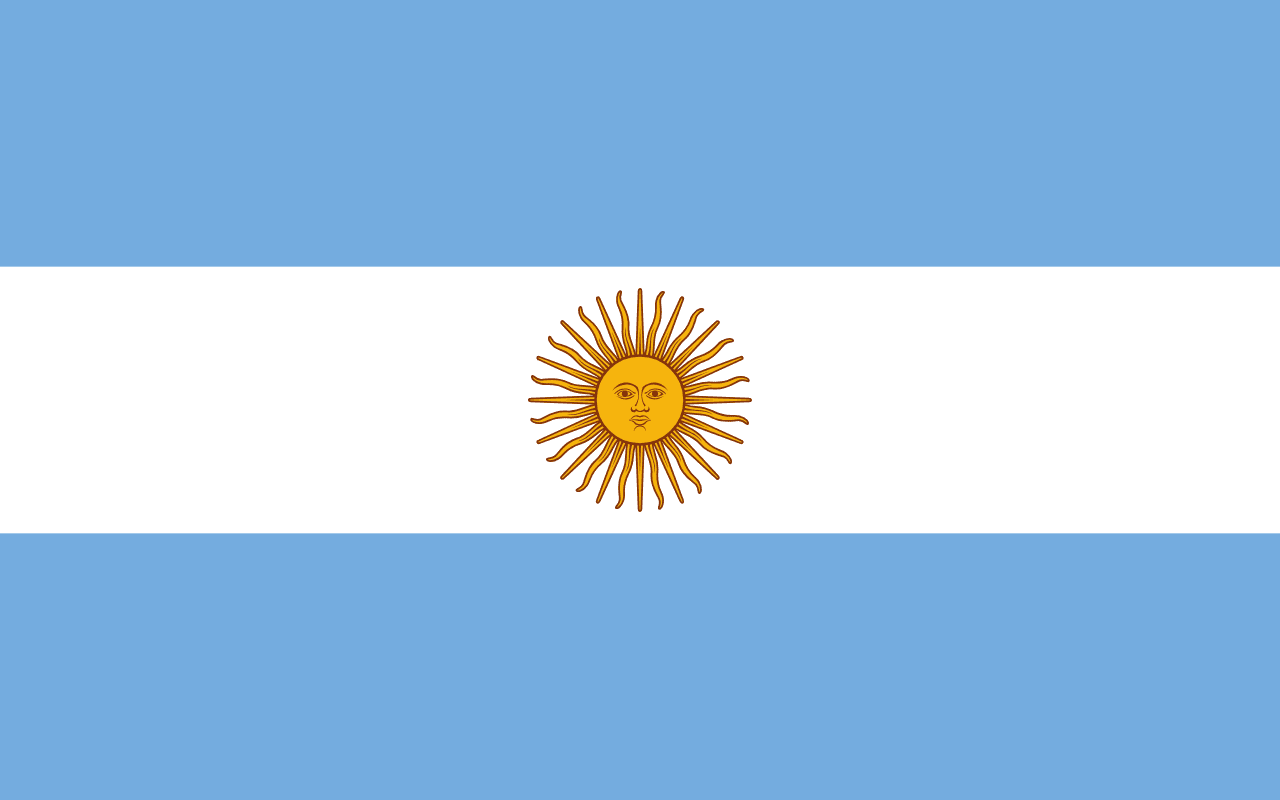
Few flags wear their meaning as openly as Argentina's. Three broad horizontal bands — light blue on the top and bottom, white in the middle — carry a small golden sun at their heart, its face turned outward as if greeting the viewer. It is a banner that looks, quite literally, like a sky split by clouds and lit by a single radiant star. Born in the turbulent years of South America's wars of independence, the Argentine flag has come to stand for an entire national story: rebellion against empire, the dawn of a new republic, and a people who chose the colors of the heavens to declare themselves free.
A Flag of Sky, Cloud, and Sun
The Argentine flag is built from three colors: light blue (often called celeste), white, and the yellow-gold of its central emblem. The symbolism is poetic and remarkably consistent with how Argentines have long described their banner. The two blue bands evoke the open sky, while the white stripe between them represents the clouds drifting across it. Set into the white is the famous Sun of May, a golden sun whose imagery reaches back to Inti, the sun deity revered by the Inca and other Andean peoples. In this way the flag fuses a vision of the natural world above with a symbol drawn from the deep cultural roots of the land below.
That choice of celeste rather than a deep navy gives the flag its gentle, luminous quality. The shade is soft and bright, an unmistakable signature that distinguishes Argentina at a glance from nations that favor darker blues. When the flag hangs in still air or ripples over a stadium, it reads less like a martial standard and more like a piece of daylight captured in cloth.
How the Tricolor Is Arranged
In its construction the flag is a horizontal triband: three stripes of equal height stacked one above the other, light blue at top, white in the middle, light blue again at the bottom. Centered in the white band sits the Sun of May, a golden sun rendered with a distinctive human face and rays radiating outward. Tradition holds that the sun is depicted with both straight and wavy rays alternating around its circumference, a detail that gives it the lively, almost animated appearance for which it is famous.
The version bearing the sun is the bandera oficial de ceremonia, the official ceremonial flag flown by the state and the armed forces. There is also a plainer variant, the same blue-white-blue triband without the sun, which serves as an ornamental or civil flag. The two have coexisted for much of Argentina's history, but it is the sun-bearing design that most people picture when they think of the country.
From Revolution to National Banner
The flag was the creation of Manuel Belgrano, a lawyer, economist, and general who became one of the central figures of Argentine independence. In 1812, during the struggle to break free from Spanish rule, Belgrano raised a blue-and-white banner for his troops along the Paraná River. The colors are widely understood to have been inspired by the celeste and white of the era, the same palette associated with the revolutionary cause that had stirred in Buenos Aires.
For several years the design existed unofficially, carried into battle and flown by patriots even as the new nation's political future remained uncertain. It was only in 1818, after the formal declaration of independence, that the flag with the Sun of May was sanctioned as a national emblem. The addition of the sun transformed Belgrano's simple bicolor into the richer symbol recognized today, tying the young republic to both the sky overhead and the ancient heritage of the continent. Belgrano did not live to see his banner fully celebrated, but his name remains inseparable from it; the anniversary of his death is commemorated each year as a day dedicated to the flag itself.
Cousins and Look-Alikes Across the Region
Argentina's celeste-and-white scheme echoes through the flags of several neighbors, a visual reminder of shared independence movements and intertwined histories. Uruguay, which once belonged to the same colonial province, also features light blue, white, and a golden sun with a human face in its canton — its Sun of May is a close relative of Argentina's. The flags can be told apart instantly, however: Uruguay's banner uses horizontal stripes and places its sun in the upper corner, while Argentina's centers the sun within a clean three-band design.
The same warm blue appears in the flags of El Salvador, Nicaragua, Guatemala, and Honduras, all descendants of the old United Provinces of Central America, which adopted a blue-white-blue triband of its own. These Central American flags share Argentina's stripe arrangement but differ in their central emblems and in the precise tone of blue. What sets Argentina apart in every comparison is the unmistakable golden face of the Sun of May resting squarely in the middle of the white. To explore more about the country behind the flag, see our argentina country guide.
A Symbol Woven Into National Identity
For Argentines, the flag is far more than an official insignia; it is a fixture of public life and personal pride. Schoolchildren swear an oath of loyalty to it, traditionally around the age of nine or ten in a ceremony that marks a small rite of passage. The banner appears at civic gatherings, on government buildings, and in countless homes, its soft blue instantly legible as a marker of belonging.
The Sun of May in particular has migrated far beyond the flag. It is stamped into coinage, featured in official seals, and embraced as a kind of national shorthand. Because it draws on Andean reverence for the sun god, the emblem also gestures toward the indigenous heritage that predates the modern state, giving the flag a layered identity that bridges pre-Columbian symbolism and republican ideals.
The Flag in Modern Life
Nowhere is the flag's emotional charge more visible than in sport. Argentina is one of the world's great football nations, and the celeste-and-white striped jersey of the national team is among the most recognizable in the game. When the team plays, oceans of light-blue-and-white flags fill the stands, and the colors spill into streets and plazas across the country during major tournaments. The sky-and-clouds palette has become inseparable from moments of collective joy and heartbreak.
Beyond the pitch, the flag flies on national holidays, at independence celebrations, and on the dedicated day honoring the banner and its creator. Located in South America, occupying much of the continent's southern cone, Argentina raises its flag over a landscape that runs from subtropical north to glacial Patagonian south — a vast territory united, at least in symbol, beneath a single luminous sun.
Interesting Facts About the Argentine Flag
- The Sun of May is depicted with a human face, complete with features, making it one of the few national flags whose emblem looks back at you.
- The flag was designed by Manuel Belgrano, a general and statesman rather than a professional artist or herald.
- It was officially adopted with the sun in 1818, the year after independence was declared.
- The light blue shade is known as celeste, deliberately softer and brighter than the navy used by many other nations.
- A plainer sun-less version exists as a civil flag, while the sun-bearing design is reserved for official and ceremonial use.
- The sun's name, the Sun of May, recalls the revolutionary events that set independence in motion.
Frequently Asked Questions
When was the flag of Argentina adopted?
The blue-and-white banner was first raised by Manuel Belgrano in 1812, but the flag bearing the Sun of May was officially adopted as a national symbol in 1818, shortly after Argentina declared its independence from Spain.
What do the colors of the Argentine flag mean?
The two light blue bands represent the sky, while the white stripe between them stands for the clouds. The golden Sun of May at the center evokes Inti, the sun god of the Inca and other Andean peoples, linking the nation to both the heavens and its indigenous heritage.
Who designed the flag of Argentina?
The flag was created by Manuel Belgrano, a lawyer, economist, and military leader who was a key figure in the country's independence movement. He first flew the celeste-and-white colors with his troops in 1812.
What continent is Argentina on, and which flags resemble it?
Argentina sits in South America, in the continent's southern cone. Its closest look-alike is the flag of Uruguay, which also features a Sun of May, though Uruguay arranges its stripes horizontally and places the sun in the upper corner. The blue-white-blue triband is also shared by several Central American nations that descend from the old United Provinces, distinguished from Argentina by their different central emblems.