
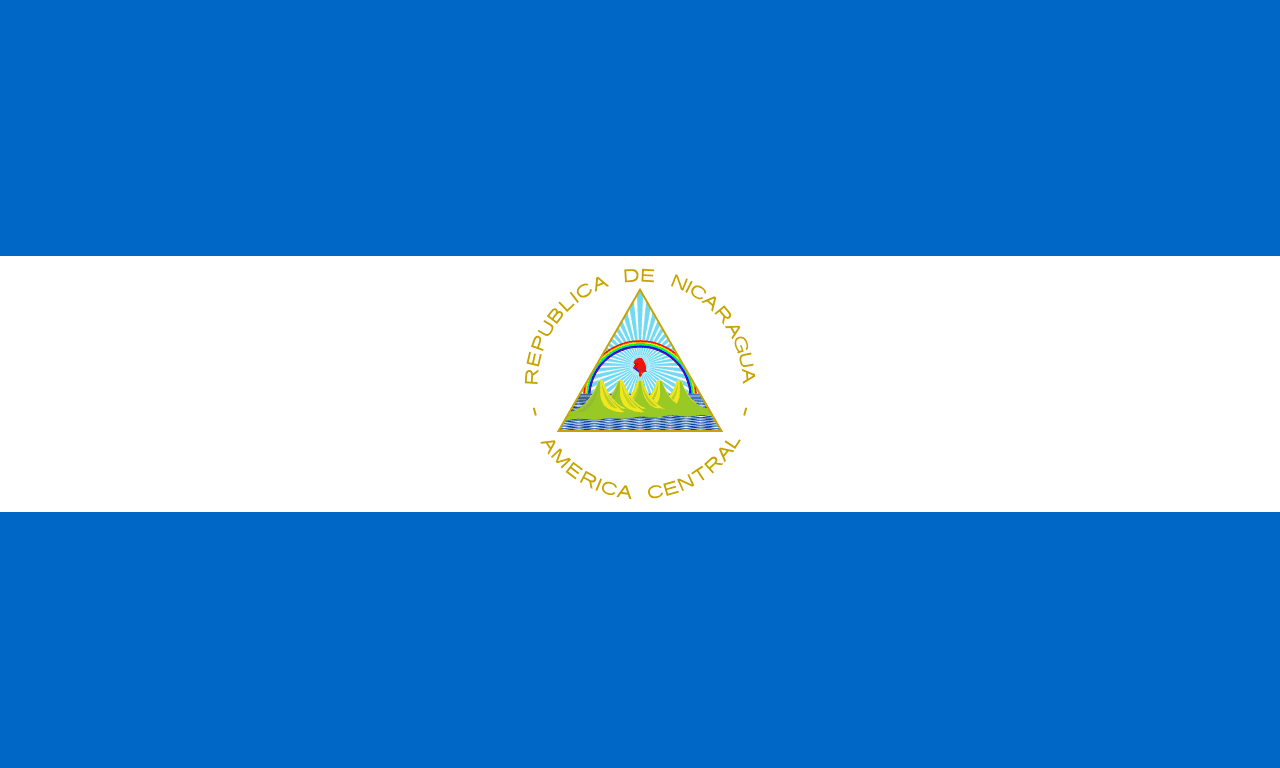
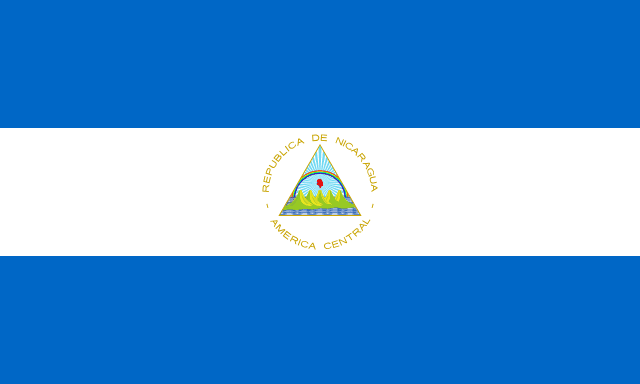
Unfurl the flag of Nicaragua and you are looking at one of the most quietly poetic banners in the Americas. Two bands of cobalt blue sandwich a stripe of white, and dead center sits an emblem so intricate it almost dares you to lean in: a triangle, a chain of volcanoes, a rising sun, and the curve of a rainbow. It is a flag that rewards close inspection. From across a stadium it reads as a calm blue-and-white tricolor, but up close it tells a story about isthmus geography, regional brotherhood, and a young republic that never quite let go of the dream of a united Central America.
To outsiders, Nicaragua's flag can look almost interchangeable with those of its neighbors, and that resemblance is no accident. It is a living souvenir of a federation that briefly bound five nations together in the early nineteenth century. Understanding the banner means understanding that shared inheritance, and also the small but deliberate touches that make Nicaragua's version unmistakably its own.
A Banner of Blue and White
The Nicaraguan flag uses just two colors, and both carry layered meaning. The twin blue stripes are usually said to represent the two oceans that border the Central American isthmus: the Pacific on one side and the Caribbean Sea on the other. That maritime reading gives the blue a geographic literalness rather than a purely heraldic flourish. The white band running between them stands for peace, and for the land itself lying between the two seas.
Compared with the deep navy you might expect from a naval ensign, Nicaragua's blue tends toward a brighter, almost sky-leaning tone, though the exact shade has drifted over the decades and across manufacturers. The pairing of blue and white is intentionally restrained. There is no red, no green, no gold filling the field. That restraint is part of the design's identity, allowing the densely detailed coat of arms to do the heavy symbolic lifting without competing against a busy backdrop.
Reading the Design from Edge to Emblem
The structure is a horizontal triband: three equal stripes stacked blue-white-blue. In the heart of the white band rests the national coat of arms, and this is where the flag becomes a small encyclopedia of national ideals.
The emblem is built around an equilateral triangle, a shape chosen deliberately to symbolize equality, with its three equal sides standing for balance and fairness. Inside the triangle sits a row of five volcanoes rising from between two seas, a direct nod to the five member states of the old Central American federation. Above them arcs a rainbow, and beneath the rainbow a Phrygian cap, the classic liberty cap of republican revolutions, radiates beams of light like a small sun. The whole emblem is encircled by words naming the republic and the region. Few national flags pack this much narrative into so small a space, which is exactly why the plain blue-and-white field around it matters so much.
From Federation to Republic: How the Flag Evolved
Nicaragua's flag descends directly from the banner of the United Provinces of Central America, the federation that emerged in the 1820s after the region broke from Spanish and then Mexican rule. That federal flag established the blue-white-blue template and the ocean-to-ocean symbolism that all the successor states would inherit. When the federation dissolved, each former member carried the basic design forward, adapting the central emblem to its own identity.
Over the following century and a half Nicaragua experimented with various arrangements and color tones, and at times the banner looked notably different from its modern form. The design that flies today, the blue-white-blue triband bearing the triangular coat of arms, was formally fixed by law in 1971. That codification settled the proportions, the colors, and the placement of the emblem, giving the country the standardized flag it uses now. For a fuller picture of the nation behind the banner, its landscapes and history, see our nicaragua country guide.
The Family Resemblance: Telling It Apart from Its Neighbors
Here is the fun fact that trips up quiz-takers everywhere: Nicaragua's flag is almost identical to those of El Salvador and Honduras. All three are blue-white-blue tribands with a central emblem, all three trace back to the same federal banner, and at a glance they can blur together. So how do you tell them apart?
- Nicaragua centers a triangle containing five volcanoes, a rainbow, and a radiant liberty cap, with comparatively vivid coloring inside the emblem.
- El Salvador also uses a triangle and the federation imagery, but its emblem and motto wording differ, and its blue is often a deeper tone.
- Honduras skips the elaborate coat of arms entirely, placing instead five blue stars in the white band, again representing the five federation states.
Beyond Central America, the blue-white-blue palette also evokes flags like those of Argentina, Guatemala, and El Salvador, but Nicaragua's specific combination of a horizontal triband plus a rainbow-and-volcano triangle is unique. The rainbow in particular is a giveaway: of the trio, Nicaragua is the one whose emblem famously features that arc of color above the volcanic ridge.
A Flag Woven into National Identity
For Nicaraguans, the flag is far more than a tidy piece of heraldry. The volcanoes are not abstract decoration; they mirror a country genuinely defined by volcanic peaks and crater lakes, where mountains smoke on the horizon and the land between the seas is exactly the geography the emblem describes. The flag, in other words, looks like the place it represents.
The liberty cap and the equality triangle also speak to a republican self-image rooted in the independence era, while the five volcanoes keep alive the memory of Central American unity, a recurring theme in the region's politics and poetry. To raise this flag is to assert both a distinct Nicaraguan nationhood and a sense of belonging to a larger isthmus family. That double meaning, proudly local and consciously regional, is unusual and gives the banner emotional weight at school ceremonies, civic gatherings, and moments of national pride.
The Flag in Modern Life
Today the blue-and-white triband appears wherever Nicaraguan public life unfolds. It flies over government buildings and schools, leads patriotic parades, and is hoisted with particular fervor around Independence Day in September, when Central America collectively marks its break from colonial rule. Children learn the meaning of the volcanoes and the triangle as part of civic education, so the emblem's symbolism stays widely understood rather than fading into mere decoration.
On the international stage, the flag travels with the national football and baseball teams, the latter especially beloved in a country where baseball rivals soccer for affection. Fans drape themselves in blue and white, and the colors turn up in everything from murals to merchandise. Because the design is so detailed, simplified versions sometimes appear on small items where the full coat of arms would be illegible, but the official banner always retains its rainbow-crowned triangle.
- The flag's three equal stripes follow a blue-white-blue order, with the emblem only on the central white band.
- The five volcanoes in the coat of arms represent the five states of the former Central American federation.
- Nicaragua's emblem is one of the rare national symbols to include a rainbow.
- The liberty cap radiating light is a Phrygian cap, a worldwide emblem of freedom and republican government.
- The current design was set in law in 1971, but its blue-and-white roots reach back to the 1820s federal flag.
- Nicaragua, El Salvador, and Honduras share the same federation-derived palette, making them frequent flag-quiz traps.
Frequently Asked Questions
When was the flag of Nicaragua adopted?
The modern flag was formally established by law in 1971, which standardized its blue-white-blue triband, its proportions, and the placement of the coat of arms. Its underlying design, however, descends from the early-1820s flag of the United Provinces of Central America, so the banner's core look is much older than its 1971 codification.
What do the colors of the Nicaraguan flag mean?
The two blue stripes are traditionally said to represent the Pacific Ocean and the Caribbean Sea that flank the Central American isthmus, while the white band between them symbolizes peace and the land lying between the two seas. The central triangle reinforces the idea of equality.
Who designed the flag of Nicaragua?
There is no single celebrated designer credited with the flag; it evolved from the shared banner of the Central American federation rather than being created by one individual. Successive Nicaraguan governments adapted that inherited template, and the design used today was fixed by legislation in 1971.
What continent is Nicaragua on, and how does its flag compare to similar ones?
Nicaragua sits in Central America, part of the North American continent. Its flag closely resembles those of El Salvador and Honduras because all three share federation roots. Nicaragua is distinguished by its triangular emblem featuring five volcanoes, a rainbow, and a radiant liberty cap, whereas Honduras uses five stars instead of a detailed coat of arms.