
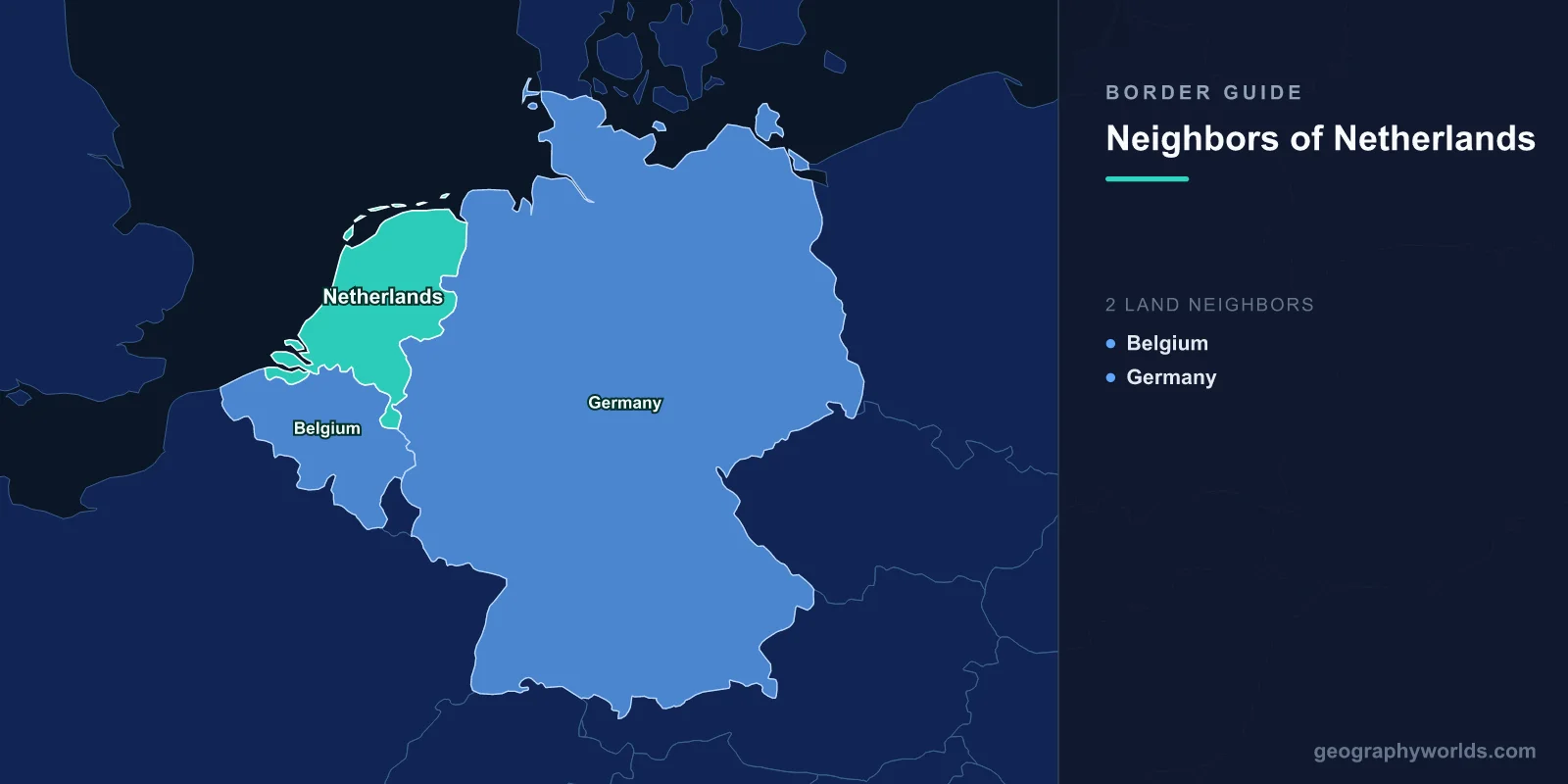
The Netherlands shares land borders with two neighboring countries: Belgium to the south and Germany to the east, with a combined land boundary of about 1,053 kilometres. Across the North Sea, the Netherlands also has a maritime neighbor in the United Kingdom. For such a small nation, the Dutch frontier is densely settled and economically busy, threading through farmland, rivers, port cities, and old fortress towns.
Belgium: The Southern Neighbor
Belgium lies directly south of the Netherlands and is the longer of the two Dutch land borders, running for roughly 478 kilometres. The boundary stretches from the North Sea coast in the west, near the Scheldt estuary, eastward across Flanders to the point where Belgium, the Netherlands, and Germany nearly converge.
This is one of the most historically tangled borders in Europe. The town of Baarle is famously split into Baarle-Nassau (Dutch) and Baarle-Hertog (Belgian), with dozens of enclaves and counter-enclaves so intricate that the international border zigzags through houses, gardens, and cafés. Front doors are sometimes labelled by country, and the line is marked with white crosses set into the pavement.
The Dutch province of Limburg narrows to just a few kilometres wide between Belgium and Germany, and the southernmost Dutch point, the Vaalserberg, sits where all three countries meet. Belgium and the Netherlands share strong economic ties, with the ports of Rotterdam and Antwerp anchoring one of the world's busiest trade corridors.
Germany: The Eastern Neighbor
Germany borders the Netherlands to the east and southeast, with a land boundary of about 575 kilometres, making it the longest single border the Dutch maintain. The frontier runs from the Ems estuary in the north, down through the agricultural plains of the eastern provinces, to the Vaalserberg tripoint in the south.
Several German federal states touch Dutch territory, including Lower Saxony and North Rhine-Westphalia. The border crosses the lower Rhine river system, and the city of Aachen, Germany, sits just across the line from the Dutch city of Maastricht. Cross-border commuting is common in this region, and the Euregio Meuse-Rhine cooperation zone formally links Dutch, German, and Belgian communities.
Trade between the two countries is immense. Germany is by far the Netherlands' largest trading partner, and goods flowing through the port of Rotterdam reach the German industrial heartland of the Ruhr via the Rhine and an extensive rail and motorway network.
The Maritime Neighbor: The United Kingdom
Although it shares no land border, the United Kingdom is the Netherlands' principal maritime neighbor across the North Sea. The two countries divide the seabed between them through agreed continental-shelf boundaries, an arrangement that governs fishing rights, shipping lanes, and offshore energy.
The North Sea between the Dutch and British coasts is dotted with oil and gas platforms and a rapidly growing fleet of offshore wind farms. Ferry routes connect ports such as Hook of Holland and Rotterdam with Harwich and Hull, and the sea has long been both a barrier and a bridge in Dutch maritime history.
A Border Shaped by Water and History
The Dutch borders are unusually flat and, in places, defined by the land's relationship with the sea. About a third of the Netherlands lies below sea level, protected by an extensive system of dikes, dunes, and pumping stations. Rivers like the Rhine, Meuse, and Scheldt enter the country from its neighbors before fanning out into the great delta that gives the country its name, meaning the "low countries."
These frontiers were settled gradually through centuries of treaties, wars, and dynastic deals, from the Eighty Years' War that separated the Dutch Republic from the southern provinces to the modern settlements of the nineteenth century, when Belgium gained independence in 1830. Today the borders are open within the European Union's Schengen Area, so travellers cross freely without passport checks.
For a deeper look at the country itself, see our netherlands country guide, which covers its geography, cities, and culture in detail.
Frequently Asked Questions
How many countries border the Netherlands?
The Netherlands has two land neighbors: Belgium and Germany. It also shares a maritime boundary with the United Kingdom across the North Sea, though no land connects them.
Which country shares the longest border with the Netherlands?
Germany shares the longest border, at roughly 575 kilometres, compared with about 478 kilometres along the Belgian frontier. Together the Dutch land borders total around 1,053 kilometres.
Where do the Netherlands, Belgium, and Germany meet?
The three countries meet at the Vaalserberg, the highest point in the European Netherlands at about 322 metres. This tripoint in southern Limburg is a popular spot for visitors who like to stand in three countries at once.
Does the Netherlands border France?
No. The Netherlands does not border France. Belgium lies between the two, separating Dutch territory from the French frontier to the south.