
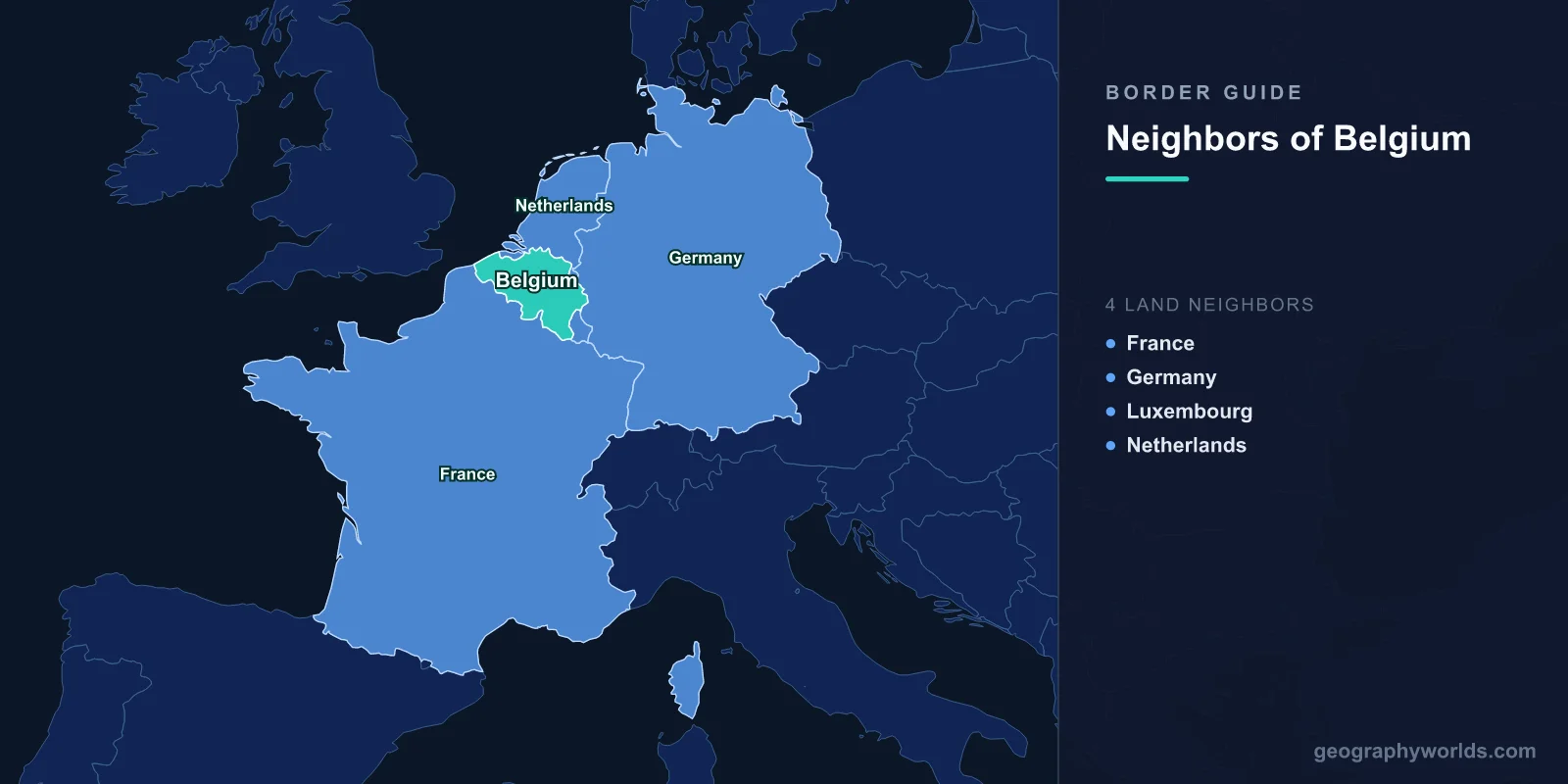
Belgium shares land borders with four neighboring countries: France, Germany, Luxembourg, and the Netherlands, totaling roughly 1,297 kilometers of frontier. Tucked into the densely populated heart of Western Europe, Belgium is a small nation with an outsized strategic position, hemmed in by some of the continent's most important states and opening onto the North Sea to the northwest.
The Four Land Neighbors at a Glance
Despite covering only about 30,500 km², Belgium touches four sovereign states. Each border reflects a different relationship and geography:
- France lies to the south and southwest and shares the longest stretch of border with Belgium, running through Wallonia's rolling farmland and the industrial corridor near Lille.
- The Netherlands sits to the north, with a long and famously intricate boundary that weaves through Flanders and the Meuse valley.
- Germany borders Belgium to the east, meeting it in the forested Ardennes and the Eupen-Malmedy region, home to Belgium's German-speaking community.
- Luxembourg, the smallest neighbor, shares a short southeastern border in the hilly Belgian province also named Luxembourg.
France and the Netherlands: The Major Frontiers
Belgium's borders with France and the Netherlands are its longest and most economically significant. The French frontier curves across the country's southern flank, separating French Flanders, Hainaut, and the Ardennes from their Belgian counterparts. Cities such as Lille sit just over the line, and the cross-border metropolitan area is so integrated that workers, students, and shoppers move freely between the two countries every day.
To the north, the Dutch border is equally busy but more unusual in its geography. It cuts through flat polder land and follows rivers and canals in places, linking the Flemish port city of Antwerp with the Dutch logistics network around Rotterdam. The region around Baarle is among the strangest borders on Earth, with Belgian and Dutch territory interlocking in a patchwork of enclaves and counter-enclaves.
Germany and Luxembourg: The Eastern Edge
The eastern borders are shorter but historically charged. Belgium's frontier with Germany runs along the High Fens plateau and the wooded Ardennes, terrain that saw heavy fighting in both World Wars, including the Battle of the Bulge in 1944. The Eupen-Malmedy cantons along this border were transferred from Germany to Belgium after World War I, which is why German remains one of Belgium's three official languages alongside Dutch and French.
Luxembourg, Belgium's closest partner in many respects, shares only a brief southeastern border. The two countries, together with the Netherlands, formed the Benelux economic union after World War II, a customs union that became a blueprint for wider European integration. You can learn more about the country itself in our belgium country guide.
The Coast and Maritime Neighbors
Belgium is not entirely landlocked. Its northwestern edge meets the North Sea along a short coastline of about 67 kilometers, anchored by the resort town of Ostend and the major port of Zeebrugge. Across this water lies the United Kingdom, Belgium's principal maritime neighbor. Ferries and the busy shipping lanes of the southern North Sea connect Belgian ports to British harbors, and the two countries share fishing waters and maritime boundaries even though no land frontier joins them.
Why Belgium's Borders Matter
Belgium's location at the crossroads of Germanic and Latin Europe has shaped its identity and its history. The country was a battleground in countless European conflicts, earning the grim nickname "the cockpit of Europe." Today those same crossroads make it a hub of cooperation rather than conflict. Brussels, the capital, hosts the headquarters of the European Union and NATO, a fitting role for a nation defined by its neighbors. The Schengen Agreement means most of these borders can be crossed without passport checks, and high-speed rail links Brussels to Paris, Amsterdam, Cologne, and London in just a few hours.
- Total land border length: approximately 1,297 km.
- Number of bordering countries: 4 by land, plus the UK as a maritime neighbor.
- Longest border: with France.
- Coastline: about 67 km along the North Sea.
Frequently Asked Questions
How many countries border Belgium?
Belgium borders four countries by land: France, Germany, Luxembourg, and the Netherlands. It also shares a maritime boundary with the United Kingdom across the North Sea.
Which country shares the longest border with Belgium?
France shares the longest land border with Belgium, stretching across the country's southern and southwestern edge through Wallonia and Flanders.
Is Belgium landlocked?
No. Belgium has a short North Sea coastline of about 67 kilometers in the northwest, where ports like Zeebrugge and the resort of Ostend are located.
What is unusual about the Belgium-Netherlands border?
The town of Baarle is split into dozens of Belgian and Dutch enclaves and counter-enclaves, creating one of the most complex international borders in the world, where the boundary can run straight through houses and cafes.