

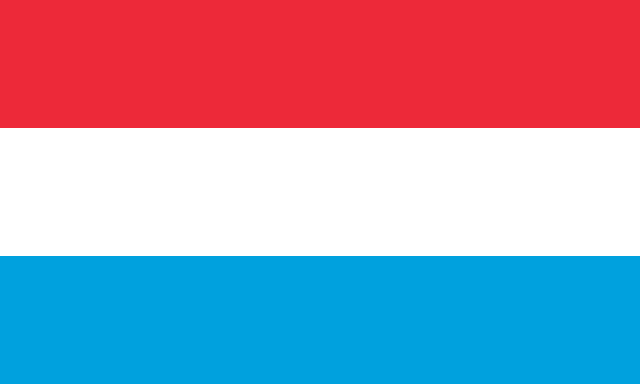
At first glance, the flag of Luxembourg looks like it might have been borrowed from a neighbor a few hundred kilometers to the north. Three horizontal bands of red, white, and a clear sky-blue stack neatly on top of one another, and travelers who know their European banners often do a double take. Yet this simple horizontal tricolor belongs to one of the continent's smallest and oldest sovereign territories, a Grand Duchy wedged between Belgium, France, and Germany. The story behind those three stripes reaches back centuries into a medieval dynasty, and the reason the blue looks the way it does is the result of a very deliberate decision to be unmistakable. This is a flag that hides a surprising amount of identity in three plain bars of color.
Three Bands, One Clear Identity
The design could hardly be simpler: a horizontal triband with red on top, white in the middle, and light blue along the bottom. There are no charges, no crests, no central emblem to study. The whole composition relies on proportion and color alone, which is exactly the kind of restraint that makes a flag instantly readable from a distance or fluttering at the top of a pole. Each stripe occupies an equal share of the field, giving the banner a balanced, orderly appearance that mirrors the small nation's reputation for stability and quiet confidence.
What sets this layout apart from the dozens of other tricolors flown around the world is not the arrangement but the particular shade of the bottom band. Where many flags reach for a deep navy or royal blue, Luxembourg's blue is noticeably lighter, almost the color of a bright midday sky. That choice is intentional, and as we'll see, it solves a genuine identity problem that the Grand Duchy faced for generations.
Where the Colors Come From
The red, white, and blue did not appear out of thin air. They were drawn directly from the coat of arms of the House of Luxembourg, the medieval dynasty whose name the country still carries. That historic shield featured a red lion rampant, crowned and with a forked tail, set against a field of horizontal white and blue stripes. When the modern nation needed a flag, it distilled those heraldic colors into three clean bands, carrying the imagery of the old counts and dukes into a form fit for the modern age.
Because the palette is rooted in heraldry rather than in a list of assigned meanings, Luxembourgers tend not to attach a fixed slogan to each stripe the way some nations do. The colors stand instead for continuity, for a lineage that stretches back to the Middle Ages and survived through empires, partitions, and two world wars. In that sense the flag is less a statement of abstract ideals and more a living link to the dynasty that gave the country its name and, eventually, its independence.
How the Flag Took Its Official Form
The tricolor had been in popular use long before it was ever written into law. Versions of the red-white-blue banner appeared during the early nineteenth century as Luxembourgers reached for a symbol of their own, distinct from the larger powers that repeatedly absorbed or administered their territory. For a long stretch, however, the flag existed by custom rather than by statute, and its exact shades were never pinned down with any precision.
That changed in 1972, when the design was formally defined by law. The most important consequence of that legislation was the specification of the blue: it was set as a distinctly light blue, deliberately separating Luxembourg's banner from the darker blue of a very similar northern flag. Codifying the colors gave the country an official, reproducible standard, ensuring that every flag flown from a government building or sewn for a national holiday would share the same crisp, sky-toned bottom stripe rather than drifting toward navy.
The Netherlands Look-Alike Problem
No discussion of this flag is complete without addressing the elephant in the room: its striking resemblance to the flag of the Netherlands. Both are horizontal tricolors of red, white, and blue, and at small sizes or in poor light they can be genuinely hard to tell apart. The fun fact most people learn first about Luxembourg's flag is precisely this near-twinning. The crucial distinction lies in that bottom band. The Netherlands uses a deep, cobalt blue, while Luxembourg uses a markedly lighter, brighter blue. Luxembourg's red also tends to run a touch more toward a vivid, lighter scarlet.
This look-alike issue is more than a trivia point. It was a real source of frustration, and over the years it prompted serious public debate about whether the country should adopt a more clearly unique national emblem. The proposed alternative was the so-called Roude Léiw, or Red Lion banner, derived from the same heraldic coat of arms and showing the crowned red lion on a white-and-blue striped field. Despite repeated discussion, the traditional tricolor has held its place as the official national flag, with the lion banner serving more as a popular civil and sporting symbol. To learn more about the nation itself, see our luxembourg country guide.
A Symbol Woven Into National Life
For a country of modest size, Luxembourg flies its colors with real enthusiasm. The tricolor appears on government buildings, at the seat of the Grand Duke, and across the streets during national celebrations. The biggest of these is National Day, observed in June to honor the official birthday of the reigning monarch, when towns light up with fireworks, torchlight processions, and a sea of red, white, and light blue. Balconies and shopfronts drape themselves in the flag, and the lighter Red Lion banner often appears right alongside it.
Sport offers another stage where the colors come alive. Fans backing the national football and cycling teams wave both the tricolor and the lion flag, and the sky-blue stripe becomes a small but proud marker of who they are among the crowds of larger nations. In a region where borders are crossed daily for work and trade, the flag remains a compact, confident assertion that the Grand Duchy is its own place with its own long history, not merely a sliver of land between bigger neighbors.
Quick Facts Worth Knowing
- The flag is a horizontal tricolor of red, white, and light blue, with the three bands of equal height.
- Its colors come from the historic coat of arms of the House of Luxembourg, featuring a crowned red lion on a white-and-blue striped field.
- The design was formally defined by law in 1972, which fixed the blue as a distinctly light shade.
- It closely resembles the flag of the Netherlands, but Luxembourg's blue is lighter and its red slightly brighter.
- Luxembourg sits in Western Europe, bordered by Belgium, France, and Germany.
- An alternative Red Lion banner is widely used as a civil and sporting symbol but is not the official national flag.
Frequently Asked Questions
When was the flag of Luxembourg adopted?
The red-white-blue tricolor had been used informally since the early nineteenth century, but it was officially defined by law in 1972. That legislation standardized the design and, importantly, specified the bottom stripe as a light blue to distinguish it clearly from similar flags.
What do the colors of the Luxembourg flag mean?
The red, white, and blue are taken from the coat of arms of the House of Luxembourg, the medieval dynasty that gave the country its name. Rather than each color carrying a separate assigned meaning, together they represent the nation's historic lineage and continuity.
Why does Luxembourg's flag look like the flag of the Netherlands?
Both are horizontal red-white-blue tricolors, so the resemblance is real. The key difference is the shade of blue: Luxembourg uses a lighter, sky-toned blue, while the Netherlands uses a deep cobalt. Luxembourg's red also tends to be a little brighter. The 1972 law made the lighter blue official precisely to keep the two flags distinct.
What continent is Luxembourg on?
Luxembourg is in Western Europe. It is a small landlocked Grand Duchy sharing borders with Belgium, France, and Germany, and despite its size it is a founding member of several major European institutions.