

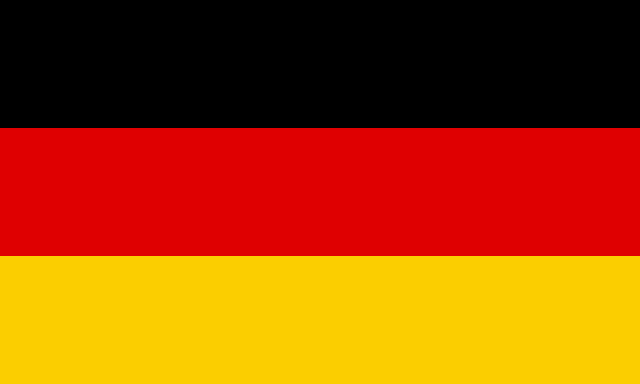
Few flags carry their meaning quite as openly as Germany's. The three horizontal bands of black, red, and gold known to Germans as Schwarz-Rot-Gold are not a decorative arrangement chosen for balance or heraldic tradition. They are a statement about how a nation wishes to see itself: united, free, and democratic. For a country whose modern history includes empire, dictatorship, division, and reunification, that simple tricolor functions as a quiet declaration that the better impulses of German history have prevailed. The flag that flies over the Reichstag today is the same banner that idealists once carried in defiance of monarchs, and that makes it one of the more meaningful tricolors in Europe.
A Tricolor of Three Equal Bands
The design could hardly be more straightforward. The flag is divided into three horizontal stripes of equal width: black on top, red in the middle, and gold at the bottom. The official proportions are 3:5, slightly more elongated than the square-ish banners some nations prefer. There are no emblems, no stars, no coats of arms cluttering the field, just three clean bands running edge to edge.
That restraint is deliberate and, in the German case, historically loaded. The plain civil flag belongs to the people, while government authorities use a version bearing the federal eagle shield. The everyday flag you see waved in stadiums and hung from balconies is the unadorned tricolor. Its simplicity is part of its strength, instantly recognizable and impossible to confuse with a busy ceremonial standard.
What Black, Red, and Gold Actually Mean
The colors are usually said to stand for unity, freedom, and democracy, but the story behind them is more vivid than that abstract summary suggests. The most enduring explanation traces the palette to the uniforms of the Lützow Free Corps, a volunteer unit that fought against Napoleon's forces in 1813. Their coats were black, their facings red, and their buttons gold. Soldiers drawn from across the German lands wore the same colors regardless of which principality they came from, and so the combination came to embody the idea of a single German people rather than a patchwork of rival states.
It is worth being precise about the colors themselves. The official shades are standardized as RAL 9005 for the black, RAL 3020 for the red, and RAL 1021 for the gold. That last one is, technically, a shade of yellow. Germans call the bottom band gold because of what it represents, the gleam of those uniform buttons and the brightness of national aspiration, even though on the color charts it is registered as a warm yellow rather than a metallic gold.
From Student Banners to the Federal Republic
The black-red-gold combination rose to prominence with the German national movement of the early nineteenth century. University students and members of patriotic fraternities adopted the colors as they campaigned for a unified, constitutional Germany in place of the dozens of separate states left after the Napoleonic Wars. To wave black, red, and gold in that era was a political act, a demand for liberty and unity that monarchs viewed with suspicion.
The tricolor's fortunes rose and fell with German democracy itself. It was embraced during the revolutionary stirrings of 1848 and later became the flag of the Weimar Republic from 1919 to 1933. When the Nazi regime took power, the black-red-gold was cast aside in favor of the party's own banner, an erasure that made the colors all the more potent as a symbol of the freedom that had been lost. After the Second World War, West Germany restored the tricolor, officially adopting it on May 23, 1949. When the country reunified in 1990, there was never any question about which flag would represent the whole nation. Black, red, and gold simply continued, now flying over a single Germany once more.
The Look-Alikes and How to Tell Them Apart
Germany's palette is shared by a small club of European flags, and confusion is easy if you are not paying attention to orientation. Belgium uses the very same three colors, black, red, and gold, but arranges them in vertical bands rather than horizontal stripes. Hold the two side by side and the difference is obvious; glance quickly and you might mix them up. The vertical-versus-horizontal distinction is the single most reliable tell.
Austria, often listed alongside Germany as a related flag, is actually a different design entirely, using red and white horizontal bands rather than the black-red-gold scheme, a reminder that geographic neighbors do not always share a visual vocabulary. Within Germany's own history, the closest look-alike was East Germany's flag, which used identical black, red, and gold stripes but added a distinctive coat of arms in the center to mark the socialist state apart. The contrast that Germans themselves find most meaningful, though, is with the black-white-red of the old Imperial era and the symbols of the Nazi years. Choosing black-red-gold was, and remains, a deliberate alignment with the democratic strand of German history rather than the authoritarian one.
A Symbol Germans Learned to Wave Again
For decades after the war, many Germans felt a deep ambivalence about openly displaying national symbols. Patriotic flag-waving carried uncomfortable associations, and the tricolor was respected more than it was celebrated. That changed dramatically when Germany hosted the 2006 FIFA World Cup. Almost spontaneously, flags appeared on cars, faces, balconies, and beer gardens across the country, and the mood was festive rather than nationalistic. Commentators described it as the first time since the war that ordinary Germans embraced their flag without unease. The national football team had long worn the colors, but the World Cup turned private pride into a cheerful public phenomenon.
In civic life the flag flies over government buildings and features prominently on German Unity Day, October 3, which marks reunification. If you want the broader context of the country behind the banner, our germany country guide covers its regions, culture, and landmarks in depth. The flag remains a fixture of official ceremony, but since 2006 it has also become an accepted part of everyday celebration.
Interesting Facts at a Glance
- Germans refer to their flag simply as Schwarz-Rot-Gold, naming the colors top to bottom.
- The "gold" band is officially registered as a shade of yellow (RAL 1021), though it symbolizes gold.
- The colors are widely traced to the black coats, red facings, and gold buttons of the Lützow Free Corps in 1813.
- East Germany used the identical color scheme but added a coat of arms to distinguish its flag.
- Belgium shares the same three colors but arranges them vertically rather than horizontally.
- The 2006 World Cup, hosted in Germany, marked a turning point in how openly Germans displayed the flag.
Frequently Asked Questions
When was the German flag adopted?
West Germany officially adopted the black-red-gold tricolor on May 23, 1949. The colors themselves had been used much earlier, including by the Weimar Republic, but 1949 marks the adoption of the modern federal flag, which continued unchanged after reunification in 1990.
What do the colors black, red, and gold mean?
They are generally said to represent unity, freedom, and democracy. The combination is most often linked to the uniforms of the Lützow Free Corps who fought Napoleon in 1813, whose black cloth, red facings, and gold buttons came to symbolize a single German people striving for liberty.
What continent is Germany on?
Germany is located in Europe, specifically in Central Europe, sharing borders with nine neighboring countries and lying at the heart of the continent.
How is the German flag different from Belgium's?
Both flags use black, red, and gold, but the arrangement differs. Germany's stripes run horizontally with black on top, red in the middle, and gold at the bottom, while Belgium's bands are vertical. That orientation is the quickest way to tell the two apart.