
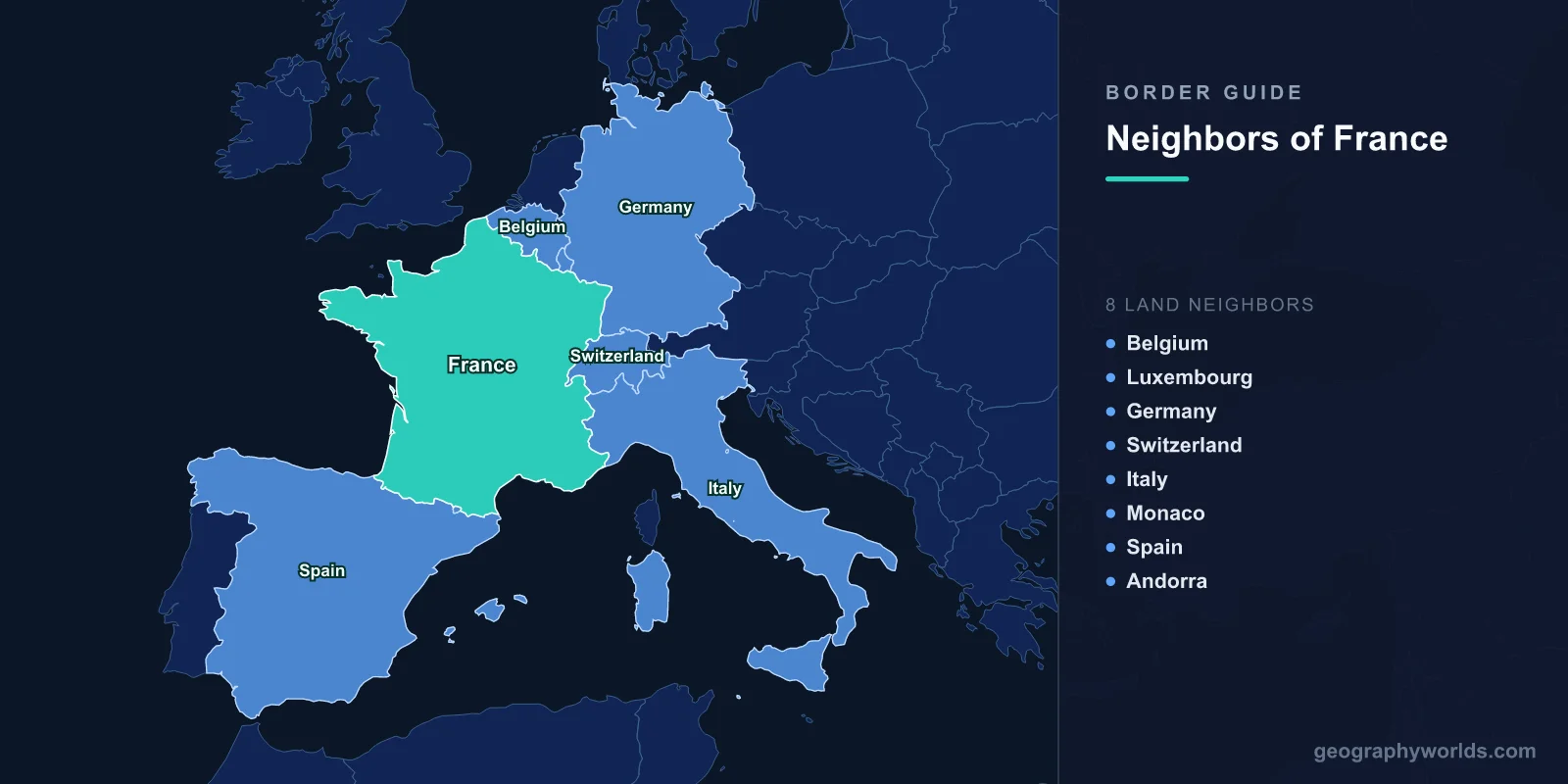
France shares land borders with eight countries: Belgium, Luxembourg, Germany, Switzerland, Italy, Monaco, Spain, and Andorra. Together these frontiers stretch for roughly 2,751 kilometres, wrapping around the hexagonal shape of mainland France from the North Sea coast down to the Mediterranean and across the Pyrenees. No other country in Western Europe touches quite so many neighbors on its mainland.
The Eight Land Neighbors at a Glance
France's neighbors range from one of Europe's largest economies to two of the world's smallest sovereign states. Listed clockwise from the northeast, they are:
- Belgium — to the north, sharing a roughly 620 km border that runs through Flanders and the Ardennes.
- Luxembourg — a tiny border of about 73 km in the northeast, France's shortest land frontier with a fully independent neighbor.
- Germany — along the Rhine to the east, a frontier of roughly 450 km defining the historic Alsace-Lorraine region.
- Switzerland — about 525 km through the Jura mountains and around Lake Geneva.
- Italy — some 515 km along the high Alps, including the slopes of Mont Blanc.
- Monaco — a micro-state of about 6 km of border, entirely surrounded by France on its land sides.
- Spain — roughly 650 km along the Pyrenees, the longest of France's mountain borders.
- Andorra — a small Pyrenean principality with about 55 km of shared frontier.
Northern Borders: Belgium, Luxembourg and Germany
France's northern and northeastern edges face some of Europe's most densely populated and industrialized land. The border with Belgium crosses flat farmland and former coalfields, and the two countries share deep cultural ties, including the French language spoken in Wallonia. Luxembourg, though tiny, is a major commuter destination: tens of thousands of French residents cross the border each day to work in its banking and EU institutions.
The frontier with Germany is among the most historically charged in Europe. The Rhine forms much of the natural boundary, and the regions of Alsace and Lorraine changed hands repeatedly between France and Germany across the 19th and 20th centuries. Today the border is open and largely invisible thanks to the Schengen Agreement, and Strasbourg sits as a symbol of Franco-German reconciliation, hosting the European Parliament.
Eastern and Alpine Borders: Switzerland, Italy and Monaco
Moving south, France meets Switzerland through the forested Jura ranges and along the shores of Lake Geneva, where the Swiss city of Geneva is almost encircled by French territory. The Alpine border with Italy climbs to dramatic heights, passing the summit of Mont Blanc — Western Europe's tallest peak at 4,808 metres — whose exact border line has long been a subject of friendly dispute. The Mont Blanc and Fréjus road tunnels link the two nations beneath the mountains.
Monaco is unique among France's neighbors: the principality is bordered by France on all of its land sides and by the Mediterranean on the other. Despite covering barely two square kilometres, Monaco is a fully sovereign state with its own monarchy, and France handles much of its defense under longstanding treaties.
Southern Borders: Spain and Andorra
Along the south, the Pyrenees form a formidable natural wall between France and the Iberian Peninsula. The border with Spain is the longest mountain frontier France has, running from the Atlantic coast near Biarritz to the Mediterranean near Perpignan, crossing Basque and Catalan cultural regions on both sides. Tucked high in these mountains is Andorra, a co-principality whose two heads of state are the President of France and a Spanish bishop — a medieval arrangement that survives to this day. For more on the country itself, see our france country guide.
Overseas and Maritime Neighbors
France's borders extend far beyond Europe. Through the overseas department of French Guiana in South America, France shares land borders with Brazil and Suriname — meaning France technically borders countries on two continents. Across the English Channel, France is a close maritime neighbor of the United Kingdom, connected since 1994 by the Channel Tunnel running beneath the sea between Calais and Folkestone.
The Channel Tunnel Counts as a Border
France and the United Kingdom share no land frontier, but the Channel Tunnel created something close to one. Since 1994 the two countries have operated juxtaposed controls, meaning British officers check passengers in Calais and Coquelles and French officers do the same at Dover and St Pancras.
The legal basis is the Le Touquet treaty of 2003, which effectively moved the British border onto French soil. It is the reason migrant encampments formed around Calais rather than on the English coast, and the arrangement has been a recurring subject of Franco-British negotiation since.
The undersea section runs about 38 kilometres, the longest of any tunnel in the world, and the notional border sits at the midpoint beneath the seabed.
The Shortest Border of All
France's shortest land frontier is with Monaco at roughly four kilometres, and its second shortest with Andorra at around 57. Both are walkable in an afternoon, which is a reminder that border length and political significance have little to do with each other.
By contrast the frontier with Spain runs some 620 kilometres along the Pyrenees, and the one with Brazil in South America is longer still.
Schengen Made Most of Them Invisible
The 1985 Schengen Agreement was signed on a boat moored on the Moselle at the point where France, Germany and Luxembourg meet, and it removed systematic checks at almost all of these frontiers.
In practice that means crossing from Strasbourg into Kehl, or from Menton into Ventimiglia, involves no formality at all, and tens of thousands of people commute across the borders daily. Around a third of Luxembourg's workforce lives in France, Belgium or Germany and drives in each morning.
The exceptions are the United Kingdom, which never joined, and periodic reintroductions of checks: France has maintained border controls under the Schengen safeguard clauses since the 2015 attacks, renewed repeatedly since. Schengen and the EU are also not the same club: Switzerland is inside Schengen but outside the EU, which is why the Geneva and Basel crossings are open, while Ireland is in the EU but outside Schengen. The full membership is in our list of Schengen countries.
The Borders France Has Overseas
France has more land neighbours than the eight in Europe, because its overseas departments are full parts of the republic rather than colonies. French Guiana in South America borders Brazil and Suriname, which makes Brazil France's longest land border at roughly 730 kilometres, longer than any of its European frontiers.
Saint Martin in the Caribbean is divided with the Kingdom of the Netherlands along a line agreed in 1648, one of the oldest continuously observed borders in the world.
These are not technicalities. The overseas departments use the euro, elect members to the National Assembly and are part of the European Union, so the EU's external frontier runs through the Amazon.
Andorra and Monaco Are Neighbours Too
Alongside the large neighbours sit two microstates. Andorra, in the Pyrenees, is a co-principality whose two heads of state are the President of France and the Bishop of Urgell in Spain, an arrangement dating from a 1278 settlement between feuding counts and bishops.
Monaco, on the Mediterranean, is surrounded by France on all three land sides and depends on it for defence under a treaty relationship going back to 1861. Both use the euro without being EU members.
Counting them, France borders eleven states in Europe and South America combined, which is more than any other EU country.
The Mountains Do Most of the Work
Three of France's borders follow mountain ranges, and the effect on history is direct. The Pyrenees separate it from Spain along a crest line fixed by the Treaty of the Pyrenees in 1659; the Alps divide it from Italy and Switzerland; the Jura run along part of the Swiss frontier.
Those ranges made invasion difficult from the south and east and concentrated centuries of military attention on the one flat approach, the North European Plain through Belgium. That is the route taken in 1914 and again in 1940, and it is why the Maginot Line was built to cover the German frontier while the Ardennes was assumed impassable.
The Mont Blanc tunnel, opened in 1965, and the Frejus tunnel were the first reliable year-round road crossings of the Alpine border, which had previously closed with the snow. The Pyrenean line has its own oddity: Llívia, a Spanish town of about 1,500 people, sits entirely inside France, because the 1659 treaty transferred villages to France and Llívia was a town. The range itself is covered in our guide to the Pyrenees.
Common Questions About France's Borders
How many countries border France?
France borders eight countries by land in mainland Europe: Belgium, Luxembourg, Germany, Switzerland, Italy, Monaco, Spain, and Andorra. Counting its overseas territory of French Guiana, France also borders Brazil and Suriname.
What is France's longest border?
France's longest border with a single country is its frontier with Spain along the Pyrenees, at roughly 650 km. Belgium's northern border is a close second at around 620 km.
Which is France's shortest border?
Among independent states, Monaco has the shortest land border with France at about 6 km. Luxembourg, at roughly 73 km, has the shortest border with a larger neighbor.
Does France border the United Kingdom?
France does not share a land border with the United Kingdom, but the two are maritime neighbors separated by the English Channel. They are physically linked by the underwater Channel Tunnel.