
The national flag of Suriname is one of the most distinctive banners in the Americas, instantly recognizable for its bold central red band crowned with a single golden star. Hoisted for the first time when this small South American nation broke free from Dutch rule, the flag was designed to do something deliberate and difficult: speak for a population that traces its roots to four different continents. With its layered horizontal stripes and a five-pointed star at the heart, the design manages to be both visually simple and densely meaningful, a deliberate statement that unity could be built from extraordinary diversity.
A First Look at the Design
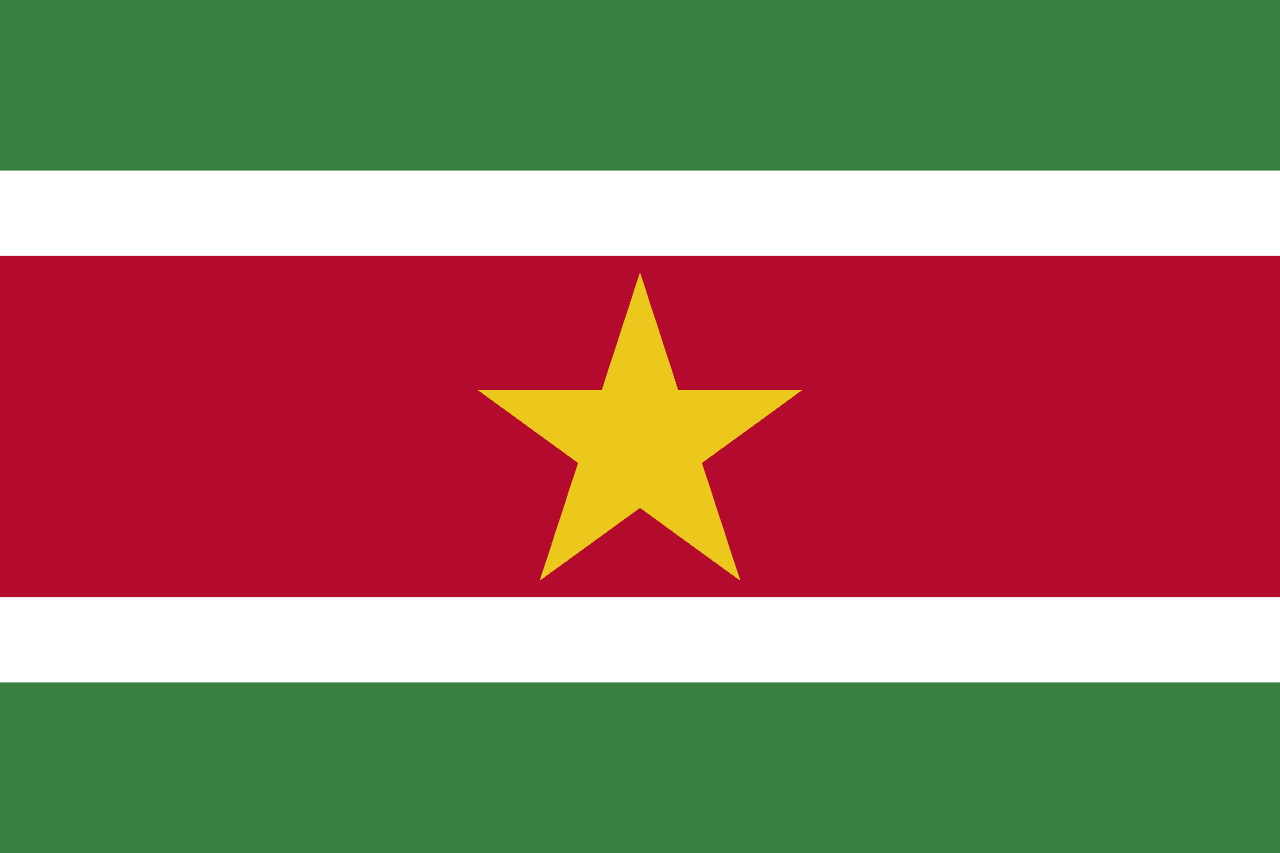
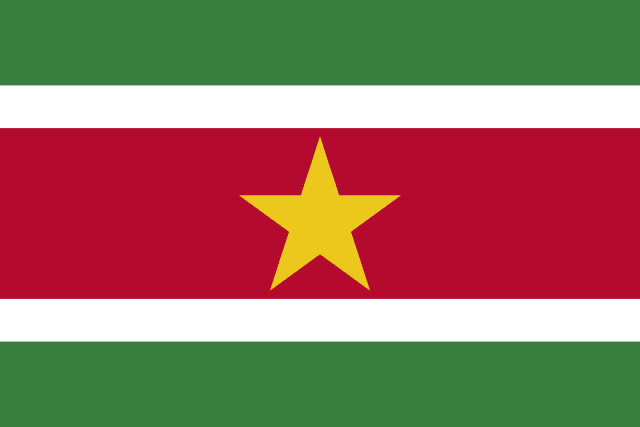
Suriname's flag is a horizontal band design composed of five stripes of unequal width. Reading from top to bottom, a narrow green stripe sits above a thinner white stripe, followed by a broad red band running through the center, then another thin white stripe and finally a narrow green stripe to close the field. The two white stripes act as crisp dividers, framing the dominant red and giving the whole composition a balanced, layered look.
Resting precisely in the middle of the central red band is a single yellow five-pointed star. Because the red stripe is by far the widest element, the star has room to stand alone and command attention rather than competing with the surrounding colors. The result is a flag that is easy to draw, easy to identify from a distance, and impossible to confuse with the more crowded heraldry of many neighboring states.
What the Colors Stand For
Every shade on the flag was chosen to carry meaning, and the symbolism is refreshingly clear. Green represents the fertility of the land, a fitting tribute to a country blanketed in dense rainforest and rich agricultural promise. White stands for justice and the peace that the new nation hoped to uphold. Red, occupying the largest portion of the flag, signifies progress and the sacrifice made by those who worked toward and dreamed of independence.
The yellow star is the emotional core of the design. Its golden color evokes hope and the bright future of a young republic, while the star itself stands for unity. Crucially, this is not unity in the abstract: the five points are widely understood to represent the major ethnic groups that together make up Surinamese society. In a single emblem, the flag asks a diverse people to see themselves as one.
From Colony to Republic
Suriname spent centuries under Dutch colonial administration, and its flag history is inseparable from the long road to self-rule. The banner that flies today was adopted in 1975, the very year Suriname gained its independence from the Netherlands. The timing was no accident. A flag is among the first things a new nation needs, and the design was prepared to be raised at the moment sovereignty arrived, replacing the colonial symbols that had represented the territory from abroad.
Choosing a flag for independence is always a charged exercise. The designers faced the challenge of crafting an image that did not favor any single community in a society shaped by Indigenous peoples, descendants of enslaved Africans, Maroons, and laborers who had arrived from India, Indonesia, China, and beyond. The answer was a flag built entirely on shared, neutral ideals rather than the iconography of any one group, with the star deliberately gathering everyone under a common point of light.
How It Compares to Other Flags
Suriname's flag belongs loosely to a family of banners that pair red, green, white, and a yellow star, a palette echoed in several pan-African and Latin American designs. Yet its specific arrangement keeps it from being mistaken for any of them. The unequal five-stripe structure, the unusually wide red center, and the lone yellow star together form a signature that is genuinely its own.
Within South America, most national flags rely on combinations of blue, yellow, and red, or on coats of arms and complex central emblems. Suriname's reliance on green and a single minimalist star sets it apart from neighbors like Brazil, Guyana, and Venezuela. Compared to Guyana's famous "Golden Arrowhead," with its dynamic triangles, Suriname opts instead for calm horizontal order. And while many flags use stars to count regions or states, Suriname's single star counting ethnic communities is a comparatively rare and humane use of the symbol. Readers exploring the wider region may enjoy this suriname country guide for more context on the nation behind the banner.
A Symbol of National Identity
For Surinamese citizens, the flag is shorthand for a national experiment in coexistence. In a country where you might hear Dutch, Sranan Tongo, Sarnami Hindustani, Javanese, and several Indigenous and Maroon languages spoken in a single day, the flag insists that difference need not mean division. The five-pointed star reminds people that the nation was conceived as a partnership of communities rather than the property of a majority.
That message has only grown more resonant over the decades since independence. The flag appears on government buildings, schools, and official documents, and it is treated as a unifying emblem precisely because no single group can claim it as exclusively theirs. Its colors and star speak to ideals, fertility, justice, sacrifice, and unity, that any citizen can embrace regardless of heritage.
The Flag in Everyday Life
The flag is woven into the rhythms of Surinamese public life. It flies most prominently around Independence Day on 25 November, when the nation marks its 1975 break from the Netherlands with celebrations, official ceremonies, and a sea of green, white, and red. On these occasions the star takes on extra significance as crowds reflect on the diverse society it represents.
Beyond national holidays, the banner travels with Surinamese athletes to international competitions, drapes over stadiums during football matches, and appears at cultural festivals that showcase the country's many traditions. The Surinamese diaspora, particularly large in the Netherlands, carries the flag to community events abroad, keeping it visible far beyond the country's borders. In every setting, the same compact design does the same quiet work of saying: this is who we are, together.
Interesting Facts About the Flag
- The flag was adopted in 1975, the same year Suriname became independent from the Netherlands.
- Its five-pointed yellow star represents the unity of the country's five major ethnic groups.
- The central red stripe is the widest element, giving the lone star a stage of its own.
- Green stands for fertility, white for justice, and red for progress and sacrifice.
- Suriname sits in South America, yet its flag's green-and-star palette looks little like its continental neighbors.
- The design is intentionally neutral, avoiding any imagery tied to a single community.
Frequently Asked Questions
When was the flag of Suriname adopted?
The flag was adopted in 1975, the same year Suriname gained independence from the Netherlands. It was prepared specifically to be raised at the moment of sovereignty, replacing the symbols of the colonial era.
What do the colors of the Suriname flag mean?
Green represents the fertility of the land, white stands for justice, and red signifies progress and the sacrifice made on the road to independence. The yellow star symbolizes hope and the unity of the nation's people.
Why does the Suriname flag have a star?
The single golden five-pointed star sits at the center of the flag to represent national unity. Its five points are understood to stand for the five major ethnic groups that together form Surinamese society, expressing the ideal of many peoples joined as one.
What continent is Suriname on, and how does its flag compare to others?
Suriname is located in South America. Its flag's emphasis on green and a minimalist lone star sets it apart from most neighbors, which favor blue, yellow, and red or detailed coats of arms. While it shares a red-green-white-and-star palette with some other world flags, its unequal five-stripe layout and wide central band make it unmistakable.