
Few flags pack as much political drama into a few horizontal stripes as the flag of Venezuela. At first glance it is a clean tricolor of yellow, blue, and red, brightened by a graceful arc of white stars set into the central band. Look closer, though, and you find a banner that has been redrawn, debated, and legislated more than once, most recently in 2006 when an eighth star joined the constellation. Behind its tidy geometry sits a story that reaches back to the wars of independence, the dream of a united South America, and the founding figures who first raised these colors against Spanish rule.
This is a flag that Venezuelans treat as living history rather than decoration. Its stripes echo across an entire region, its stars are counted with pride, and its symbolism is taught to schoolchildren as a kind of national catechism. Understanding it means understanding how Venezuela sees itself: heir to a revolutionary ideal, custodian of its provinces, and a country still arguing, in the most literal sense, over what its emblem should contain.
A Tricolor Born of Revolution
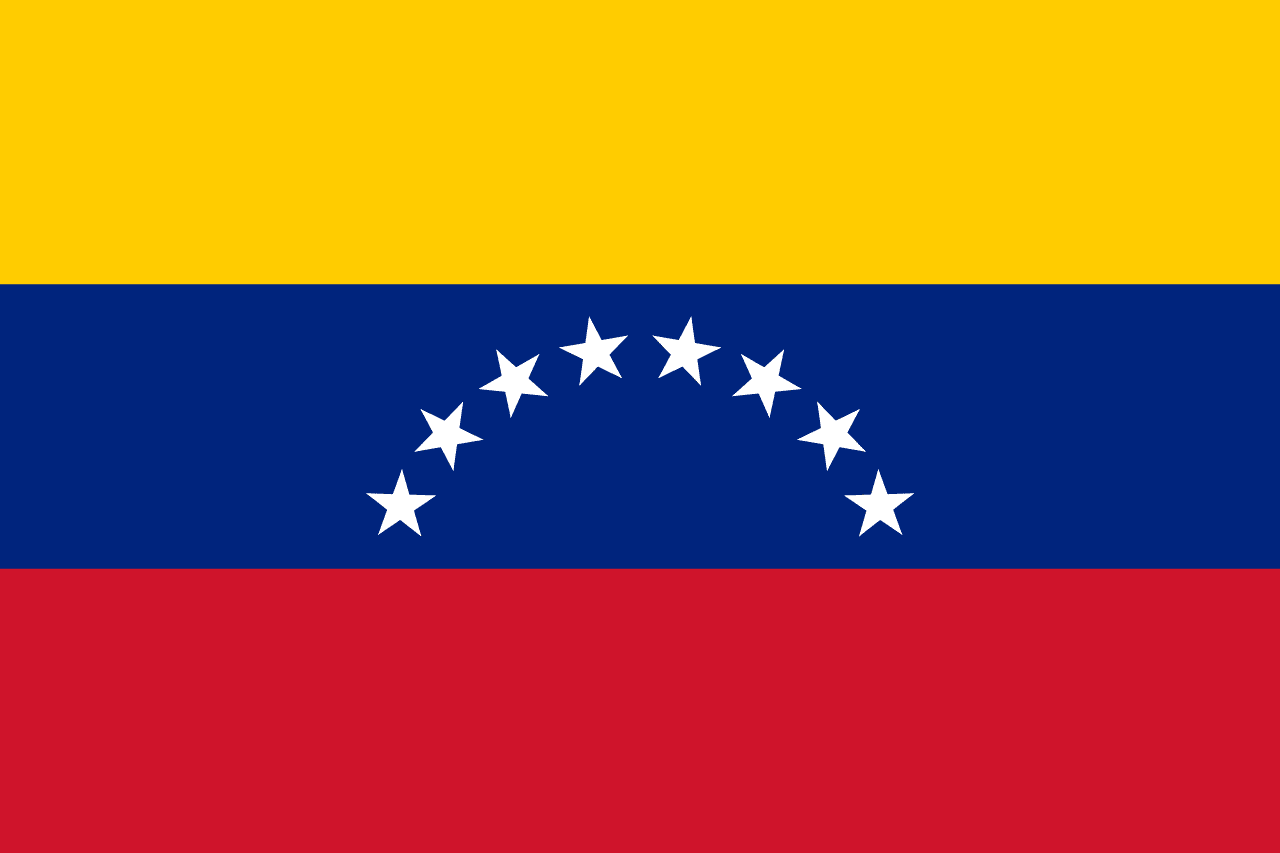
The Venezuelan flag is a horizontal triband of three equal stripes: yellow on top, blue in the middle, and red at the bottom. These three colors are the inheritance of Gran Colombia, the short-lived republic that once united Venezuela, Colombia, Ecuador, and Panama under a single banner in the early nineteenth century. When that union dissolved, each successor nation kept the yellow-blue-red palette but went its own way with the details. Venezuela's version preserved the original sequence and added the touches that make it instantly recognizable today.
The design owes its origin to Francisco de Miranda, the precursor of South American independence, whose tricolor became the seed of the modern flag. Over the decades that followed, Venezuela layered new elements onto Miranda's foundation: a coat of arms in the upper hoist corner used on the state flag, and the row of stars that has become the banner's signature feature. The current flag is best described as a modified version of the Miranda flag, faithful to the revolutionary colors while carrying meaning that later generations attached to it.
What the Colors and Stars Stand For
Every band carries a meaning that has been passed down and popularized in patriotic teaching. The yellow stripe is traditionally read as the wealth of the land, the gold and fertile riches of Venezuelan soil. The blue represents the sea, specifically the ocean that separates Venezuela from Spain, a deliberate symbol of independence and the distance the new nation placed between itself and the colonial power. The red stands for the courage and the blood shed by the patriots who fought for that freedom.
The most discussed element, though, is the arc of eight white stars sitting in the blue band. The stars represent the provinces that joined the original 1811 declaration of independence. For most of the modern era the flag carried seven stars. In 2006 an eighth star was added, restoring a star associated with the Guayana province in line with a wish long attributed to the liberator Simón Bolívar. That single addition turned a familiar flag into a current one, and it is why the country's own fun fact about the banner is simply this: the present version has eight stars.
How the Design Is Arranged
The geometry is straightforward, which is part of its strength. Three stripes of equal height stack horizontally, giving the flag a balanced, stable proportion. The eight stars are arranged in a gentle upward-curving semicircle centered in the blue band, evenly spaced so the eye reads them as a single sweeping arc rather than a scattered cluster.
Venezuela actually maintains more than one official variant. The civil flag shows only the stripes and the stars. The state and naval ensign adds the national coat of arms in the canton, the upper corner nearest the flagpole, featuring a wheat sheaf, weapons, a galloping white horse, and other heraldic devices. For everyday public use and the version most people picture, the plain starred tricolor is what flies from balconies, stadiums, and government buildings.
The Andean Family and Its Look-Alikes
Anyone who has glanced at a map of South American flags knows that Venezuela does not stand alone in its color scheme. Colombia and Ecuador share the same yellow-blue-red ancestry, all three descending from the Gran Colombia banner. The resemblance is no accident; it is a family portrait of nations that were once a single country.
The differences, however, are clear once you know what to look for. Colombia uses unequal stripes, with a broad yellow band taking up the top half of the flag and thinner blue and red bands below, and it carries no stars or emblem in its civil form. Ecuador shares Colombia's wide-yellow proportions but places an elaborate coat of arms with a condor and Mount Chimborazo in the center. Venezuela is the one with three equal stripes and the unmistakable arc of stars. So while a quick glance might lump these three together, the star arc is Venezuela's fingerprint. The shared palette tells the story of unity; the distinguishing details tell the story of three separate nations that grew from it.
A Banner Woven Into National Identity
In Venezuela the flag is inseparable from the cult of independence and the figure of Bolívar himself. The colors are explained to children with the same phrases generation after generation, and the eight stars are recited as a roll call of the provinces that dared to break from Spain. This continuity makes the flag a teaching tool as much as a symbol, a compact lesson in geography and history that hangs on classroom walls.
It is also a flag that has been pulled into contemporary politics. Because the 2006 change came amid intense national debate, the banner can read differently to different Venezuelans depending on how they view that era. Yet across those divisions, the underlying tricolor and the meaning of its colors remain shared ground, the common inheritance that unites people who disagree about almost everything else. To understand the country behind the colors, the venezuela country guide offers a fuller picture of its geography and culture.
The Flag in Everyday Modern Life
The flag appears wherever Venezuelans gather. Flag Day is observed on the twelfth of August, commemorating the date in 1806 when Miranda first raised his tricolor on Venezuelan soil, and it brings out parades, school ceremonies, and public displays of the colors. Independence celebrations in early July fill streets and balconies with yellow, blue, and red.
Sport is another stage where the flag lives loudly. Baseball is something close to a national religion in Venezuela, and the colors travel with players and fans far beyond the country's borders, draped in stadiums from the Caribbean to the major leagues. Among the large Venezuelan communities abroad, the starred tricolor has become a portable piece of home, waved at concerts, rallies, and reunions. Whether stitched onto a uniform or painted on a face, the flag does the same work it has always done: it says, instantly and without words, where someone is from.
Interesting Facts at a Glance
- The yellow-blue-red colors come directly from Gran Colombia, shared today with Colombia and Ecuador.
- The flag's lineage traces to Francisco de Miranda, the precursor of South American independence.
- The current eight-star version was adopted in 2006, adding a star linked to Guayana province.
- The stars represent the provinces that backed the 1811 declaration of independence.
- Venezuela has separate civil, state, and naval versions, with the coat of arms appearing only on the official variants.
- Flag Day falls on August 12, marking Miranda's first raising of the tricolor in 1806.
- The blue stripe symbolizes the ocean dividing Venezuela from Spain, a deliberate emblem of independence.
Frequently Asked Questions
When was the Venezuelan flag adopted?
The current version of the flag was adopted in 2006, when an eighth star was added to the blue band. The underlying yellow-blue-red tricolor is far older, descending from the flag of Francisco de Miranda and the Gran Colombia era of the early nineteenth century, but the modern eight-star design dates specifically to 2006.
What do the colors and stars mean?
Yellow represents the riches and fertile land of Venezuela, blue represents the sea that separates the country from Spain, and red stands for the courage and blood of those who fought for independence. The eight white stars represent the provinces associated with the original 1811 declaration of independence, with the eighth star linked to the Guayana province.
Who designed the Venezuelan flag?
The flag is a modified version of the banner created by Francisco de Miranda, the precursor of South American independence, who is credited with the original yellow-blue-red tricolor. Later modifications, including the row of stars and the eventual eighth star added in 2006, built on that foundation rather than starting from a single new designer.
What continent is Venezuela on, and how does its flag compare to similar ones?
Venezuela is in South America. Its flag closely resembles those of Colombia and Ecuador because all three share the Gran Colombia palette, but Venezuela is distinguished by three equal horizontal stripes and a curved arc of eight stars in the blue band, features neither neighbor uses in the same way.
