
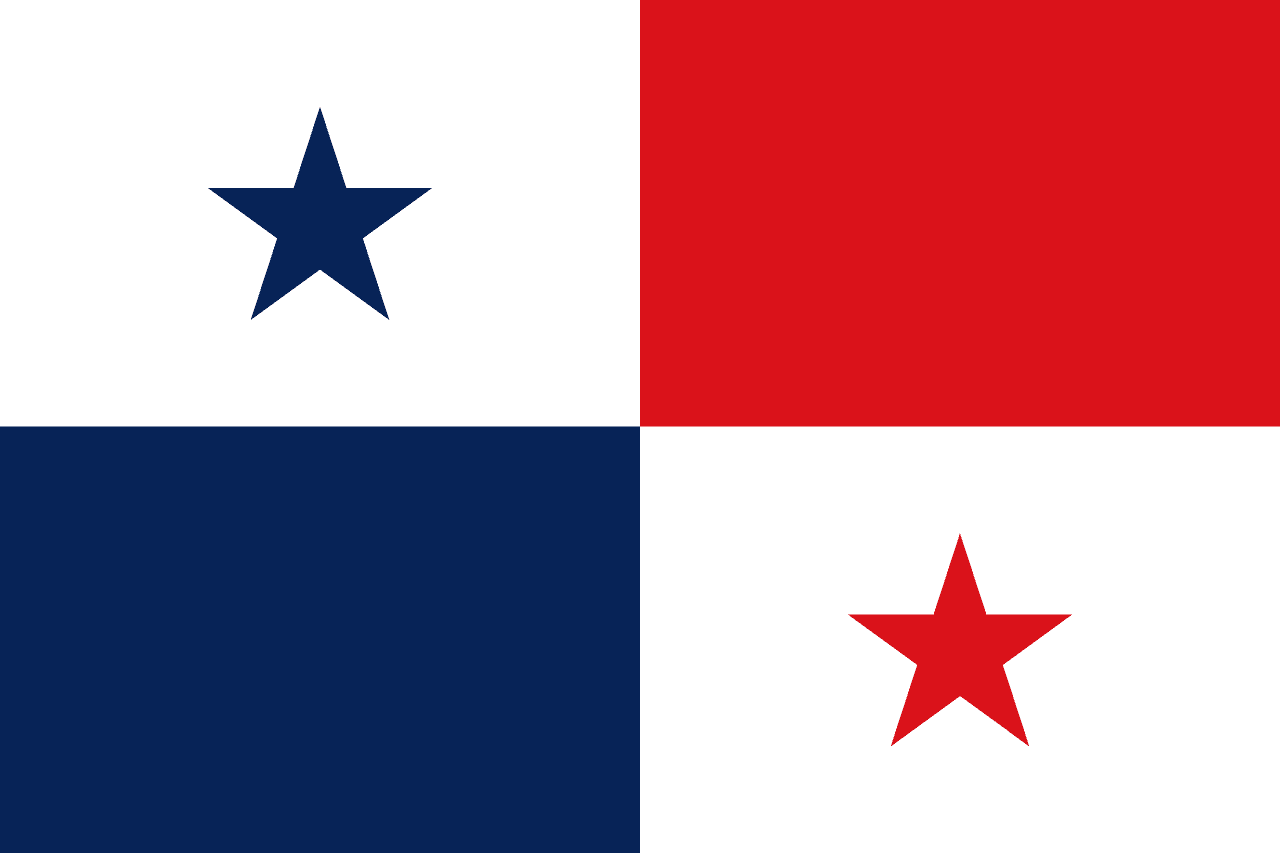
Few national banners wear their politics so openly as the flag of Panama. At first glance it is a tidy arrangement of four rectangles, two carrying a single star against white, the others filled with solid blue and red. Look a little closer, though, and the layout tells the story of a young nation trying to knit together rival factions at the very moment it declared its independence. Rather than papering over the divisions of Conservative and Liberal, the design folded both into one shared emblem, turning a quartered field into a quiet pact of reconciliation. It is a flag built less on conquest and more on compromise.
A Quartered Field Unlike Most Others
Panama's flag is divided into four equal rectangles, an arrangement vexillologists call quartered. The upper hoist quarter is white and holds a blue five-pointed star; diagonally opposite it, in the lower fly, sits a second white quarter bearing a red star. The remaining two quarters are filled with solid color: blue in the upper fly and red in the lower hoist. The result is a balanced, almost rotational symmetry where no single color dominates and the eye is drawn to the two stars set against their pale backgrounds.
This is an unusually deliberate geometry. Many flags rely on horizontal stripes or a central device, but Panama distributes its three colors across the field so that each gets roughly equal weight. The diagonal pairing of white quarters and the diagonal pairing of solid color quarters gives the design a sense of motion and balance at the same time, a visual equivalent of two opposing forces held in equilibrium.
What the Blue, Red, and White Stand For
The three colors of Panama's flag carry meanings rooted directly in the country's founding-era politics. Blue was chosen to represent the Conservative party, while red stood for the Liberal party, the two great rival movements whose feud had shaped the politics of the isthmus for decades. By giving each party its own color and its own star, the flag acknowledged both sides as legitimate parts of the new republic rather than crowning one the victor.
The white fields between them are the connective tissue of that bargain. White symbolizes peace, and the space it occupies between the partisan colors reads almost like a buffer zone, a neutral ground where the two factions might coexist. The two stars reinforce the message: they are taken to represent purity and the rule of law, the civic virtues meant to govern the nation once the partisan struggle had cooled. The blue star and the red star, each resting on white, together suggest that loyalty to country should outrank loyalty to party.
Birth of a Flag at the Birth of a Nation
Panama declared its separation from Colombia in 1903, and the question of a national flag was bound up with the larger drama of independence. The accepted account credits the design to the family of Panama's first leader, with the flag traditionally said to have been conceived by the son of the country's first president and then sewn and refined by other members of that household. The political symbolism of blue for Conservatives and red for Liberals fit the moment exactly, because the new state needed both factions to buy into the project of nationhood.
An early proposed design was reportedly more elaborate, leaning on additional stripes and motifs, but it was set aside in favor of the cleaner quartered pattern that survives today. The flag was used through the republic's first decades, and it was formally adopted as the official national flag in 1925, fixing in law the banner that Panamanians had already embraced in practice. That gap between first use and formal adoption is common among flags born in revolutionary moments, when symbols outrun the paperwork that later confirms them.
How It Compares to Other Red, White, and Blue Flags
Red, white, and blue is one of the most crowded color palettes in the world of flags, shared by the United States, France, the United Kingdom, and dozens of others. What sets Panama apart is not the palette but the structure. Where the U.S. flag uses many stars and stripes and the French Tricolore uses three vertical bands, Panama uses a four-quarter grid with exactly two stars, a layout that is genuinely rare among national flags.
The closest visual cousins tend to be flags that also employ a quartered or paneled field, yet even those rarely place isolated stars in opposite corners the way Panama does. The single-star-per-white-quarter motif gives the flag a distinctive fingerprint: a viewer who knows what to look for can spot Panama's banner instantly, even in a crowded row of similarly colored flags at an international event. The deliberate two-star, two-solid-quarter scheme is, in effect, a signature that no other major national flag duplicates. To understand how this design fits into the wider story of the isthmus, the panama country guide offers a fuller picture of the country behind the symbol.
A Symbol of National Identity
For Panamanians, the flag is inseparable from the idea of unity forged out of difference. Because its very colors encode a truce between former rivals, it functions as a standing reminder that the republic was built through reconciliation rather than the triumph of one side. That origin story gives the banner a meaning that runs deeper than decoration; it is a lesson in shared nationhood stitched into cloth.
The flag also anchors a calendar of civic devotion. Panama observes a stretch of patriotic holidays in November tied to its independence, and the national flag is central to the parades, school ceremonies, and public displays that mark those days. Generations of Panamanian students have learned the symbolism of the blue and red parties and the white of peace as a basic part of their civic education, ensuring the meaning of the design is passed down rather than forgotten.
The Flag in Everyday and Modern Life
Beyond the ceremonial calendar, Panama's flag turns up wherever the country presents itself to the world. It flies over government buildings and embassies, appears on the uniforms and kit of national sports teams, and waves in the stands when Panamanians follow their athletes at international competitions. As a hub of global shipping, Panama is also one of the most common flags seen on the open ocean, since enormous numbers of merchant vessels are registered to fly it, though that maritime ubiquity reflects ship registration rather than the patriotic display of the homeland flag itself.
In digital life the banner has become a compact piece of identity, used as an emoji, on social media, and in branding that wants to signal a Panamanian connection. Whatever the setting, the quartered field with its two stars remains immediately recognizable, a design that has aged well precisely because it was kept simple.
Interesting Facts About Panama's Flag
- The flag is quartered into four equal rectangles, a layout shared by very few national flags.
- Blue stands for the Conservative party and red for the Liberal party, making the colors an explicit nod to political reconciliation.
- The two five-pointed stars, one blue and one red, are read as symbols of purity and the rule of law.
- Design of the flag is traditionally credited to the family of Panama's first president, specifically the president's son.
- Although used from the country's founding era, the flag was formally adopted in 1925.
- Panama sits in Central America, on the narrow isthmus linking North and South America.
Frequently Asked Questions
When was the flag of Panama adopted?
Panama's flag dates to the nation's founding era around its 1903 separation from Colombia, but it was formally adopted as the official national flag in 1925. The years between first use and official adoption are why some sources cite different dates.
What do the colors of the Panama flag mean?
Blue represents the historic Conservative party and red the Liberal party, while white symbolizes the peace meant to hold between them. The two stars, one blue and one red, stand for purity and the rule of law, reinforcing the flag's theme of political reconciliation.
Who designed the flag of Panama?
The design is traditionally attributed to the family of Panama's first president, with the flag commonly said to have been conceived by the president's son and then refined and sewn within that household during the country's earliest days of independence.
What continent is Panama on, and how does its flag compare to similar ones?
Panama lies in Central America on the isthmus joining North and South America. While many countries use the red, white, and blue palette, Panama's quartered field with two opposing stars is a distinctive layout that sets it apart from striped designs like those of France or the United States.