
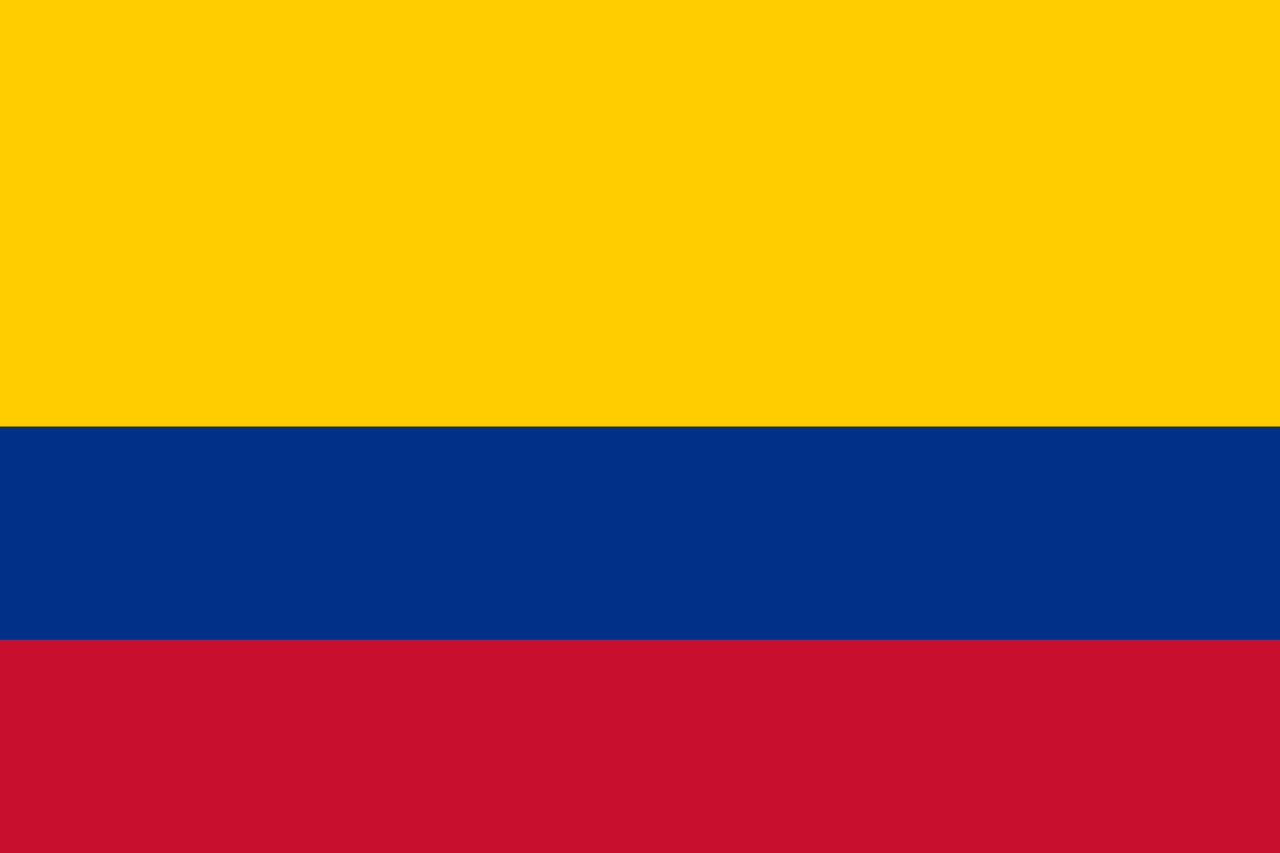

Hang the Colombian flag next to a dozen others and your eye snaps to it instantly. Most national flags split their stripes evenly, but Colombia refuses the symmetry: a broad band of gold crowns the top, claiming fully half the field, while blue and red share the remaining space in equal slivers below. That single design decision — top-heavy, golden, unmistakable — turns an ordinary tricolor into something memorable. Adopted in its modern form in 1861, the flag carries the story of a young republic that grew out of a much larger dream, and it still flies over Bogotá's plazas, Caribbean coastlines, and Andean mountain towns with the same proud weight today.
A Tricolor Built on Gold, Sea, and Sacrifice
Colombia's flag uses three colors — yellow, blue, and red — and each one is tied to a clear idea in the national imagination. Yellow stands for the country's gold and natural wealth, a nod to the mineral riches and abundant land that drew settlers and shaped the economy for centuries. Blue represents the seas that border the nation: Colombia is one of the few South American countries with coastlines on both the Pacific Ocean and the Caribbean Sea, so the color is more than poetic. Red honors the blood shed by patriots in the long struggle for independence from Spain.
That reading — gold, seas, and the blood of freedom — is the version most Colombians grow up reciting, and it gives the flag an emotional logic that matches its visual one. The colors are not arbitrary decoration; they are a compressed history lesson, repeated every time the banner is raised.
The Design: Why the Yellow Band Is So Wide
The most distinctive feature of Colombia's flag is its unusual proportions. It is a horizontal triband, but the bands are not equal. The top yellow stripe occupies one half of the entire flag, while the blue and red stripes each take up a quarter, stacked beneath it. So from top to bottom you read yellow, then blue, then red, in a ratio of roughly 2:1:1.
This is what vexillologists call an unequal or "Spanish fess" arrangement, and it is the detail that separates Colombia from look-alike designs at a glance. A flag with three even stripes reads as balanced and calm; Colombia's heavy golden crown gives the banner a sense of weight and prominence at the top, almost as if the wealth of the land is pressing down on the page. The fun consequence of this layout is simple to state: the yellow is double the width of either of the other two stripes.
From Gran Colombia to a Nation of Its Own
The flag did not spring up overnight. Its roots reach back to the early nineteenth century and the revolutionary period led by figures associated with the liberation of northern South America. The yellow-blue-red palette is famously linked to the banner carried by independence forces, and it became the flag of Gran Colombia, the large federation that briefly united territories now divided among several modern countries.
When that federation dissolved, the nations that emerged from it kept the shared color scheme but went their separate ways in arranging it. Colombia eventually settled on its distinctive half-yellow layout, formalizing the version recognizable today in 1861. The continuity is striking: the same three colors that once flew over a continental union now belong to a single republic, a visual thread connecting modern Colombia back to its founding ambitions. To understand how that history still shapes the country's regions and identity, the colombia country guide offers a fuller picture.
The Family Resemblance: Colombia, Ecuador, and Venezuela
Because all three nations descend from Gran Colombia, the flags of Colombia, Ecuador, and Venezuela form an unmistakable family. All three use the same yellow-blue-red horizontal sequence, and all three give yellow the dominant top half. At a quick glance — on a phone screen, a passport, or a stadium crowd — they can be hard to tell apart.
The differences live in the details. Ecuador's flag places a detailed coat of arms in the center, complete with a condor and a depiction of a volcano, making it visually busy. Venezuela's version carries an arc of white stars across the blue band. Colombia's flag, by contrast, is the purest of the three: just the three bands, no emblem, no stars on its standard civil form. That clean simplicity is itself a distinguishing feature — when you see the yellow-blue-red triband with nothing added, you are almost certainly looking at Colombia. The shared palette tells you these countries were once one; the small variations tell you they no longer are.
A Banner Woven Into National Identity
For Colombians, the flag is a fixture of daily and ceremonial life. It appears on government buildings, in schools where children pledge their respect to it, and at the sporting events where national pride runs hottest. The country's football supporters drape themselves in yellow, blue, and red, and the dominant yellow makes the crowds especially vivid on television. Cycling, one of Colombia's great sporting passions, sees the colors flying along mountain roads whenever a Colombian climber pulls ahead in a Grand Tour.
The flag is honored on patriotic occasions including the country's independence celebrations in July, when streets, balconies, and town squares fill with the tricolor. Its presence is so woven into civic ritual that the colors function almost as shorthand for the nation itself — you do not need to write the word "Colombia" if you have the gold band and its blue and red companions.
Quick Facts Worth Knowing
- The yellow stripe is twice as wide as the blue or red stripe, giving the flag its signature top-heavy look.
- The modern design was adopted in 1861.
- The color scheme comes from the banner of Gran Colombia, the federation Colombia once belonged to.
- Colombia sits in South America and has coastlines on both the Caribbean Sea and the Pacific Ocean — which is why blue means "the seas," plural.
- The standard civil flag carries no coat of arms or stars, unlike its Ecuadorian and Venezuelan cousins.
- The three colors are read top to bottom as yellow, blue, then red.
Frequently Asked Questions
When was the flag of Colombia adopted?
Colombia's flag in its modern form was adopted in 1861. Its yellow-blue-red color scheme, however, is much older, dating to the independence era and the banner of Gran Colombia, so the 1861 date marks the formalization of the layout rather than the birth of the colors themselves.
What do the colors of the Colombian flag mean?
Yellow represents the country's gold and natural riches, blue represents the seas that border Colombia on both the Caribbean and Pacific coasts, and red honors the blood shed by those who fought for the nation's freedom from Spanish rule.
What continent is Colombia on?
Colombia is in South America. It occupies the northwestern corner of the continent and is notable for touching both the Pacific Ocean and the Caribbean Sea, a geography reflected in the blue band's meaning of "the seas."
How is Colombia's flag different from Ecuador's and Venezuela's?
All three share the same yellow-blue-red horizontal bands inherited from Gran Colombia, with yellow filling the top half. Ecuador adds a detailed coat of arms in the center and Venezuela adds an arc of white stars, while Colombia's standard flag stays plain — three bands and nothing more, which is the easiest way to identify it.