

Tunis is the capital and largest city of Tunisia, spread across low hills between the shallow Lake of Tunis and the Sebkha Séjoumi in the north-east of the country, a short way inland from the Gulf of Tunis. Greater Tunis is home to about 2.7 million people, and as of 2020 it was the third-largest city in the Maghreb after Casablanca and Algiers. Its defining feature is the Medina, a historic old town of some 700 monuments that has been a UNESCO World Heritage Site since 1979, sitting right beside a French-built grid of boulevards. The country itself takes its name from the city, which says a great deal about how thoroughly Tunis has dominated Tunisian life for the past eight centuries.
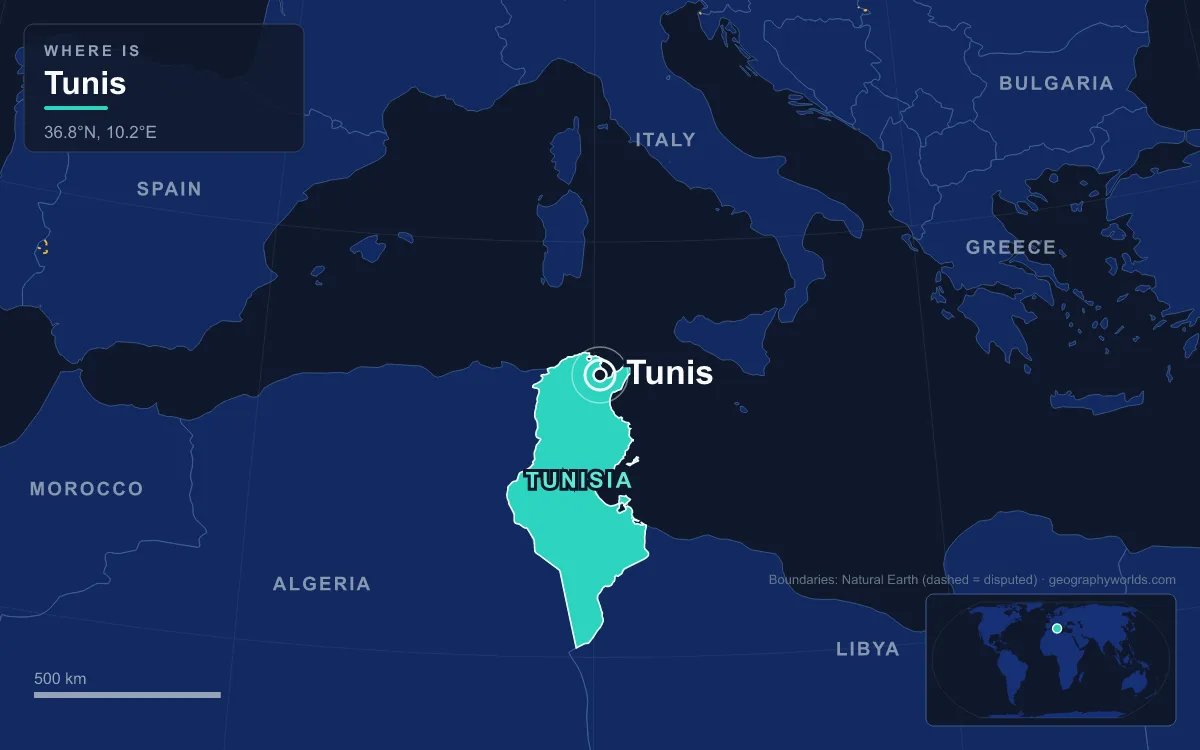
That dominance was not always a given. For most of its history Tunis stood in the shadow of somewhere else: first Carthage, then Kairouan and Mahdia. The story of how it became the capital is best told era by era.
Before 698: Tynes in the Shadow of Carthage
The site began as a Berber settlement on a hill, and sources from the 4th century BC already mention a town here. Its value was its view. From the hilltop that later became the Kasbah, anyone could watch the ships and caravans moving to and from Carthage, which lay only a short distance away on the coast. The Greek historians Diodorus Siculus and Polybius described a place called Tynes, and Neo-Punic coins spell the name TWNṢN. One theory ties the name to a Berber root, ens, meaning to lie down or pass the night, so that Tunis may once have meant something like "camp" or "the last stop before Carthage".
Being next door to a great power had costs. When Agathocles of Syracuse landed at Cape Bon in 310 BC, the town changed hands several times, and according to Strabo the Romans destroyed it in 146 BC along with Carthage at the end of the Third Punic War. Tunis was rebuilt under Augustus, grew into a farming centre, and appears on the Roman road map known as the Tabula Peutingeriana as Thuni, a mutatio or way station. It later had its own bishop, but it stayed small beside the rebuilt Carthage, whose ruins you can read about in our guide to the archaeological site of Carthage.
698 to 1159: Hassan ibn al-Nu'man's Mosque Town
The Tunis that exists today was founded in 698, when the Umayyad commander Hassan ibn al-Nu'man established a settlement and a mosque on the edge of the ancient ruins. That mosque became the Zaytuna, the "Mosque of the Olive", and the Medina grew outward from it. The Umayyad caliph Abd al-Malik ordered a dockyard built at the same time, because Tunis faced the Strait of Sicily and could serve as a naval base for the western Mediterranean. The mosque's current form dates from a 9th-century rebuilding that reused many antique columns taken from Carthage.
Tunis was important in these centuries but not yet the capital of the region. The Aghlabid ruler Ibrahim II made it his seat briefly, from 902 until the Fatimids took control of Ifriqiya in 909. The real centres of power were Kairouan and later Mahdia. Then the region was shaken apart. After the Zirid ruler al-Mu'izz ibn Badis broke with the Fatimids in 1048, the Fatimid caliph unleashed the Banu Hilal tribes on Ifriqiya, and Kairouan was razed in 1057. Tunis was one of the few coastal towns to escape. By 1059 its citizens had turned to the Hammadids of Béjaïa for protection, and the governor sent from Béjaïa soon set up his own small Khurasanid dynasty with Tunis as its capital.

1159 to 1574: Almohad and Hafsid Tunis Takes the Crown
The turning point came in 1159, when the Almohad ruler Abd al-Mu'min captured Tunis, removed the last Khurasanid, and installed his government in the Kasbah. For the first time Tunis outranked Kairouan and Mahdia as the seat of provincial power. In 1228 the governor Abu Zakariya seized control, and in 1229 he declared himself emir and founded the Hafsid dynasty. Tunis became the capital of a kingdom that at times reached towards Tripoli and Fez, and new walls enclosed the Medina, the Kasbah and the growing suburbs of Bab Souika to the north and Bab El Jazira to the south.
Hafsid Tunis was one of the richest cities in the Islamic world, with about 100,000 people. Andalusian Muslims and Jews driven out of Spain settled here and shaped its trade and scholarship. The Zaytuna grew into the leading teaching institution of the country from around the 13th century, and Ibn Khaldun, the historian whose Muqaddimah is still read as an early work of sociology, was born in the city in 1332. In 1270 Louis IX of France landed at Carthage hoping to convert the Hafsid sultan; dysentery swept his army, and he died outside the walls of the capital. The traveller Ibn Battuta passed through in the reign of Sultan Abu Yahya and watched crowds in their most luxurious clothes gather for the festival that ends Ramadan, with the sultan arriving on horseback.
The Hafsids' final century was a tug of war. The Ottoman admiral Hayreddin Barbarossa took Tunis in 1534. Charles V of Spain retook it in 1535 and restored the Hafsid sultan as a vassal. The Ottomans returned under Uluç Ali in 1569, the Spanish under John of Austria recaptured the city in October 1573, and in August 1574 the Ottomans finally took it for good.
1574 to 1881: Deys, Beys and the Husainid City
As an Ottoman province, Tunis was nominally ruled from Constantinople, but after 1591 the local governors acted with growing independence. Corsairing and trade both boomed, and the profits paid for new building. Hammouda Pasha, who ruled from 1631 to 1666, added souks and palaces and in 1655 built the Hammouda Pacha Mosque with its octagonal Turkish-style minaret. The Dar El Bey palace in the Kasbah also dates from his reign. His son Murad II built the Mouradia Madrasa, and the Sidi Mahrez Mosque, with its great central dome, followed later in the 17th century.
The Husainid dynasty took over at the start of the 18th century and ruled until 1957. The city was not always secure: Algerian forces captured Tunis in 1756, a Venetian fleet bombarded it under Hammouda Bey, and naval defeats by Britain in 1826 and France in 1827 drew European interest deeper into the city's economy. In the 19th century Tunis had somewhere between 90,000 and 110,000 inhabitants. European immigration pushed the city past its limits, and from 1860 the old walls began to come down. Running water arrived in 1860, gas lighting in 1872 and organised waste collection in 1873.
1881 to 1956: The French Ville Nouvelle Beyond Bab el Bhar
France declared a protectorate over Tunisia in 1881, and within two or three decades Tunis became two cities. The Medina remained Arab, while a new European town was laid out east of the Sea Gate, Bab el Bhar, also called the Porte de France. Its spine, now Avenue Habib Bourguiba, runs towards the lake and is often compared with the Champs-Élysées. Half of the city's population came to be of European origin, including a large Italian community; the neighbourhood of La Petite Sicile, beside the old port, takes its name from the Italian workers who first lived there.

The French rebuilt the city's link with the sea as well. The Lake of Tunis, a 37-square-kilometre lagoon so shallow that it had once served as the natural harbour only for small boats, was crossed by a canal 10 kilometres long, 450 metres wide and 6 metres deep. The causeway along it now carries the road and railway to La Goulette, Carthage, Sidi Bou Said and La Marsa. Water, gas, electricity and public transport networks followed, and in 1893 Adrien Loir founded the Pasteur Institute beside Belvedere Park.
During the Second World War, Axis forces held Tunis from November 1942 to May 1943; it was their last base in Africa. The city fell to the British First Army and US forces on 7 May 1943, and on 20 May the Allies held a victory parade to mark the end of the North African campaign.
1956 to Today: Capital of an Independent Republic
Tunisia became independent on 20 March 1956, and the new constitution required the Chamber of Deputies and the Presidency to sit in Tunis and its suburbs. As European residents left, Tunisians from the rest of the country moved in to take their place. Tunisia had 255,000 residents of European origin in 1956, and as the Catholic population shrank, a modus vivendi between the Holy See and the new republic transferred many church buildings, including the Saint Louis Cathedral at Carthage, to the state. The suburbs grew fastest of all.
Tunis also became a diplomatic capital for the wider Arab world. The Arab League moved its headquarters here in 1979 after Egypt made peace with Israel, and returned to Cairo in 1990. The Palestine Liberation Organization was based in Tunis from 1982 to 2003, and an Israeli air raid on its headquarters in 1985 killed about 60 people. Today the Head of Government works from Dar El Bey in the Kasbah, the same hilltop where the Almohads installed their governors in 1159.
Since 2011 the city has been the stage for the country's political upheavals: many protests took place in the city during the Arab Spring of 2011 and 2012, and on 18 March 2015 gunmen attacked the Bardo National Museum, killing 20 civilians and a police officer. Summers are hot and dry, with a record 49.0 °C measured at Tunis-Carthage International Airport on 24 July 2023, while winter is the wettest season. Tunis is now the centre of Tunisia's government, commerce and culture for a country of about 12.1 million people. For the bigger picture of the nation that took its name from this city, see our Tunisia country guide, or compare it with its neighbours in our overview of the Maghreb countries.
Quick Facts About Tunis
- Country: Tunisia
- Continent: Africa (North Africa)
- Country population: approximately 12.4 million
- Capital city status: Tunis is the capital of Tunisia, the seat of national government, and the location of foreign embassies, parliament, and the head of state's official residence.
Frequently Asked Questions
What is the capital of Tunisia?
The capital of Tunisia is Tunis. Tunis is the seat of national government, hosts most foreign embassies and consulates, and is typically where the head of state and parliament are located.
What continent is Tunis in?
Tunis, the capital of Tunisia, is located in Africa, in the North Africa region. As Tunisia's capital, Tunis serves as the country's primary connection to the broader African political, economic, and cultural sphere.
Why is Tunis the capital of Tunisia?
Tunis was chosen as the capital of Tunisia for reasons that typically combine geography, history, and politics. Capital city selections often reflect a desire for centrality (being accessible from across the country), historical importance (being a longstanding seat of government or culture), or neutrality (being acceptable to multiple regions or ethnic groups within the country). The specific reasons for Tunis's designation are detailed in the city's history above.
What is Tunis known for?
As the capital of Tunisia, Tunis is best known for housing the country's central government institutions — parliament, presidential or royal residences, supreme court, and key ministries. It is also typically a major cultural and economic center within Tunisia, hosting national museums, embassies, and signature monuments. The introduction and history sections above provide detailed coverage of the city's specific notable institutions and landmarks.
Related Pages
- Tunisia Country Guide — full geography, climate, economy, and culture overview
- Flag of Tunisia — meaning, history, and design of Tunisia's national flag