
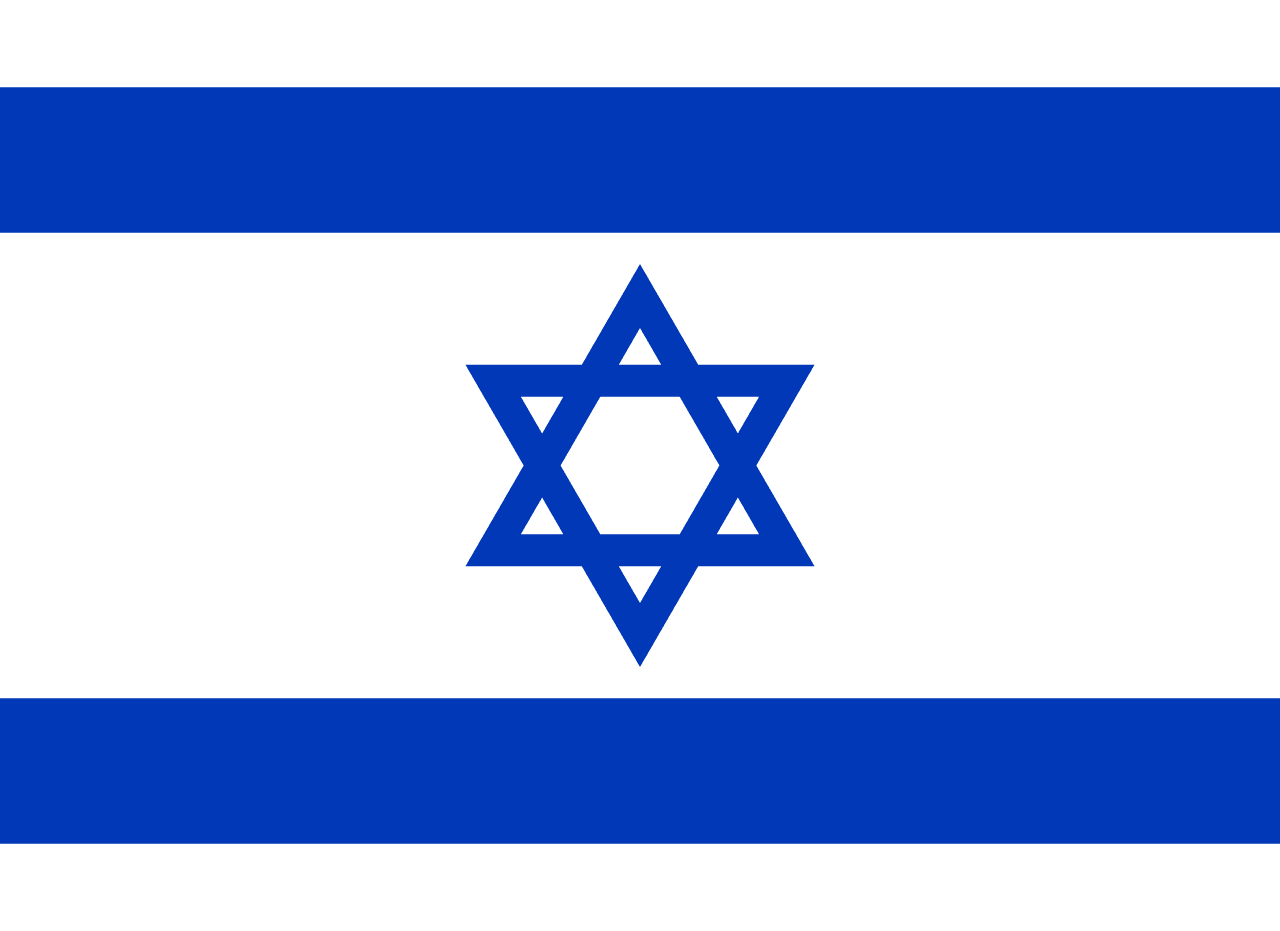
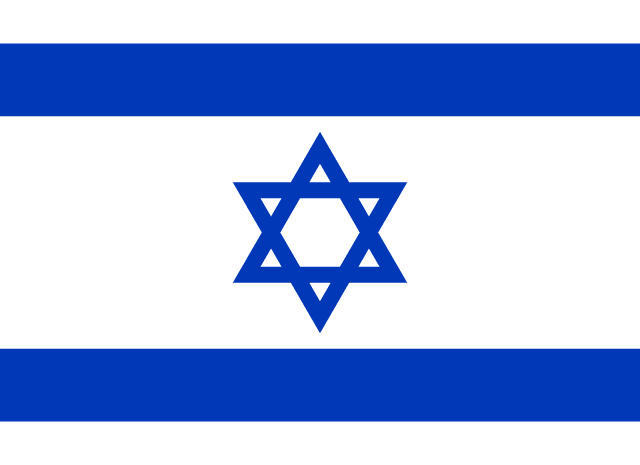
Few national banners wear their heritage as plainly as the flag of Israel. With nothing more than two blue stripes and a six-pointed star set against a clean white field, it manages to compress thousands of years of religious tradition, cultural memory, and national aspiration into a single rectangle of cloth. Adopted in 1948, the year the modern state declared its independence, the design was not invented from scratch by a committee chasing novelty. Instead, it borrowed the most intimate object in Jewish daily life and lifted it into the sky.
This is a flag rooted in the prayer shawl, the tallit, worn by observant Jews during worship. That choice gives the banner an unusual quality: people who recognize the cloth on their shoulders during morning prayers can look up at a flagpole and see the same pattern overhead. In this article we will trace where those colors come from, how the layout was settled, the Zionist origins of the design, how it compares to other blue-and-white flags, and why it still stirs strong feelings today.
Blue and White: The Meaning Behind the Palette
The Israeli flag uses only two colors, and that restraint is part of its power. The field is white, and across it run two horizontal blue stripes near the top and bottom, with the blue star centered between them. The blue and white were not selected at random; they echo the colors of the traditional tallit, the fringed prayer shawl whose white wool is crossed by dark bands. For generations, blue and white had been understood informally as the Jewish national colors precisely because of this garment.
White, in this context, carries associations of purity, peace, and the simplicity of devotion. The blue stripes recall not only the shawl's bands but also, by long tradition, a thread of tekhelet, a sky-blue dye that Jewish law once prescribed for ritual fringes. The result is a palette that feels calm and ancient at once. There is no red, no green, no gold; the absence of additional color keeps the eye fixed on the two elements that matter most, the stripes and the star.
How the Design Is Arranged
The composition is straightforward to describe and instantly recognizable. A white rectangle holds two blue horizontal stripes, one set in from the top edge and one set in from the bottom edge, leaving generous white margins above, below, and between them. Centered in the open white space between the stripes sits the Star of David, a six-pointed star formed by two overlapping equilateral triangles.
That central star is the design's anchor. Known in Hebrew as the Magen David, or Shield of David, the six-pointed figure had become widely associated with Jewish communities across Europe and the Middle East in the centuries before the flag existed. By placing it dead center, framed symmetrically by the two stripes, the designers created a balanced emblem that reads clearly whether it is stitched onto a small lapel pin or unfurled across a stadium. The stripes do more than decorate; they quote the tallit directly, so the whole flag becomes, in effect, a prayer shawl with the people's most enduring symbol laid upon it.
From Zionist Banner to National Flag
The flag did not appear suddenly in 1948. Its design grew out of the Zionist movement, the political and cultural effort that emerged in the late nineteenth century to establish a Jewish homeland. Activists wanted a unifying symbol, and the natural reference point was the tallit, an object every Jewish community already shared regardless of where it lived. Wrapping the Star of David in the colors and stripes of the prayer shawl produced a banner that felt familiar from the first moment people saw it.
This Zionist flag flew at movement gatherings and in Jewish communities for decades before statehood, building recognition and emotional weight along the way. So when Israel declared independence in 1948, the new government did not have to persuade anyone to embrace an unfamiliar emblem. The flag was formally adopted that same year, confirming as official what had already become, in practice, the symbol of a people's hopes. If you want broader context on the country itself, its regions, and its history, the israel country guide is a good companion read.
Comparing It to Other Blue-and-White Flags
Blue and white is a popular combination in vexillology, which means Israel's flag shares a family resemblance with several others, yet remains hard to confuse with any of them. Greece, for instance, uses blue and white with horizontal stripes and a cross in the canton, a design tied to Orthodox Christianity rather than Judaism. Several Central American flags, including those derived from the old United Provinces, also pair blue stripes with white, but they place national emblems or coats of arms in the center instead of a star.
What sets Israel's flag apart is the specific symbol at its heart. No other national flag centers the Star of David, so even at a glance the emblem identifies the banner unambiguously. The two-stripe arrangement is also distinctive: rather than dividing the flag into equal horizontal bands like Greece, the stripes sit near the edges and leave a wide white middle, deliberately imitating the layout of a tallit. That faithfulness to a real religious garment is something few other flags attempt, and it gives this one a texture of meaning that look-alikes do not have.
A Flag Tied to Identity
For many people, the flag of Israel is inseparable from questions of belonging and continuity. Because its core elements, the Star of David and the prayer-shawl stripes, predate the state by centuries, the banner functions as a bridge between an ancient religious tradition and a modern political nation. It is not merely the emblem of a government; it gestures toward a much longer story of dispersed communities and shared symbols.
That depth also makes the flag a focus of strong emotion. It appears at moments of mourning and celebration alike, at memorial ceremonies, religious occasions, and national milestones. Israel sits within the continent of Asia, in the eastern Mediterranean region of the Middle East, and the flag travels with Israelis and Jewish communities around the world as a marker of identity well beyond its borders.
The Flag in Everyday Modern Life
Today the banner is woven into ordinary civic and cultural rhythms. It is hoisted on government buildings, draped from balconies during national holidays, and carried by athletes representing the country at international competitions, where the Star of David appears on uniforms and medal podiums. On Independence Day the streets fill with the blue and white, with flags clipped to car windows and strung between lampposts.
The design's simplicity is a practical asset here. Because it uses just two colors and a clean central figure, it reproduces cleanly at any size, from a tiny enamel badge to an enormous flag flown over a public square. That clarity helps explain why the emblem reads so instantly in news footage, on jerseys, and across screens. Here are a few quick points worth remembering:
- The flag was officially adopted in 1948, the year Israel declared independence.
- Its blue stripes and white field are modeled on the tallit, the Jewish prayer shawl.
- The central emblem is the Star of David, a six-pointed star also called the Magen David.
- The design originated within the Zionist movement before becoming the national flag.
- Only two colors appear, blue and white, with no red, gold, or other shades.
- Israel lies on the continent of Asia, in the eastern Mediterranean.
Frequently Asked Questions
When was the flag of Israel adopted?
The flag was officially adopted in 1948, the same year the modern state of Israel declared its independence. By then the design had already been used for decades as the banner of the Zionist movement, so its adoption confirmed a symbol that was already widely recognized.
What do the colors of the Israeli flag mean?
The flag uses blue and white, the colors long regarded as Jewish national colors because of the tallit, the traditional prayer shawl. White suggests purity and peace, while the blue stripes echo the bands of the shawl and the sky-blue thread associated with ritual fringes in Jewish tradition.
Who designed the flag of Israel?
The flag emerged from the Zionist movement rather than from a single named author, drawing directly on the prayer shawl and the Star of David, symbols already shared across Jewish communities. It was used as the movement's banner well before independence and then adopted as the national flag in 1948.
What continent is Israel on, and how does its flag compare to similar ones?
Israel is located on the continent of Asia, in the eastern Mediterranean part of the Middle East. While other countries such as Greece also use blue-and-white horizontal designs, Israel's flag is unmistakable because it centers the Star of David and arranges its two stripes to mirror the layout of a tallit, a feature unique among national flags.