
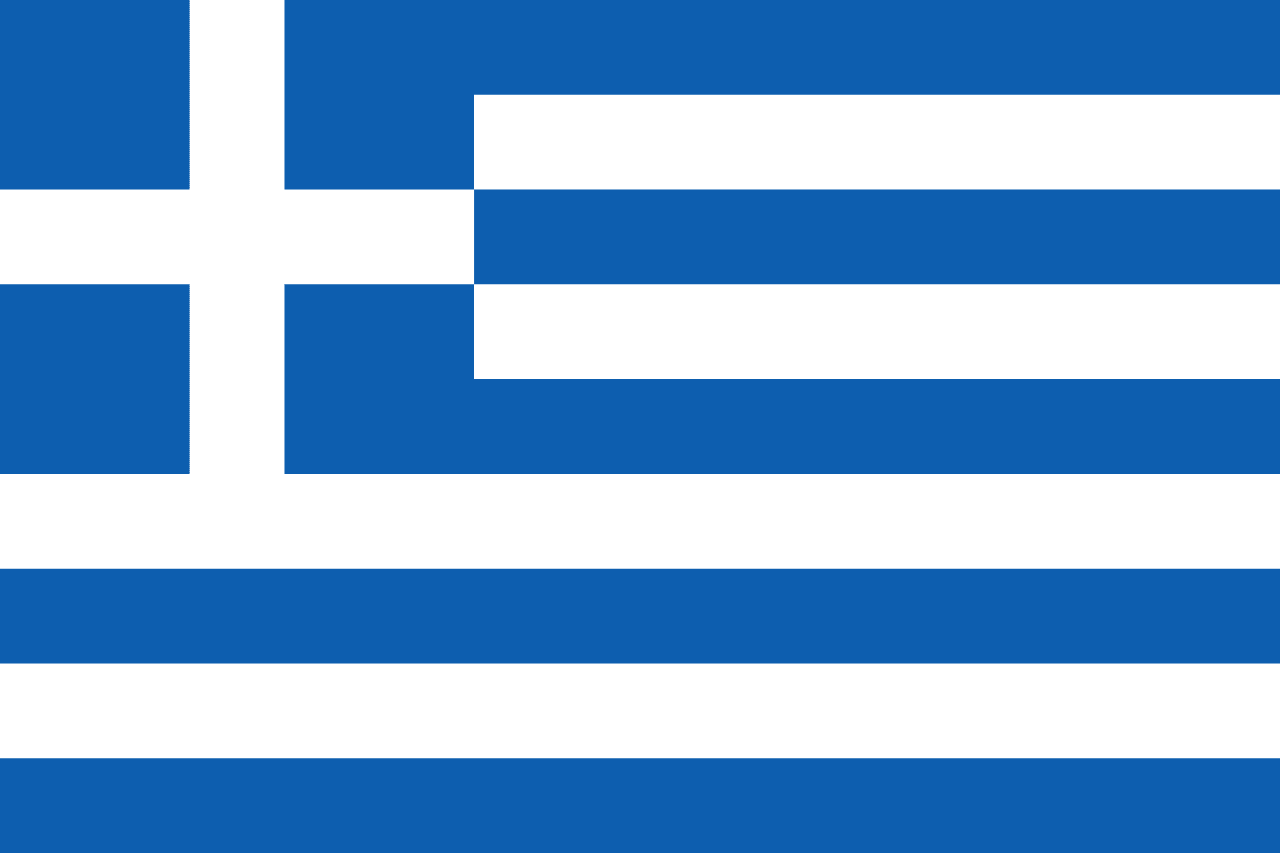
Few flags pack as much meaning into so simple a palette as the flag of Greece. Two colors, blue and white, are arranged into nine horizontal stripes with a clean white cross set against a blue square in the upper corner. Greeks affectionately call it galanolefki or kyanolefki, both meaning "the blue and white." For a nation that gave the world the words democracy, geography, and philosophy, the banner is fittingly economical, every element earning its place. Behind that restraint lies a story of revolution, faith, and a young kingdom searching for the symbols that would define it.
What the Blue and White Stand For
The two colors of the Greek flag are loaded with association, even if their meanings were never fixed by a single official decree. Blue is most often linked to the sky that arches over the Aegean and the sea that surrounds Greece's thousands of islands, while white evokes the foam of the waves, the marble of ancient temples, and the purity of the struggle for independence. Together they have become so tied to Greek identity that the pairing feels inevitable, as though no other combination could possibly represent the country.
There is also a more earthly explanation tucked into the nation's history. After Greece won its freedom in the nineteenth century, the throne was given to Otto of Bavaria, and blue and white happened to be the colors of the Bavarian royal house. The young king's heraldic palette and the country's chosen revolutionary colors aligned neatly, reinforcing a scheme that already carried popular meaning. The result is a flag whose blue and white can be read as sky and sea, as faith and freedom, or as a quiet nod to the monarch who first wore the crown.
Reading the Design: Stripes and the Cross
The construction of the flag is precise and easy to describe. Nine equal horizontal stripes alternate between blue and white, beginning and ending with blue, so there are five blue stripes and four white ones. In the upper hoist corner sits a blue canton, a square that spans the height of the top five stripes, and on it rests a white cross with arms of equal length reaching to each edge. This cross is a Greek cross rather than the elongated Latin form, its symmetry mirroring the balance of the stripes below.
The most widely repeated interpretation holds that the nine stripes stand for the nine syllables of the Greek rallying cry Eleftheria i thanatos, "Freedom or Death," the motto that carried fighters through the War of Independence. Others have counted the syllables of the word Eleftheria alone, or read the stripes simply as the alternating rhythm of sea and foam. The cross, by contrast, has a single clear meaning: it honors Greek Orthodox Christianity, the faith that bound the population together during centuries of Ottoman rule and became inseparable from the idea of Greek nationhood.
From Revolution to the Modern Banner
Greek flags did not arrive fully formed. During the early years of the 1821 uprising against Ottoman rule, revolutionaries flew a variety of banners, many built around the cross as the central emblem of their cause. In 1822 the first national assembly formalized two designs: a blue flag with a white cross for use on land, and the striped cross flag for the sea. The naval ensign, with its nine stripes and corner cross, gradually proved the more enduring and recognizable of the two.
For much of the kingdom's history a royal crown sat at the center of the cross on certain official versions, appearing and vanishing as monarchs rose and fell. The two parallel flags, plain cross on land and striped at sea, coexisted for generations. It was only in 1978 that Greece settled the matter definitively, designating the striped blue-and-white cross flag as the single national flag for all purposes on land and sea alike. The version flown today therefore carries more than a century and a half of revisions inside its familiar shape.
Cousins and Look-Alikes Around the World
Blue and white is a popular flag palette, and a handful of national banners invite comparison with the Greek one. The flag of Finland also pairs a blue cross with white, but there the cross is the Nordic offset type, shifted toward the hoist, and the colors are reversed, with blue laid over a white field. Israel's flag shares the blue-and-white scheme and a horizontal-stripe sensibility, yet its central Star of David and its two-stripe layout make confusion unlikely.
The closest relatives are Greece's own historical land flag, a plain white cross on solid blue, and various Orthodox or revolutionary banners that lean on the cross motif. What distinguishes the modern Greek flag from all of these is the specific count of nine stripes and the square canton, a combination found nowhere else. Once you have noticed that the stripes start and end in blue and that the cross fills its own little blue box, the flag becomes impossible to mistake for any other. You can place it in regional context with the greece country guide.
A Symbol Woven into National Life
For Greeks at home and across a vast diaspora, the blue and white is more than a state emblem; it is a thread of belonging. It flies over schools and churches, hangs from balconies on national holidays, and waves in dense forests of small flags at parades. Two dates in particular bring it out in force: March 25, which marks both the start of the 1821 revolution and the religious feast of the Annunciation, and October 28, known as Ochi ("No") Day, commemorating Greece's refusal of an ultimatum in 1940. On those mornings, children march in formation through town squares clutching the flag, learning early that it stands for hard-won freedom.
The flag travels well, too. Greek football and basketball supporters drape it across stadiums, sailors raise it on yachts threading between the islands, and emigrant communities from Melbourne to Chicago unfurl it at festivals to declare where their roots lie. In each setting the same nine stripes and single cross do the quiet work of saying "this is Greek."
Quick Facts Worth Knowing
- The flag has nine horizontal stripes, five blue and four white, beginning and ending with blue.
- The white cross in the canton honors Greek Orthodox Christianity.
- The current single national flag was officially fixed in 1978, ending the old split between land and sea designs.
- The nine stripes are popularly tied to the nine syllables of "Eleftheria i thanatos" — "Freedom or Death."
- Greece sits in southeastern Europe, at the meeting point of the European, Asian, and African worlds around the Mediterranean.
- The blue-and-white scheme echoes the heraldic colors of Otto of Bavaria, Greece's first king.
Frequently Asked Questions
When was the current Greek flag adopted?
The striped blue-and-white cross flag was made the sole national flag of Greece in 1978. Before that, the design had a long pedigree dating back to the 1820s, but it had coexisted with a plain blue flag bearing a white cross that was used on land. The 1978 decision unified all official use under a single banner.
What do the colors of the Greek flag mean?
Blue and white are most often read as the sky and sea of Greece and the foam of its waves, along with the purity of the independence struggle. The white cross specifically represents Greek Orthodox Christianity. The colors also align with those of the Bavarian royal house of Greece's first king, Otto.
Who designed the Greek flag?
The flag was not the work of a single named designer. It emerged from the banners of the Greek War of Independence and was formalized by the national assembly in 1822, drawing on earlier Greek and Orthodox cross designs. Its present form is the product of gradual evolution rather than one creator's vision.
What continent is Greece on, and how does its flag compare to similar ones?
Greece is in southeastern Europe, bordering the Balkans to the north and the Mediterranean to the south. Its flag resembles other blue-and-white cross banners such as Finland's, but Finland uses an offset Nordic cross on a white field, while Greece uses an upright Greek cross in a blue canton above nine alternating stripes, a layout unique to it.