

At 1,334 metres above sea level, in a valley of the Galgodon (Ogo) highlands, Hargeisa is a highland city, far cooler than the Somali ports on the coast below it. It is the capital and largest city of Somaliland, a self-declared republic in the Horn of Africa that has governed itself since 1991 but that Somalia, and most of the world, still regard as part of Somalia; that makes Hargeisa, by the international reckoning, Somalia's second-largest city. An estimate for 2019 put its population at about 1.2 million. Its defining trait is a double identity: it is the working capital of a state with its own parliament, currency and elections, and at the same time a regional capital in a country whose recognised government sits in Mogadishu. The easiest way to see Hargeisa clearly is through comparison.
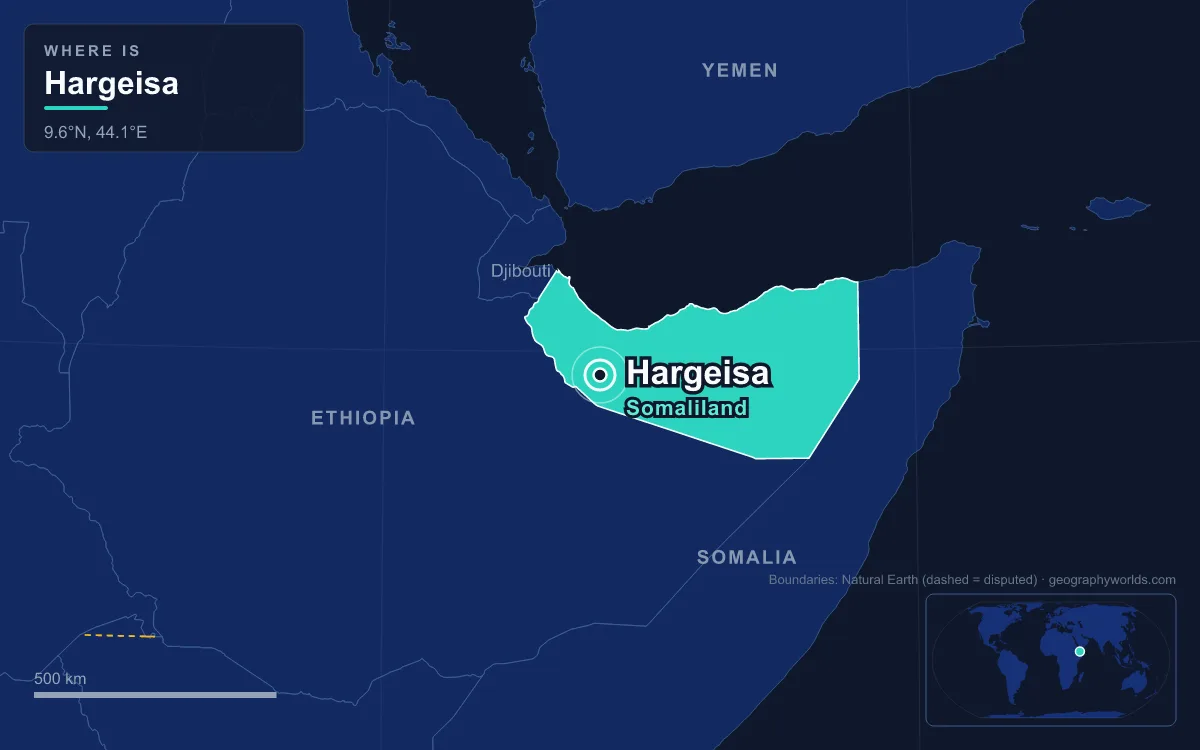
1,334 Metres Up: Hargeisa Against the Gulf of Aden Coast
Altitude is the first contrast. Berbera, Somaliland's main seaport, lies about 160 kilometres away on the Gulf of Aden, on a coast so hot that its residents traditionally leave for milder weather in the summer. Hargeisa, up on the plateau, rarely gets very hot or very cold. Average monthly temperatures run from about 18 °C in December and January to about 24 °C in June. The climate is hot semi-arid (BSh), with just over 400 mm of rain a year, most of it falling between April and September.
Set that beside Mogadishu, the Somali capital on the Indian Ocean. Mogadishu's mean temperature hovers around 27 °C all year, its annual rainfall is similar at about 429 mm, and its humidity averages 79 percent. The two cities receive roughly the same amount of rain, but Hargeisa's height takes several degrees off every month, and it escapes the extreme summer heat of Berbera.
| Hargeisa | Mogadishu | |
|---|---|---|
| Setting | Highland valley, 1,334 m | Indian Ocean coast |
| Average temperature | 18–24 °C by month | About 27 °C year-round |
| Annual rainfall | Just over 400 mm | About 429 mm |
| Population estimate | About 1.2 million (2019) | About 2.4 million (2017) |
| Capital since | 1941 (British Somaliland) | 1905 (Italian Somaliland) |
From 30,000 People in 1958 to About 1.2 Million
Hargeisa's growth is steep even by African standards. The anthropologist I. M. Lewis estimated its population at 30,000 in 1958. The UNDP counted 560,028 in 2005, the CIA World Factbook gave around 760,000 for 2015, and by 2019 estimates had reached about 1.2 million. The urban area covers roughly 75 square kilometres, which works out at a density of about 12,600 people per square kilometre.
Somaliland as a whole claims about 176,120 square kilometres and had roughly 6.2 million people in 2024, so on those estimates something like a fifth of its population lives in the capital. Burao, capital of Togdheer region, is Somaliland's second city. The main residents of Hargeisa belong to sub-clans of the Isaaq, among them the Sa'ad Musa, Eidagale, Habar Yoonis and Arap, with Gadabursi communities and others also living in the city.
Hargeisa or Berbera: The 1941 Capital Switch
Hargeisa was not always the obvious capital. It began as a watering and trading stop on the caravan routes between the coast and the interior. Around 1860 Sheikh Madar Shirwa, a scholar born in Berbera who had studied in Harar, founded a Qadiriyya religious commune here, and one explanation of the name is that he called it "Little Harar". Another derives it from hargageys, a place to sell hides and skins, the town's chief trade good. Madar's followers planted large fields of sorghum and built stone houses, turning a seasonal camp into a permanent town. A British traveller in the 1880s or 1890s noted a sorghum plot two and a half miles long and some 400 people employed guarding it from birds.
Through treaties with Somali sultans and chiefs in the 1880s, Britain established the British Somaliland protectorate, with Berbera serving as its capital from 1884 to 1941. Italy invaded the protectorate in August 1940 during the East African Campaign; Britain recaptured it in March 1941, and that year the capital moved from the port up to Hargeisa. Berbera kept the harbour and the trade, Hargeisa got the administration, and that division has held ever since.
The new capital was not always a quiet one. In 1945 the British administration, which saw religious teachers as an obstacle to its education and farming reforms, arrested several of them in Hargeisa. After the arrests on 4 June a crowd briefly freed the prisoners; they were recaptured the next day, and when several thousand people marched on the district headquarters, the District Commissioner's troops opened fire, killing one person. Religious leaders had shaped the town from the start: at a meeting outside the town in 1870, Sheikh Madar and the Isaaq Grand Sultan Deria Hassan had agreed to ban poaching and tree cutting around Hargeisa.
Five Days in 1960: Independence and the Union with Mogadishu
The protectorate became independent on 26 June 1960 as the State of Somaliland. Five days later, on 1 July, it united as planned with the former Italian-administered Trust Territory to form the Somali Republic, with Mogadishu as the national capital. Hargeisa dropped a rank, becoming the capital of the Woqooyi Galbeed province. The new government did build there: it opened the Hargeisa Provincial Museum, the first museum founded in Somalia after independence, and modernised the airport, which the Royal Air Force had opened in 1954. Now named Egal International Airport after Muhammad Haji Ibrahim Egal, who was Somalia's prime minister in the 1960s and later Somaliland's second president, it handled 85,800 passengers in 2002 and reopened on 17 August 2013 after a runway rebuild, with enlarged terminals and five wind turbines.
31 May 1988: When Up to 90 Percent of Hargeisa Was Destroyed
The union soured, above all for the Isaaq clan family, under Siad Barre's military government. At 2:15 a.m. on 31 May 1988 the rebel Somali National Movement attacked Hargeisa with an estimated 500 fighters, and by 1 June it held everything except the airport. The government's response was artillery shelling and aerial bombardment of the city, with aircraft taking off from Hargeisa's own airport to bomb it. Up to 90 percent of Hargeisa was destroyed; the United States embassy estimated 70 percent damaged or destroyed. The campaign against Isaaq civilians is now widely described as the Isaaq genocide.

The Hargeisa War Memorial, a fighter jet raised on a plinth in the city centre, commemorates the war. Rebuilding after 1991 was paid for largely by local entrepreneurs and by remittances from the Somali diaspora. Most destroyed homes and shops have been replaced, and single-storey buildings downtown are steadily giving way to multi-storey blocks.
Hargeisa and Mogadishu: Two Capitals About 850 Kilometres Apart
The biggest contrast is political. After Barre fell, Somaliland's independence was declared at a conference in Burao in April and May 1991, and 18 May is kept as its national day. Hargeisa became the seat of its parliament, presidential palace and ministries. Mogadishu, about 850 kilometres to the south-east in a straight line, is the seat of the Federal Government of Somalia, which regards Somaliland as one of its federal member states and does not accept the declaration. Somaliland describes itself as the successor to British Somaliland; Somalia describes it as part of its territory. Following the Las Anod conflict that began in 2022, Somaliland also lost control of a significant part of its east to pro-union forces who set up the SSC-Khatumo administration.
Hargeisa carries the symbols of a state. The Somaliland shilling replaced the Somali shilling on 18 October 1994, and Somaliland has held its own elections, including municipal polls in 2021. Ethiopia and Taiwan keep representative offices in the city. Formal recognition was absent for more than three decades until 26 December 2025, when Israel became the first and so far only UN member state to recognise Somaliland; Somalia, which has not recognised Somaliland's independence, still counts it as part of its territory. Airline schedules show the tension: since August 2024 Ethiopian Airlines and flydubai list Hargeisa as being in Somalia, after an ultimatum from the Somali government.

Laas Geel: Rock Art Thousands of Years Older Than the City
The last contrast is time. Hargeisa as a town is little more than 160 years old, but on its rural outskirts are the Laas Geel caves, whose paintings of long-horned cattle and their herders are estimated to be between about 5,500 and 4,500 years old. The ten rock shelters had long been known to local people, but a French archaeological team brought them to international attention during a survey in November and December 2002, and returned for detailed study in November 2003. They are among the earliest known paintings of domesticated cattle in the Horn of Africa.

Modern Hargeisa has its own cultural calendar. The Hargeisa International Book Fair, launched in 2008 by Jama Musse Jama, grew from 200 to 10,000 participants in six years and is one of the largest public book fairs in the Horn of Africa. The University of Hargeisa, Gollis University and several other colleges are here, as is the Edna Adan Maternity Hospital, which trains nurses. For the wider territory and its politics, read our Somaliland guide; to see how the region fits together, try the Horn of Africa guide; and for the southern rival that the table above compares it with, there is our profile of Mogadishu.
Quick Facts About Hargeisa
- Country: Somaliland
- Continent: Africa (East Africa)
- Country population: approximately 5.7 million
- Capital city status: Hargeisa is the capital of Somaliland, the seat of national government, and the location of foreign embassies, parliament, and the head of state's official residence.
Frequently Asked Questions
What is the capital of Somaliland?
The capital of Somaliland is Hargeisa. Hargeisa is the seat of national government, hosts most foreign embassies and consulates, and is typically where the head of state and parliament are located.
What continent is Hargeisa in?
Hargeisa, the capital of Somaliland, is located in Africa, in the East Africa region. As Somaliland's capital, Hargeisa serves as the country's primary connection to the broader African political, economic, and cultural sphere.
Why is Hargeisa the capital of Somaliland?
Hargeisa was chosen as the capital of Somaliland for reasons that typically combine geography, history, and politics. Capital city selections often reflect a desire for centrality (being accessible from across the country), historical importance (being a longstanding seat of government or culture), or neutrality (being acceptable to multiple regions or ethnic groups within the country). The specific reasons for Hargeisa's designation are detailed in the city's history above.
What is Hargeisa known for?
As the capital of Somaliland, Hargeisa is best known for housing the country's central government institutions — parliament, presidential or royal residences, supreme court, and key ministries. It is also typically a major cultural and economic center within Somaliland, hosting national museums, embassies, and signature monuments. The introduction and history sections above provide detailed coverage of the city's specific notable institutions and landmarks.
Related Pages
- Somaliland Country Guide — full geography, climate, economy, and culture overview
- Flag of Somaliland — meaning, history, and design of Somaliland's national flag