
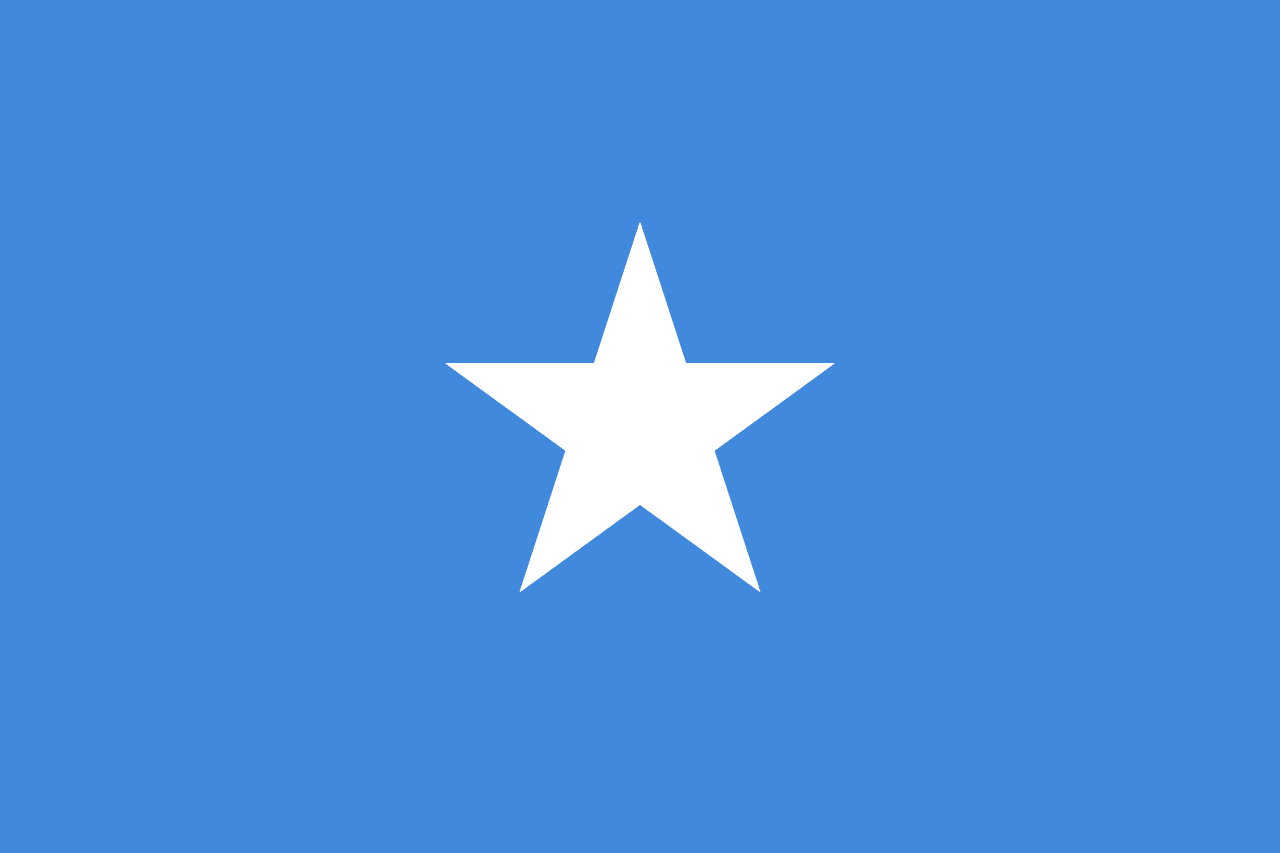
Few national flags manage to say so much with so little. The flag of Somalia is built from just two elements: a calm field of light blue and a single white five-pointed star resting at its center. There are no stripes, no crests, no calligraphy, no intricate emblems. Yet behind that minimalist design lies a story of pan-Somali ambition, mid-century independence movements, and a people scattered across borders who looked to one shared symbol to imagine themselves as a single nation. It remains one of the most elegant and recognizable flags in Africa.
A Flag of Two Colors
Somalia's flag uses only two colors, and both carry deliberate meaning. The light blue field is the dominant feature, stretching edge to edge as the backdrop. This shade of sky blue evokes both the heavens above and the long Indian Ocean coastline that defines the country's geography. Somalia has one of the longest coastlines on the African mainland, so the connection between the blue of the flag and the blue of the sea is more than poetic; it is geographic fact woven into national identity.
Against that blue sits a crisp white star. White here works as a color of peace, light, and clarity, giving the star the visual punch it needs to stand out. The two-tone palette keeps the design uncluttered, which is why the flag reads so cleanly from a distance, whether flying over a government building in Mogadishu or stitched onto a jersey at an international match.
Proportions and Design Conventions
The flag is rendered in a ratio of 2:3, the same dimensions used by a great many national flags. The white star is centered precisely on both axes, so the design looks balanced no matter how the flag hangs. The star is what vexillologists call a mullet, a regular five-pointed star with one point aimed straight up, sized so its points reach roughly halfway toward the edges. That generous margin of blue is part of why the emblem never feels crowded.
The Star and What Its Points Represent
The heart of the flag is the white five-pointed star, often called the Star of Unity. Each point stands for a region where ethnic Somalis have historically lived. At the time the flag was created, Somali communities were spread across five territories shaped by colonial borders: British Somaliland, Italian Somaliland, French Somaliland (modern Djibouti), the Ogaden region within Ethiopia, and the northern frontier district of what is now Kenya.
The star, then, was never just decoration. It was a political statement about Greater Somalia, the aspiration to unite all Somali-speaking peoples under one banner. When the flag was first raised, only two of those five territories had joined to form the independent state, yet the five points expressed a hope reaching well beyond the new nation's borders. To this day the flag is a quiet reminder that the Somali nation, as imagined by its founders, was meant to be larger than the lines drawn on European maps.
How the Flag Came to Be
The flag was adopted on 12 October 1954, several years before full independence. It was designed by Mohammed Awale Liban, a Somali scholar whose creation was selected for the Italian-administered Trust Territory of Somaliland. His choice of a single white star on a blue ground was reportedly inspired by the flag of the United Nations, which oversaw the trusteeship; that influence helps explain the familiar light-blue tone.
Before this banner, the territories had flown the symbols of their colonial administrators: the Italian tricolor in the south and British ensigns in the north. There was no single flag Somalis could point to as their own, so Liban's design filled that gap, giving an emerging nation a homegrown emblem rather than an inherited one.
When British Somaliland and the Italian-administered south merged in 1960 to form the independent Somali Republic, the same flag carried over. Remarkably, while many flags from that era of decolonization were redesigned with each change of government, Somalia's banner has remained essentially unchanged for its entire independent existence. For readers who want the broader picture of the country behind the flag, our somalia country guide covers its geography, culture, and history in more depth.
How It Compares to Related Flags
Somalia's flag belongs to a small family of "single white star on blue" designs. The most obvious link is to its neighbor Djibouti, once French Somaliland and one of the five points on Somalia's star. Djibouti's flag also features a five-pointed star, though a red one set inside a white triangle against light-blue and green bands. The shared star is no accident: it reflects the same pan-Somali story.
What sets the Somali flag apart from generic star-on-blue designs is its single, centered, perfectly upright star with no border, stripe, or supporting emblem. It is one of the few national flags to rely on a lone central star with nothing else competing for attention, which is why it reads as calm and confident rather than busy. Its palette also sits outside the familiar Pan-African (green, gold, red) and Pan-Arab (red, black, white, green) schemes used by many neighbors; by choosing UN-inspired blue, the flag signaled a fresh, internationally minded identity rather than alignment with one ideological color tradition.
Cultural Significance and National Identity
For a people defined by a shared language, faith, and pastoral heritage rather than by colonial map lines, the flag became a rare unifying object. The five-pointed star spoke directly to the idea that Somalis everywhere belonged to one community, an idea that still appears in poetry, songs, and political rhetoric today.
Even through periods of conflict and fragmentation, the flag has stayed a constant. It is one of the few symbols that virtually all Somalis recognize and claim, regardless of region or clan, a reminder of nationhood that has outlasted governments.
The Flag in Modern Life
Today the flag appears where you would expect: above ministries and embassies, on official documents, and at ceremonies marking national days such as the 1 July anniversary of the unified republic. Somali athletes carry it at international competitions, and the large Somali diaspora displays it at festivals and community events from Minneapolis to London to Nairobi.
As one of the more instantly identifiable banners on the continent, Somalia's flag does double duty as both a state emblem and a marker of a wider cultural family. You will find it painted on buses, printed on textiles, and worn as face paint by football fans, woven into everyday life.
Quick Facts Worth Knowing
- The flag carries just two colors: light blue and white.
- The central white star is known as the Star of Unity.
- Each of the star's five points represents a territory where Somalis traditionally lived.
- It was adopted in 1954, six years before independence in 1960.
- The light-blue color is widely linked to the United Nations flag of the trusteeship era.
- It uses a 2:3 ratio with a single upright star, and is one of the few post-colonial African flags never redesigned.
Frequently Asked Questions
When was the flag of Somalia adopted?
The flag was adopted in 1954, during the period when the south was administered as a United Nations trust territory. It was retained without change when the independent Somali Republic was formed in 1960, and it has remained the national flag ever since.
What do the colors and star of the Somali flag mean?
The light blue field represents the sky and the sea, reflecting Somalia's long coastline, while the white five-pointed star stands for unity. Each of the star's five points symbolizes a region where Somali people have historically lived, expressing the hope of uniting all Somalis.
Who designed the flag of Somalia?
The flag was designed by Mohammed Awale Liban, a Somali scholar. His design of a single white star on a sky-blue field was chosen to represent the territory and went on to become the flag of the independent nation.
What continent is Somalia on, and which flags are similar?
Somalia is located in Africa, in the Horn of Africa region along the Indian Ocean. Its blue field and white star resemble several other single-star flags worldwide, and it shares a star motif with neighboring Djibouti, which has close historical and cultural links to the Somali people.
Why does the Somali flag look similar to the United Nations flag?
The resemblance is intentional. When the flag was created in 1954, southern Somalia was a UN trust territory administered ahead of independence, and designer Mohammed Awale Liban drew on the pale-blue tone of the United Nations flag. The choice signaled the nation's path to self-rule under international oversight, and that light blue has been a defining feature ever since.