
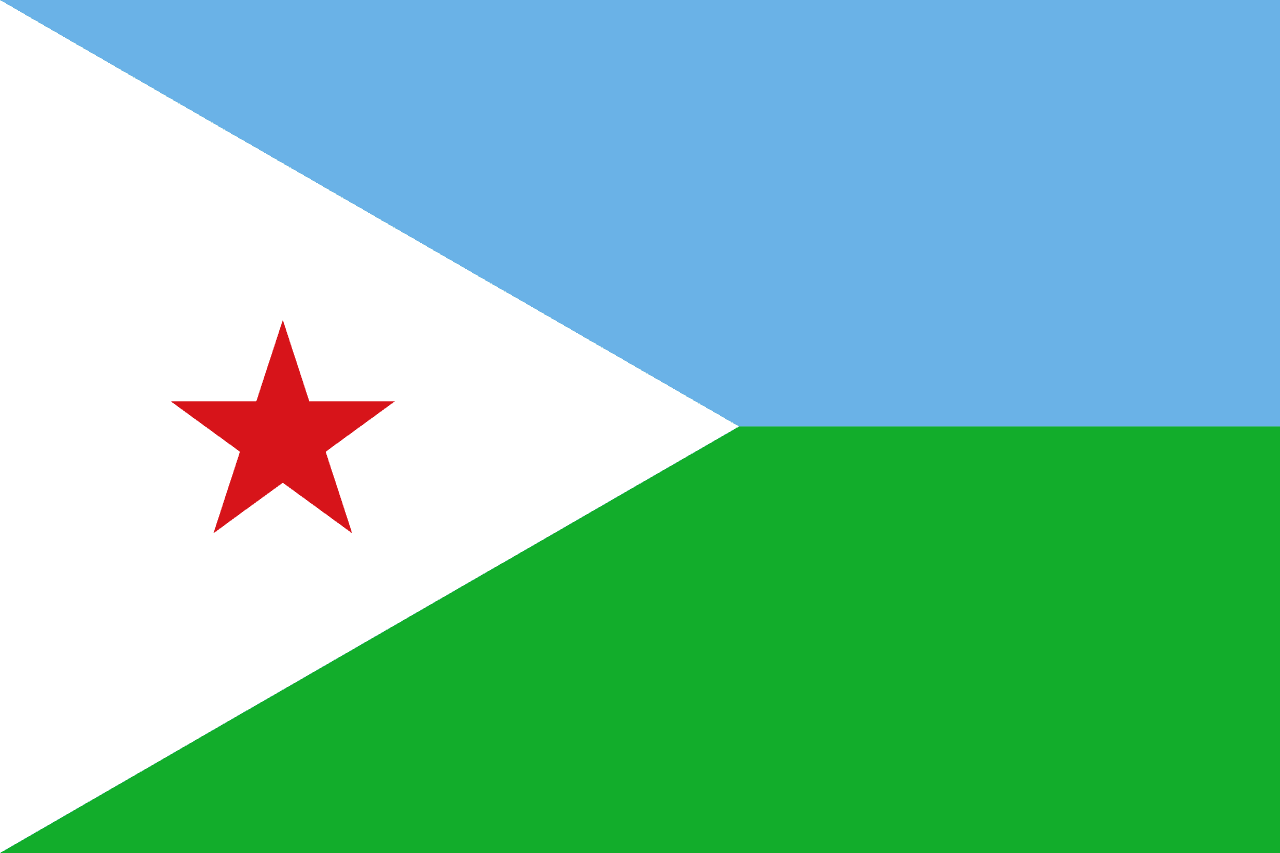
At the entrance to the Red Sea, where the Gulf of Aden narrows toward one of the busiest shipping lanes on the planet, sits a small nation with an outsized strategic importance. The flag of Djibouti captures that sense of place in a clean, memorable design: two horizontal bands of light blue and green, a white triangle anchored at the hoist, and a single red star resting at its center. Raised for the first time when the country gained its independence in 1977, the banner has remained unchanged ever since, a quiet constant for a republic shaped by geography, trade, and a careful balance between its two principal peoples.
A Quick Look at the Design
Djibouti's flag is built from a few bold geometric elements that fit together with satisfying simplicity. The field is split into two equal horizontal stripes. The upper band is light blue, the lower band green. Reaching in from the staff side is a white isosceles triangle whose point stretches toward the center of the flag, and inside that white field sits a five-pointed red star.
The arrangement is deliberate and easy to recognize, even from a distance. The pale blue reads instantly as sky and water, the green grounds the design, and the white wedge with its red star draws the eye to a single focal point. There is nothing cluttered here; every shape carries meaning, which is precisely what makes the flag effective both up close and on a distant pole.
What the Colors and Star Mean
Each element of the flag was chosen to express something about the land and its hopes at the moment of nationhood. The meanings are direct rather than abstract:
- Light blue stands for the sky above and the sea that surrounds the country, fitting for a coastal nation defined by its waters.
- Green represents the earth, a nod to the land itself and to growth.
- White signifies peace, expressed through the broad triangle that frames the star.
- Red, carried in the five-pointed star, symbolizes unity, the binding together of the nation's communities.
The star itself does double duty. Beyond the idea of unity, it is widely understood to represent the country's two main ethnic groups, the Issa and the Afar, drawn together under one banner. That single point of red, set against the calm of the white triangle, turns an otherwise serene flag into a statement about cooperation between peoples.
Born at Independence
For much of the twentieth century, the territory was governed by France, known at different stages as French Somaliland and later as the French Territory of the Afars and the Issas. Those very names hint at the demographic reality the future flag would have to honor: a population built largely around the Somali Issa and the Afar communities.
When independence arrived in 1977 and the Republic of Djibouti was born, the new state needed symbols of its own. The flag was adopted that same year, replacing the colonial arrangement and giving the young republic an emblem that spoke to its land, its sea, and above all its people. Unlike many national flags that have been revised, redesigned, or re-proportioned over the decades, Djibouti's has stayed remarkably stable, the same colors and the same star flying since the first day of sovereignty. If you want broader context on the nation behind the banner, the djibouti country guide traces its geography, culture, and history in more depth.
A Flag About Balance
Many national flags celebrate a single triumphant idea: a revolution, a faith, a founding leader. Djibouti's is more about equilibrium. The choice to let the red star evoke the Issa and the Afar reflects a country acutely aware that its stability depends on the relationship between its communities. In a region that has seen plenty of conflict, a flag that visually insists on unity is far from decorative; it is a daily reminder of the political settlement the nation rests upon.
That theme of balance runs through the design too. The blue and green stripes are equal partners, neither dominating the other. The white triangle, the color of peace, literally wedges itself between the bands and holds the unifying star. It is a composition in which no single element overwhelms the rest, a fitting metaphor for a state that has worked to keep its various parts in harmony.
The Flag in Everyday Life
Within Djibouti, the flag appears in all the places you would expect a national emblem to surface. It flies over government buildings and the presidential palace, marks official ceremonies, and takes pride of place on Independence Day, the annual celebration of the events of 1977. Schoolchildren grow up with it, and it accompanies the country's representatives abroad at diplomatic functions and international gatherings.
It also travels with the nation's athletes. When Djibouti competes at the Olympic Games or in regional championships, the light blue and green with its red star is what spectators see during opening ceremonies and on the kit of competitors. For a small country, these moments on the world stage are valuable, and the distinctive flag makes the team instantly identifiable among dozens of others.
How It Compares to Its Neighbors
Flags built from horizontal bands and a hoist-side triangle carrying a star are a recognizable family, especially across parts of Africa and the wider region. Several nations near the Horn and the Arabian Peninsula use a white triangle at the staff with a star inside, which can make a quick glance deceptive. Djibouti distinguishes itself through its specific palette: the soft, almost sky-toned blue paired with green is not a combination many other countries use, and the lone red star against white keeps the look crisp and particular. Once you have learned to associate that pale blue with the waters off the Gulf of Aden, the flag becomes hard to confuse with any other.
Interesting Facts at a Glance
- The flag has flown unchanged since the country became independent in 1977.
- Its red five-pointed star is commonly read as a symbol of the Issa and Afar peoples.
- The light blue is tied to both the sky and the surrounding sea, reflecting Djibouti's coastal setting on the African continent.
- White, carried by the large triangle, was chosen to represent peace.
- The design uses just four colors, yet manages to encode land, water, peace, and unity in a single image.
Frequently Asked Questions
When was the flag of Djibouti adopted?
The flag was adopted in 1977, the same year Djibouti gained its independence from France. It replaced the colonial-era arrangement and has remained the official national flag without alteration ever since.
What do the colors of the Djibouti flag mean?
Light blue represents the sky and the sea, green stands for the earth, white symbolizes peace, and the red of the central star signifies unity. Together they tie the nation's geography to its founding ideals.
What does the red star on the flag represent?
The five-pointed red star stands for unity, and it is widely understood to represent the country's two main ethnic groups, the Issa and the Afar, brought together under one nation.
What continent is Djibouti on, and which flags look similar?
Djibouti is located in the Horn of Africa, on the African continent, beside the Gulf of Aden. Its flag belongs to a broader family of designs that pair horizontal bands with a hoist-side triangle and star, but its distinctive light blue and green combination sets it apart from regional neighbors.