
Introduction
Turkey 🇹🇷 and Egypt 🇪🇬 are two of the eastern Mediterranean's heavyweight nations, each anchoring a region and each carrying thousands of years of history. They sit on different continents and grew out of very different landscapes, yet both have long served as bridges between worlds, Turkey between Europe and Asia, Egypt between Africa and the Middle East. This comparison sets them against each other across area, population, capitals, climate and natural features.
Whether you are studying for a geography class, planning a trip around the region, or simply curious how the two stack up, the figures below put the essentials side by side.
Size & Geography
| Feature | Turkey 🇹🇷 | Egypt 🇪🇬 |
|---|---|---|
| Area | 783,562 km² | 1,002,450 km² |
| Continent | Asia | Africa |
| Region | Middle East | North Africa |
| Land Borders | Greece, Bulgaria, Georgia, Armenia, Iran, Iraq, Syria | Libya, Sudan, Israel, Palestine |
| Landscape | high central plateau (Anatolia), narrow coastal plain | vast desert with the fertile Nile Valley |
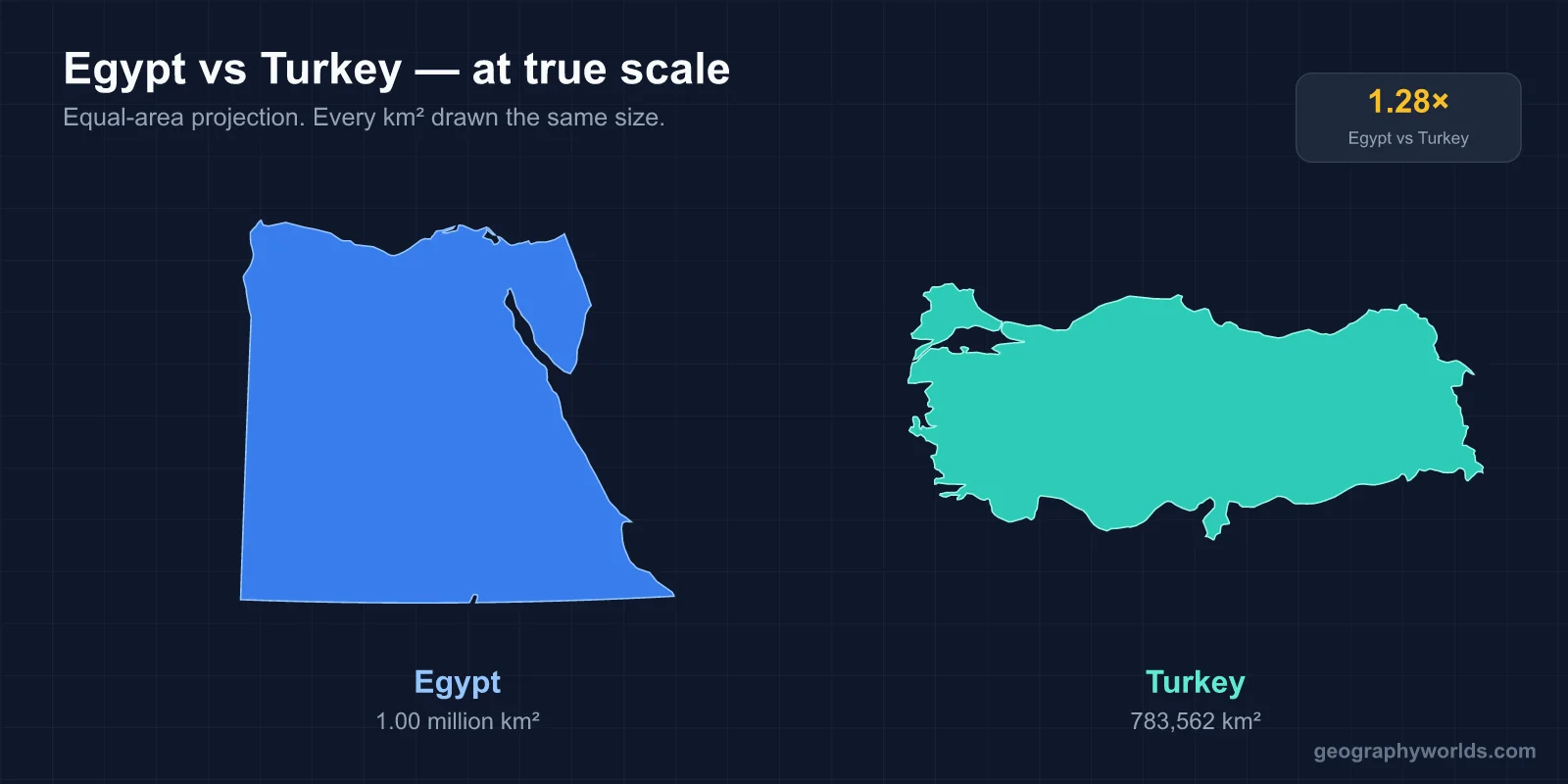
Egypt is the larger of the two, covering 1,002,450 km² to Turkey's 783,562 km², roughly 1.3 times the area. The shape of that land could hardly be more different. Turkey is dominated by the high Anatolian plateau ringed by a narrow coastal plain, and it reaches into seven neighbors from Greece in the west to Iran and Iraq in the east. Egypt, by contrast, is mostly desert: the overwhelming majority of its territory is sparsely inhabited Sahara, with life concentrated along the thin, fertile ribbon of the Nile Valley.
Population & Demographics
| Metric | Turkey 🇹🇷 | Egypt 🇪🇬 |
|---|---|---|
| Population | 87.9 million | 120.1 million |
| Population Density | 112.2 per km² | 119.8 per km² |
Egypt is also the more populous, with 120.1 million people against Turkey's 87.9 million, about 1.4 times as many. On paper the two have similar densities, 119.8 per km² in Egypt and 112.2 in Turkey, a gap of just 7.6 people per km². But Egypt's figure is misleading: because almost no one lives in its deserts, the real density along the Nile and in the Delta is far higher, while Turkey's population is spread more evenly across habitable land.
Capital Cities
Ankara, sitting on the Anatolian plateau, is the capital of Turkey, even though Istanbul is the country's largest city. Cairo, sprawling along the Nile, is Egypt's capital and one of Africa's largest urban centers. The two sit on different continents, Ankara in Asia and Cairo in Africa.
Language, Currency & Culture
| Aspect | Turkey 🇹🇷 | Egypt 🇪🇬 |
|---|---|---|
| Languages | Turkish (official), Kurdish | Arabic (official), Egyptian Arabic widely spoken |
| Currency | Turkish Lira (TRY) | Egyptian Pound (EGP) |
Turkey's official language is Turkish, a Turkic language unrelated to its neighbors' tongues, with Kurdish widely spoken in the southeast. Egypt's official language is Arabic, and the Egyptian Arabic dialect heard on its streets is one of the most widely understood in the Arab world thanks to the country's film and music industries. Each keeps its own currency, the Turkish Lira (TRY) and the Egyptian Pound (EGP).
Climate & Natural Features
| Aspect | Turkey 🇹🇷 | Egypt 🇪🇬 |
|---|---|---|
| Climate | temperate; hot summers, mild winters; harsher in interior | desert; hot, dry summers and mild winters |
| Key Features | Cappadocia, Bosphorus Strait, Mount Ararat, Pamukkale | Nile River, Sahara Desert, Suez Canal, Sinai Peninsula |
| Economy | automotive, textiles, agriculture, tourism | tourism, Suez Canal revenues, oil, agriculture |
Turkey's climate is broadly temperate, with hot summers and mild winters along the coasts giving way to harsher conditions across the high interior. Its landmarks span the otherworldly rock formations of Cappadocia, the Bosphorus Strait dividing Istanbul, Mount Ararat and the white terraces of Pamukkale. Egypt is overwhelmingly a desert country, hot and dry in summer and mild in winter, and its signature features all relate to that, the life-giving Nile, the surrounding Sahara, the strategically vital Suez Canal and the Sinai Peninsula. Both economies lean heavily on tourism, with Turkey adding automotive and textile manufacturing and Egypt drawing major revenue from Suez Canal traffic.
What Makes Each Country Unique
Turkey is famous for straddling two continents, for the Hagia Sophia, for the hot-air balloons that drift over Cappadocia, and for its cuisine. Its largest city, Istanbul, is the only city in the world that spans both Europe and Asia, split by the Bosphorus Strait.
Egypt is inseparable from the Pyramids of Giza, the pharaonic civilization that built them, and the Nile that made it all possible. The Great Pyramid of Giza held the title of tallest man-made structure on Earth for more than 3,800 years.
Key Differences at a Glance
- Area: Turkey (783,562 km²) vs Egypt (1,002,450 km²) — Egypt is 1.3x larger
- Population: Turkey (87.9 million) vs Egypt (120.1 million) — Egypt is 1.4x more populous
- Capitals: Ankara vs Cairo
- Currency: Turkish Lira (TRY) vs Egyptian Pound (EGP)
- Continents: Asia vs Africa
- Density: Egypt is marginally denser overall (difference of ~7.6 people per km²)
- Languages: Turkish (official) vs Arabic (official)
Verdict
Turkey and Egypt are transcontinental civilizations with deep histories, and on the headline numbers Egypt edges ahead, larger in area by a factor of 1.3 and more populous by 1.4. Yet the comparison is as much about geography as size. Egypt's vast deserts mean its people cluster on a sliver of habitable land, while Turkey's population and landscape are more dispersed across plateau and coast.
Turkey's draw lies in its temperate variety and sights like Cappadocia and the Bosphorus, whereas Egypt's identity is written into the desert, the Nile and the monuments along it. Tourism matters greatly to both, with Turkish industry and Egyptian canal revenues filling out their economies.
Taken together, the two nations show how civilizations on opposite shores of the same sea built very different countries. Whether you are traveling, studying, or simply curious, comparing them deepens the picture of this crossroads region.
Test Your Knowledge!
Think you know your countries? Try our interactive geography quiz!
Play Geography Games →