

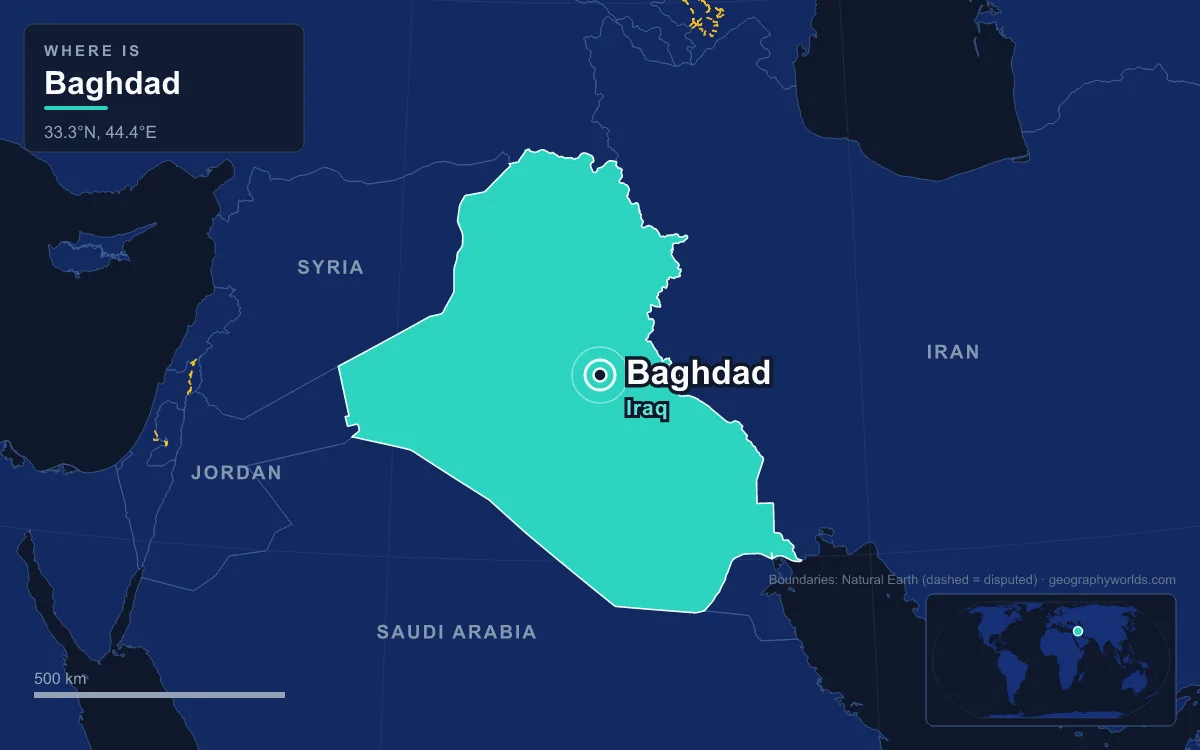
Baghdad, the capital and largest city of Iraq, lies on both banks of the Tigris in the centre of the country, only about 34 metres above sea level on the flat Mesopotamian plain. The 2024 census counted about 7.8 million people in the city, and the capital generates roughly 40 percent of Iraq's economy. Founded by the Abbasid caliph al-Mansur in 762, it was probably the largest city in the world for much of the following two centuries, and its surviving buildings, streets and monuments trace a history of golden ages, sieges and rebuilding. Six of them tell that story best.
The Round City of al-Mansur, Begun in 762
The most important landmark in Baghdad no longer exists. When the Abbasids overthrew the Umayyads, they wanted a new capital, and on 30 July 762 Caliph al-Mansur commissioned a city beside the Tigris, on a site where Neo-Babylonian bricks stamped with the name of Nebuchadnezzar II show much older settlement. Arab chroniclers reported 100,000 workers and craftsmen on the project. The caliph's Palace of the Golden Gate and the main mosque were largely finished by 763, and the rest was complete by 766. Its official name was Madinat as-Salam, the City of Peace.
The plan was a circle about one kilometre in radius, with the palace, crowned by a green dome, at the centre. Four gates, named after the destinations they faced, Kufa, Basra, Khurasan and Syria, pierced a double ring of walls protected by towers and a moat. The design echoed older Near Eastern round cities such as the Sasanian city of Gur rather than the grids of Greek and Roman planning. The House of Wisdom, the academy that held the largest collection of books in the world by the mid-9th century, flourished in Baghdad, and scholars such as al-Khwarizmi, al-Kindi and the translator Hunayn ibn Ishaq worked there.
Baghdad quickly outgrew the circle, with markets moved to the al-Karkh district outside it. By the 10th century the population was estimated at between 1.2 and 2 million, and it was likely the largest city on Earth until the 930s. None of the Round City's structures has survived, and everything known about its layout comes from written sources; its site lies beneath the streets of the modern city.
The Mustansiriya Madrasa, 1227 to 1258
One of the very few Abbasid buildings still standing in the city sits on the left, or eastern, bank of the Tigris. The Mustansiriya Madrasa was founded in 1227 by Caliph al-Mustansir and opened for teaching on 6 April 1233, at a reported cost of 700,000 dinars. It was the first Islamic university to teach the jurisprudence of all four Sunni schools, Hanafi, Shafi'i, Maliki and Hanbali, under one roof, and it also taught mathematics, medicine, grammar and philosophy. Students received lodging, food, clothes and a monthly allowance. In 1235 a water-powered clock that announced the prayer hours day and night was installed in its entrance hall.

The madrasa's golden age was short. On 10 February 1258 the Mongols under Hulegu, a grandson of Genghis Khan, captured Baghdad, killed the last Abbasid caliph al-Musta'sim, massacred much of the population and wrecked the canals and dykes that irrigated the surrounding land. The sack ended the Abbasid Caliphate and damaged the madrasa badly. Timur sacked the city again in 1401. The building, now part of al-Mustansiriyya University and under restoration by Iraq's antiquities authority, is on UNESCO's tentative World Heritage list.
The Kadhimiya Shrine and Its Gilded Domes
North of the city centre, the Kadhimiya Shrine grew out of a cemetery that al-Mansur laid out for the Quraysh and his own family when the Round City was built. The seventh Twelver Shia imam, Musa al-Kadhim, was buried there in 799, followed by his grandson, the ninth imam, Muhammad al-Jawad, in 834. The present building dates from a restoration by the Safavid shah Ismail I between 1502 and 1524, and the Ottoman sultan Suleiman the Magnificent added to it after he took Baghdad in 1534. A whole district, al-Kadhimiya, grew up around the shrine, which draws pilgrims from across the Shia world. A freshly gilded dome over the grave of Muhammad al-Jawad was unveiled on 28 March 2004.
The shrine also reflects the city's modern violence. In 1920 it hosted gatherings during the revolt against British rule. On 2 March 2004, during the Ashura commemorations, bombings there killed at least 75 people. Baghdad's other great shrines divide along similar lines: Adhamiyah, across the river, is a mainly Sunni district named after the title of Abu Hanifa, whose mosque stands there.
Al-Mutanabbi Street and the Qishla Clock Tower
For an idea of what Baghdad values, walk the book market. Al-Mutanabbi Street, a car-free lane of just under a kilometre near al-Rashid Street in the old quarter, has been the centre of the city's book trade since the Abbasid era. It was formally opened by King Faisal I in 1932 and named after the 10th-century poet al-Mutanabbi, whose statue by the sculptor Mohammed Ghani Hikmat stands at the river end. The saying that Cairo writes, Beirut publishes and Baghdad reads is associated with it. The Shabandar Café, open since 1917, has long been a meeting place for politicians and writers.

On 5 March 2007 a car bomb on the street killed 26 people, destroyed many bookshops and wrecked the Shabandar Café, killing five of the owner's sons. Prime Minister Nouri al-Maliki reopened the restored street on 18 December 2008. At its end, the Qishla, an Ottoman-era barracks on the Tigris with a clock tower donated by George V, has become a public square where Baghdadis read poetry. The whole area, including the Mustansiriya Madrasa and the Abbasid-era palace nearby, is on UNESCO's tentative list.
Nasb al-Hurriyah, the Freedom Monument in Tahrir Square
Modern Baghdad's best-known public artwork overlooks Tahrir Square and the al-Jumhuriya Bridge. In 1959 Brigadier General Abd al-Karim Qasim, who had overthrown the monarchy in the coup of 14 July 1958, commissioned a monument to the new republic. The architect Rifat Chadirji worked with the sculptor Jawad Saleem, who resisted every attempt to include Qasim's likeness and instead depicted the people's struggle against tyranny in a style drawing on Babylonian, Assyrian and Abbasid reliefs.
Saleem died in January 1961 before it was finished; his wife, the artist Lorna Selim, and the sculptor Mohammed Ghani Hikmat completed it that year. The monument consists of 14 bronze castings representing 25 figures on a travertine slab raised 6 metres off the ground, 10 metres high and 50 metres long. It is meant to be read like a line of Arabic poetry, from right to left, beginning before the revolution and ending in harmony after independence. It has survived several attempts to pull it down and has appeared on Iraqi banknotes of 250 and 10,000 dinars.
The Iraq Museum and the Looting of April 2003
The national museum began in 1922, when Gertrude Bell collected finds from foreign excavations in a government building to keep them in Iraq. On 14 June 1926 the collection moved into its own building as the Baghdad Antiquities Museum, with Bell as director, and in 1966 it moved again to a 45,000-square-metre building in the al-Salihiyah neighbourhood of the Karkh district, taking the name Iraq Museum. Its 28 galleries and vaults cover more than 5,000 years of Mesopotamian history, including the Nimrud gold and Uruk carvings from 3500 to 3000 BC.
After US forces took Baghdad on 9 April 2003, the museum was looted between 10 and 12 April. Early reports claimed 170,000 lots were stolen; the accurate figure was around 15,000 items, including 5,000 cylinder seals. The Warka Vase and the Bassetki Statue were among the pieces taken, though both were later recovered, and the headless statue of King Entemena of Lagash was recovered in the United States in 2006. After years of restoration, the museum formally reopened in February 2015.
Karkh, Rusafa and a Capital of Nearly 8 Million
The Tigris still organises the city: the western half is called Karkh and the eastern half Rusafa, on almost flat alluvial ground built up by the river's floods, with the Diyala River bordering the eastern suburbs. Basra lies about 530 kilometres to the south-east and Mosul about 403 kilometres to the north. The climate is hot desert: from June to August average maximum temperatures reach 44°C, and the city recorded 51.8°C on 28 July 2020. Annual rainfall averages about 150 millimetres, almost all between November and March, and light snow fell on 11 January 2008 for the first time in a century.
Baghdad became capital of the British-mandated kingdom in 1921 and of independent Iraq in 1932, and its population grew from about 145,000 in 1900 to 580,000 in 1950. In 1960 it hosted the conference that founded OPEC. Wars in 1980 to 1988, 1991 and after 2003 damaged it heavily, but attacks have become rare since the Islamic State's territorial defeat in 2017, and in December 2015 UNESCO named Baghdad a Creative City of Literature, the first Arab city to receive the title. To follow the river that made the city, read our guide to the Tigris River, set it within the wider story of Mesopotamian geography, or compare it with Mosul and Basra in our list of the largest cities in Iraq.
Quick Facts About Baghdad
- Country: Iraq
- Continent: Asia (Middle East)
- Country population: approximately 48.0 million
- Capital city status: Baghdad is the capital of Iraq, the seat of national government, and the location of foreign embassies, parliament, and the head of state's official residence.
Frequently Asked Questions
What is the capital of Iraq?
The capital of Iraq is Baghdad. Baghdad is the seat of national government, hosts most foreign embassies and consulates, and is typically where the head of state and parliament are located.
What continent is Baghdad in?
Baghdad, the capital of Iraq, is located in Asia, in the Middle East region. As Iraq's capital, Baghdad serves as the country's primary connection to the broader Asian political, economic, and cultural sphere.
Why is Baghdad the capital of Iraq?
Baghdad was chosen as the capital of Iraq for reasons that typically combine geography, history, and politics. Capital city selections often reflect a desire for centrality (being accessible from across the country), historical importance (being a longstanding seat of government or culture), or neutrality (being acceptable to multiple regions or ethnic groups within the country). The specific reasons for Baghdad's designation are detailed in the city's history above.
What is Baghdad known for?
As the capital of Iraq, Baghdad is best known for housing the country's central government institutions — parliament, presidential or royal residences, supreme court, and key ministries. It is also typically a major cultural and economic center within Iraq, hosting national museums, embassies, and signature monuments. The introduction and history sections above provide detailed coverage of the city's specific notable institutions and landmarks.
Related Pages
- Iraq Country Guide — full geography, climate, economy, and culture overview
- Flag of Iraq — meaning, history, and design of Iraq's national flag