
Few flags in the Middle East have changed hands as often as the banner of Syria. Across the past century it has been hoisted, lowered, redesigned, and restored more times than almost any other in the Arab world, each version carrying the political mood of its moment. The horizontal tricolor of red, white, and black, brightened by two green stars across its center, is one of the more recent chapters in that long story. To read this flag is to read a compressed history of pan-Arab ambition, regional unity, and the symbols that nations reach for when they want to say who they are.
A Quick Look at the Design
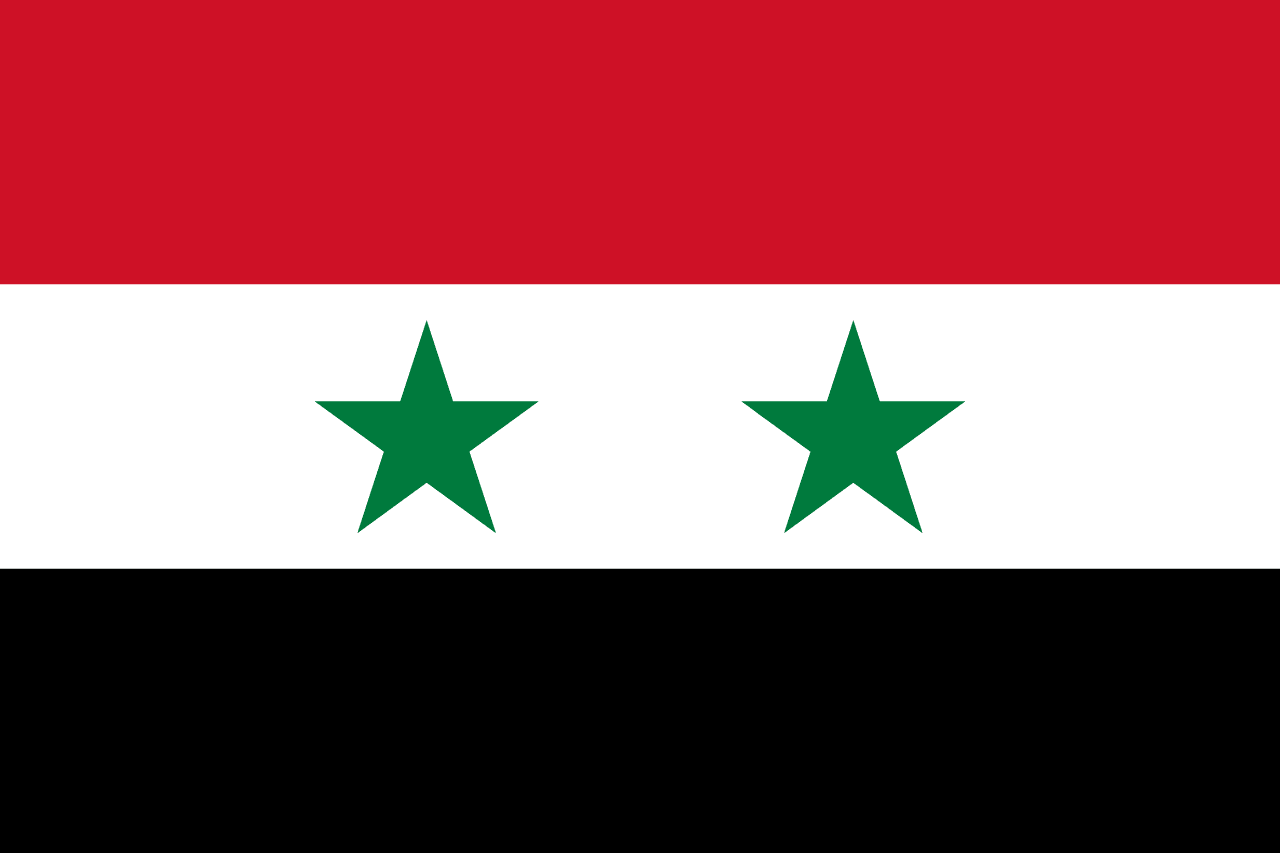
The flag is a horizontal triband, divided into three equal stripes. From top to bottom they run red, white, and black. Resting on the central white band are two five-pointed stars, both green and spaced symmetrically so that they sit balanced against the field. There is no emblem, crest, or script, no sunburst or eagle of the kind that crowds some neighboring designs. The visual logic is deliberately spare: bold horizontal blocks of color, two crisp points of green, and nothing else competing for attention. That restraint is part of what makes the flag instantly legible at a distance, whether it is flying from a government building or printed on a small hand-held pennant.
What the Colors Mean
The red, white, black, and green of the flag are the classic pan-Arab colors, a palette that recurs across much of the region and reaches back to a shared sense of Arab heritage. These four colors are often traced to the great Arab dynasties and to the banners of the early twentieth-century Arab Revolt, and together they were meant to evoke a common identity that crossed individual borders. On the Syrian flag specifically, the colors function less as a list of separate meanings and more as a declaration of belonging to that wider Arab family.
The two green stars carry their own freight of history. They originally stood for the union of Egypt and Syria, the two member states that came together as the United Arab Republic. When that union was formed, the pair of stars announced the partnership directly on the flag itself. Even after the political arrangement that created them faded, the stars remained, and over time they came to be read more broadly as symbols of Arab unity and aspiration rather than of two specific countries.
From Union to Restoration
Understanding the present flag requires a short detour through a restless century. Syria moved through several distinct banners as it passed from foreign mandate to independence and then through a series of unions and breakups. The two-star design first appeared in connection with the United Arab Republic, the short-lived merger with Egypt. When that union dissolved, Syria experimented with other designs, including flags that carried different numbers of stars or different emblems, each reflecting the governing ideology of the day.
The version with two green stars on a red-white-black triband was ultimately restored in 1980, bringing back the look associated with the earlier period of Arab union. That act of restoration is itself meaningful: rather than inventing something wholly new, the country chose to return to a familiar symbol, signaling continuity with the pan-Arab project. The flag has since become the form most people picture when they think of the Syrian banner, even as the design's roots stretch back decades earlier. For more on the country itself, see our syria country guide.
How It Compares to Its Neighbors
Because the pan-Arab palette is so widely shared, the Syrian flag belongs to a family of look-alikes that can genuinely confuse newcomers. Several Arab states use red, white, and black horizontal stripes, distinguishing their flags only through the central charge. The most useful rule for telling them apart is to count and color the stars.
- Egypt uses the same red-white-black triband but places a golden eagle of Saladin in the center rather than stars.
- Iraq shares the three stripes but carries green Arabic script across the white band instead of stars.
- Yemen reduces the design to a plain red-white-black tricolor with no central emblem at all.
What sets Syria's flag apart within this group is precisely its pair of green five-pointed stars. The green is unusual; many regional flags reserve their stars or charges for gold, white, or red. That choice of color, combined with the specific count of two, makes the Syrian banner identifiable once you know what to look for, even when glimpsed quickly among similar designs.
National Identity and Everyday Meaning
For Syrians, the flag is bound up with questions of identity that go beyond simple geography. Syria sits in Western Asia, at the crossroads where the Arab world has long met the Mediterranean, and its banner has served as shorthand for an idea of shared Arab nationhood that the country actively promoted during the era of union. The pan-Arab colors place Syria within a regional story rather than presenting it as an island unto itself, and the stars keep alive the memory of an attempt at unity that, however brief, shaped how the nation imagined its place in the world.
Symbols this charged rarely stay neutral, and the Syrian flag has at times been a contested emblem, embraced by some and rejected by others depending on the political winds. That contestation is itself a measure of how much the flag matters: people do not argue over banners they consider meaningless. Whatever the disagreements, the red-white-black field with its two green stars remains the form most widely recognized internationally as standing for Syria.
The Flag in Modern Life
In everyday civic use, the flag appears where national symbols always appear. It flies above ministries and embassies, is raised at official ceremonies and on days of national commemoration, and is carried by athletes and supporters at international sporting events. Schoolchildren learn its layout, and it is reproduced on documents, currency, and the official seals of the state. Because the design is simple and high-contrast, it reproduces cleanly at every scale, from a stadium-sized banner to a lapel pin.
The flag also travels well as a visual identifier. Broadcasters, mapmakers, and sports organizations rely on the two-green-star triband to mark Syria in graphics and scoreboards, and its distinctiveness within the pan-Arab family makes that job manageable. For ordinary citizens at home and in diaspora communities abroad, the flag is the most portable piece of national symbolism available, a quick and unmistakable way to signal where one comes from.
Interesting Facts
- The current design with two green stars was restored in 1980, reviving a look tied to an earlier era of Arab union.
- Its four colors, red, white, black, and green, are the shared pan-Arab colors found on many flags across the region.
- The two stars originally represented Egypt and Syria as partners in the United Arab Republic.
- Green is a relatively uncommon color for stars on Arab flags, which helps distinguish Syria's banner from its neighbors.
- The flag carries no emblem or script, relying entirely on stripes and stars for its identity.
- Syria is located on the continent of Asia, in the Western Asian region near the eastern Mediterranean.
Frequently Asked Questions
When was the current Syrian flag adopted?
The version with two green stars on a red, white, and black horizontal triband was restored in 1980. The design itself, however, has older roots tied to the period of union with Egypt, so the 1980 date marks a return to a familiar banner rather than the creation of a brand-new one.
What do the colors and stars on the flag mean?
The red, white, black, and green are the pan-Arab colors, expressing Syria's place within the broader Arab world. The two green five-pointed stars on the central white stripe originally represented Egypt and Syria as members of the United Arab Republic, and over time they have come to symbolize Arab unity more generally.
Who designed the Syrian flag?
The flag is not credited to a single named designer. It emerged from the pan-Arab visual tradition and from the political arrangements of the mid-twentieth century, particularly the union with Egypt. Rather than being the work of one individual, it reflects shared regional symbolism that was adopted and later restored by the state.
What continent is Syria on, and how does its flag compare to similar ones?
Syria is in Asia, specifically Western Asia near the Mediterranean. Its flag closely resembles those of Egypt, Iraq, and Yemen because they all use the red-white-black pan-Arab triband. The distinguishing feature is Syria's pair of green stars, where Egypt uses a golden eagle, Iraq uses green Arabic script, and Yemen leaves the white band plain.
