
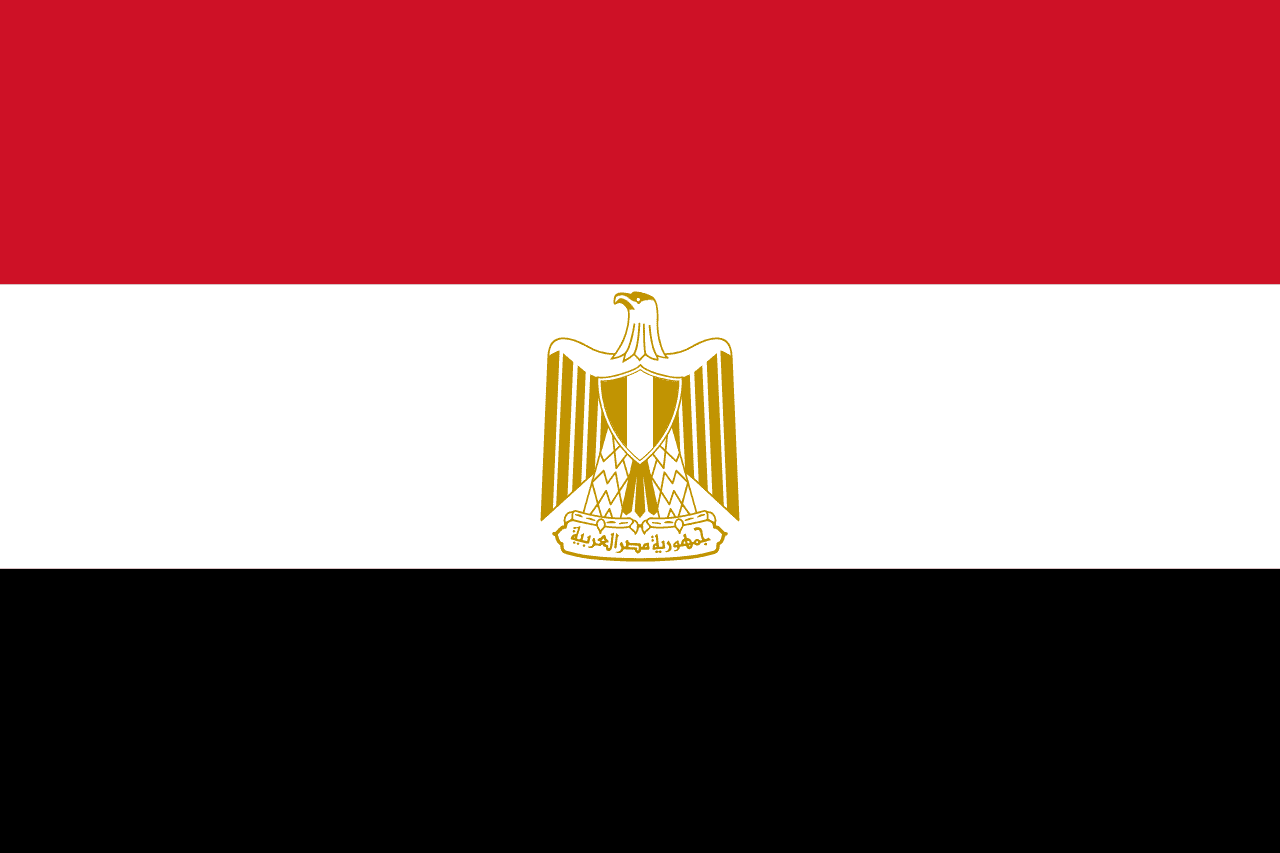
Few flags carry the weight of an entire civilization quite like Egypt's. Three bold horizontal bands of red, white, and black frame a single golden bird at the center, and together they tell a story stretching from ancient empires to a twentieth-century revolution. The current version was adopted on October 4, 1984, but its roots reach back to the upheaval of the 1950s, when Egypt redefined itself as a modern Arab republic.
A Banner of Three Colors
The Egyptian flag belongs to the family of Pan-Arab flags, a visual vocabulary shared across much of the Arab world. Its three equal stripes are stacked in a deliberate order, and each color speaks to a chapter of national experience. The red band along the top honors the sacrifices and blood of martyrs who fought for independence and dignity. The white middle stripe stands for a bright future and peace. The black band represents the dark period of oppression and colonial domination that the country struggled out of.
Read from top to bottom, the colors form a narrative arc: struggle, hope, and the shadows left behind. It is a rare flag that doubles as a short history lesson, part of why the Pan-Arab palette has proved so durable.
The Eagle at the Heart of the Flag
What sets Egypt apart from neighbors who share the same colors is the emblem resting on the white band. This is the Eagle of Saladin, rendered in gold and facing toward the hoist, the side nearest the flagpole. Beneath its talons it grips a scroll bearing the words Arab Republic of Egypt in Arabic Kufic script, the angular calligraphic style of the medieval Islamic world.
The eagle is not a decorative flourish. It is named for Salah ad-Din, the Kurdish-Arab sultan known in the West as Saladin, who founded the Ayyubid dynasty and recaptured Jerusalem from the Crusaders in the twelfth century. As a symbol he stands for power, strength, and Arab unity, qualities the modern Egyptian state placed quite literally at its center.
The choice to have the eagle face the hoist is more than aesthetic. In vexillology, a figure that turns toward the pole is read as facing forward when the flag flies, so the bird appears to lead rather than retreat. Placing the emblem on the white stripe also maximizes contrast, letting the gold detailing read clearly from a distance.
How the Flag Reached Its Present Form
Egypt has one of the most frequently revised flags in the world. By some counts, the design has changed at least fifteen times since 1882, mirroring a turbulent century of monarchy, foreign influence, revolution, and shifting alliances. Today's flag is the product of that long process rather than a single design moment.
Before the republic, Egypt flew very different colors. Under the monarchy, the flag was green, charged with a white crescent and three stars, a design tied to Islamic and dynastic symbolism rather than the revolutionary message that would follow. The shift to red-white-black was not a cosmetic update but a complete reimagining of what the nation wanted its banner to say.
The tricolor dates to the Egyptian Revolution of 1952, when the Free Officers Movement overthrew the monarchy. Those same colors were carried into the United Arab Republic, the union of Egypt and Syria that lasted from 1958 to 1971, whose flag added two green stars to the white band for the two member states. The central emblem kept evolving with each political reconfiguration. During the Federation of Arab Republics era of the early 1970s, the flag bore the golden Hawk of Quraish, a reference to the Prophet Muhammad's tribe. When Egypt left that federation, it replaced the hawk with the Eagle of Saladin, formally adopted in 1984. The flag uses a 2:3 ratio that keeps the eagle legible on the white field.
How It Compares to Related Flags
Egypt's flag sits within a tight cluster of Arab tricolors that can look alike at a glance. The flags of Iraq, Syria, and Yemen all use the same red, white, and black arrangement from the Pan-Arab tradition, a heritage tracing back to the Arab Revolt of World War I and the ideal of a unified Arab nation. Yemen's flag is the purest of the group, three plain bands with no emblem. Syria's has carried green stars on the white stripe, while Iraq's white band bears the Arabic phrase Allahu Akbar in green script.
Against these, Egypt's distinguishing mark is unmistakable: the golden Eagle of Saladin. No other national flag in the group places a large heraldic bird at its center, so the eagle functions like a signature. That same eagle appears on the coats of arms of Iraq, Palestine, and Yemen, even though it is absent from their flags, showing how the symbol is shared across Arab statehood even as Egypt alone flies it on the flag.
A Symbol of Arab Identity and Revolution
For Egyptians, the flag is bound up with two intertwined ideas: Arab identity and revolutionary heritage. The shared Pan-Arab colors link Egypt to a broader community of nations, while the emblem and the meanings of each stripe root the design firmly in Egypt's own twentieth-century story of liberation. To understand how this symbolism fits into the country's broader culture, geography, and history, the egypt country guide offers a fuller portrait of the nation behind the banner.
The Flag in Everyday and Public Life
The flag appears most prominently on Egypt's calendar of national observances. It is flown on Revolution Day each July 23, marking the 1952 overthrow of the monarchy, and on Armed Forces Day on October 6, when streets and buildings fill with the familiar tricolor.
Sport offers another stage. When the national football team, the Pharaohs, competes in the Africa Cup of Nations, stadiums turn red, white, and black. Egypt is the most successful side in the tournament's history, and the flag becomes a sea of waving fabric whenever the team plays. Beyond these occasions, the flag has a quieter daily presence too, flying over government buildings, schools, and embassies, along the banks of the Nile, and at the ancient monuments where modern Egypt and its deep past stand side by side. Citizens also encounter it on official documents, currency, and military uniforms, woven so thoroughly into civic life that it often goes unremarked until a holiday or a match brings it back into view.
Interesting Facts About the Egyptian Flag
- The Eagle of Saladin does not belong to Egypt alone; it also appears on the coats of arms of Iraq, Palestine, and Yemen.
- Egypt's flag is one of the most-changed national flags, revised at least fifteen times since 1882.
- The red, white, and black bands are shared with the flags of Iraq, Syria, and Yemen as part of the Pan-Arab tradition.
- The present design was adopted in 1984, the same period in which Egypt parted ways with the Federation of Arab Republics.
- Saladin, the eagle's namesake, founded the Ayyubid dynasty and recaptured Jerusalem from the Crusaders.
Frequently Asked Questions
When was the current Egyptian flag adopted?
The flag in use today was officially adopted on October 4, 1984. While the red-white-black color scheme had been in place since the 1952 revolution, 1984 is when the Eagle of Saladin replaced the earlier Hawk of Quraish as the central emblem.
What do the colors of the Egyptian flag mean?
They are Pan-Arab colors with specific meanings. Red represents the sacrifices and blood of martyrs, white stands for a bright future and peace, and black recalls the dark period of oppression and colonialism that Egypt overcame. The golden Eagle of Saladin in the center symbolizes power and strength.
What continent is Egypt on?
Egypt is located in Africa, in the continent's northeastern corner, with the Sinai Peninsula extending into Asia. This position has long made it a crossroads between Africa, the Arab world, and the Mediterranean, reflected in the flag's blend of Pan-Arab symbolism and Egyptian identity.
Why does the Egyptian flag look like the flags of Iraq, Syria, and Yemen?
All four share the red, white, and black horizontal stripes of the Pan-Arab tradition, rooted in twentieth-century movements for Arab unity. What distinguishes Egypt's is the golden Eagle of Saladin on the white band, an emblem the others either omit or render differently.
What did the Egyptian flag look like before 1952?
Before the 1952 revolution, Egypt's flag under the monarchy was green and bore a white crescent with three stars, drawing on Islamic and dynastic symbolism. The republican era swept that away in favor of the red, white, and black tricolor, a deliberate break with the monarchy and a turn toward the revolutionary identity the flag still expresses.