
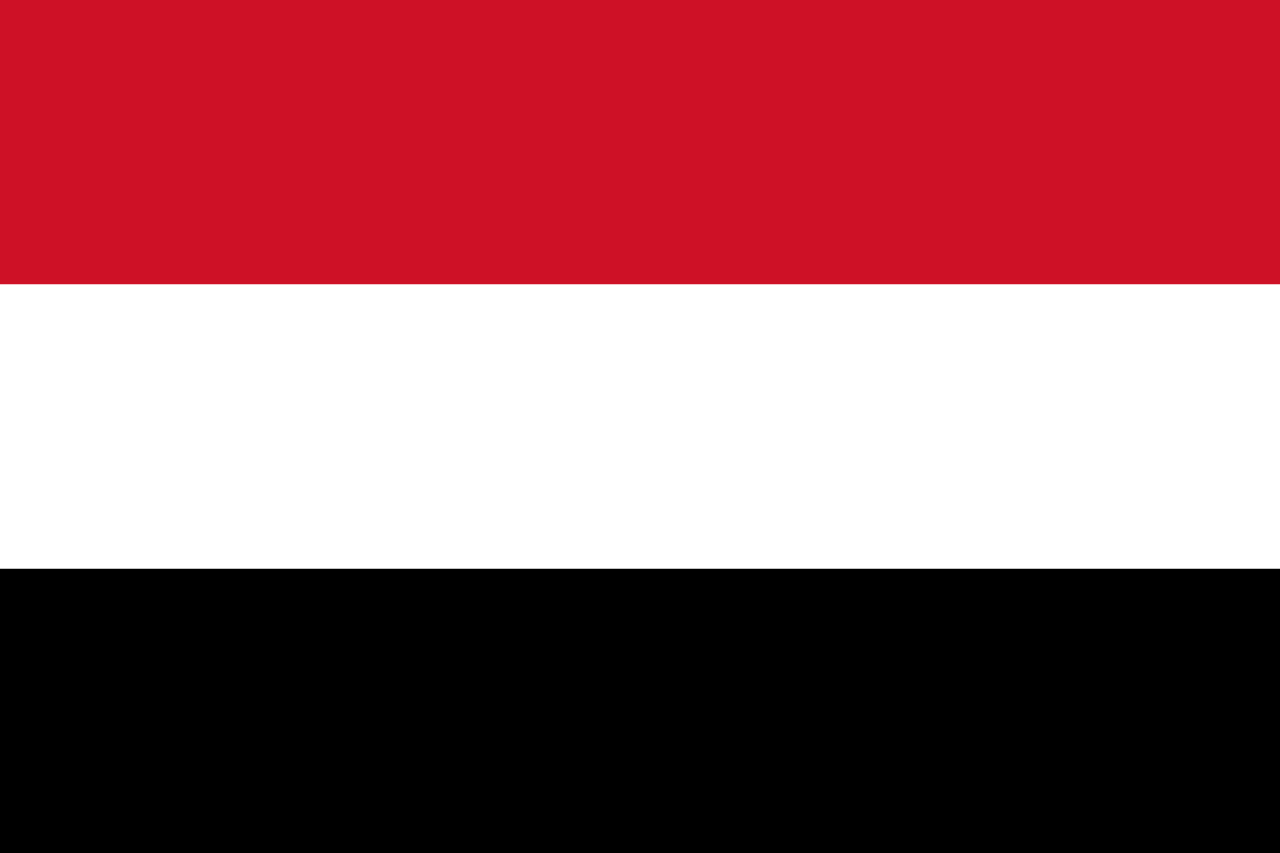
Few flags say so much with so little. The flag of Yemen is a plain horizontal triband of red, white, and black, with no emblem, star, or inscription to interrupt its three even stripes. That stark simplicity is deliberate, and it places Yemen squarely within one of the most recognizable visual families in the world: the Pan-Arab tricolors. Adopted in 1990, the flag is younger than many visitors assume, and its story is inseparable from one of the most consequential moments in modern Arabian history. Understanding why those three bands sit in that order is, in many ways, understanding how two very different Yemeni states became one.
A Tricolor Born of Unification
Yemen's flag was raised for the first time as a national banner in 1990, the year the Yemen Arab Republic in the north and the People's Democratic Republic of Yemen in the south merged into a single country. Before that moment, the two states had flown distinct flags. Both, however, drew on the same red-white-black palette, each adding its own emblems, stars, or charges to mark its particular political identity. When unification arrived, the negotiators stripped those distinguishing devices away entirely.
The result was a clean triband that belonged to neither predecessor exclusively and therefore could belong to both. By removing the stars and the green chevron that had set the southern flag apart, and the eagle and stars associated with the north, the new republic produced something neutral and unifying. The flag was less a brand-new invention than a deliberate distillation of what the two Yemens already shared.
What the Three Colors Mean
The colors of the Yemeni flag are not chosen for decoration; each carries a layered meaning rooted in the wider Arab nationalist tradition. From top to bottom the bands are red, white, and black.
- Red stands for revolution and the bloodshed of struggle, honoring those who fought for independence and unity.
- White represents a bright future and the hope that follows hardship.
- Black recalls the dark past of oppression, foreign domination, and the difficult periods the Yemeni people endured.
Read together, the stripes trace an arc from a painful history at the base, through the present, toward an aspirational future at the top. This is the essence of the Pan-Arab color scheme: a shorthand for revolution, hope, and the memory of struggle that many Arab nations share. Yemen's version is among the purest expressions of that idea precisely because it carries nothing else.
Design and Proportions
Visually, the flag could hardly be more straightforward. It is a horizontal triband divided into three equal bands of identical width, stacked red over white over black. There is no canton, no fimbriation, no central emblem, and no text. Each stripe occupies exactly one-third of the flag's height, and the colors run edge to edge.
This restraint gives the flag a powerful clarity. At a distance, on a windy mast or a stadium banner, the order of the three bands reads instantly. The downside of such simplicity is that the design is not unique to Yemen, a quirk that has made the flag a favorite trivia question among vexillologists. To tell it apart from its relatives, you have to know the company it keeps.
The Look-Alike Problem: Yemen Among the Arab Tricolors
Here is where Yemen's flag becomes genuinely interesting. The plain red-white-black triband is not Yemen's alone. It was, in fact, identical to the flag of Egypt between 1958 and 1972 and to the flag of Libya between 1969 and 1972, during periods when those countries used a bare Pan-Arab tricolor without any emblem. For a stretch of history, three flags could not be told apart at all.
Those other nations have since moved on. Egypt added its golden Eagle of Saladin to the white stripe, and Libya, after later experiments, returned to an entirely different design featuring a crescent and star on a black band. Yemen, by contrast, kept its triband unadorned, making it today the principal bearer of the pure red-white-black form.
The flag also shares its DNA with several other neighbors. Syria and Iraq use variations of red, white, and black, but distinguish themselves with green stars or an inscription. Sudan adds a green triangle at the hoist. The lesson is that the red-white-black palette is a regional language, and Yemen speaks its plainest dialect. What separates Yemen's flag from the crowd is not what it includes but what it pointedly leaves out.
Cultural Significance and National Identity
For Yemenis, the flag is more than a regional cousin of other Arab banners; it is the emblem of a hard-won union. Because it was created at the moment two states became one, the flag carries the weight of national reconciliation. It appears on government buildings, currency, official documents, and at the borders of a country with one of the longest continuous civilizations in the Arabian Peninsula. Travelers curious about that deep heritage can explore our yemen country guide for the broader context behind the symbol.
The flag's neutrality was, and remains, part of its message. By refusing to favor the iconography of either former state, it asks Yemenis to see themselves first as a single people. That aspiration has been tested repeatedly in the decades since 1990, but the banner itself has not changed, standing as a constant reminder of the ideal of unity even through periods of division and conflict.
The Flag in Modern Life
In everyday use, the Yemeni tricolor turns up wherever national identity is expressed. It flies on Unity Day and other civic occasions, decorates schools and ministries, and is carried by supporters at international sporting events where Yemeni athletes compete. Because the design is so easy to reproduce, it is painted on walls, printed on banners, and waved in crowds without any of the registration difficulties that a complex emblem would create. Yemen sits in the southwestern corner of the Asian continent, on the Arabian Peninsula, and its flag travels with its people and diaspora as a compact, instantly legible badge of home.
Interesting Facts About the Flag of Yemen
- The flag was adopted in 1990, the year North and South Yemen unified into a single republic.
- It is a pure Pan-Arab tricolor, using only red, white, and black with no added emblem.
- It was identical to Egypt's flag (1958–1972) and Libya's flag (1969–1972) before those countries added their own symbols.
- The three stripes are exactly equal in width, each taking up one-third of the flag's height.
- The color order encodes a narrative: dark past at the bottom, hope in the middle, revolution at the top.
- Its simplicity makes it one of the easiest national flags in the world to draw from memory.
Frequently Asked Questions
When was the flag of Yemen adopted?
The current flag was adopted in 1990, coinciding with the unification of the Yemen Arab Republic (North Yemen) and the People's Democratic Republic of Yemen (South Yemen) into the single Republic of Yemen.
What do the colors of the Yemeni flag mean?
The flag uses the Pan-Arab colors. Red symbolizes revolution and the blood of those who struggled, white represents a hopeful future, and black recalls the dark periods of oppression in the country's past.
Who designed the flag of Yemen?
The flag was not the work of a single named designer but emerged from the political process of unification in 1990. It was created by stripping the emblems from the earlier northern and southern flags, leaving the shared red-white-black triband as a neutral, unifying banner.
What continent is Yemen on, and which flags look similar?
Yemen is located in Asia, on the southern Arabian Peninsula. Its flag closely resembles the older plain tricolors once used by Egypt and Libya, and shares its red-white-black palette with neighbors such as Syria, Iraq, and Sudan, which distinguish themselves with stars, inscriptions, or additional shapes.