
Few national flags carry a story of erasure and return quite like Libya's. The banner that flies over Tripoli today is, in a sense, a flag that came back from the dead. For more than four decades it vanished entirely, replaced by an unbroken field of green that holds a strange place in the history of vexillology. When it reappeared in 2011, it did so as both a symbol of revolution and a deliberate act of memory, reaching back to the country's first years of independence. Understanding this flag means understanding why a nation chose to look backward in order to move forward.
A Tricolor Anchored by Black
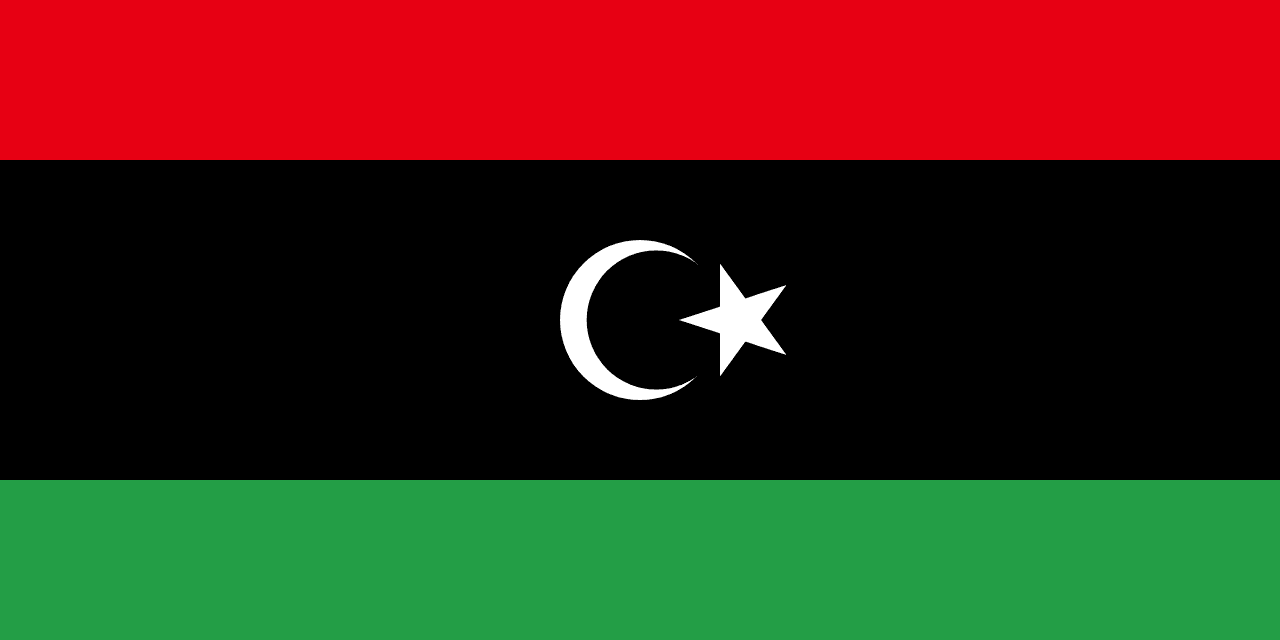
The Libyan flag is a horizontal triband, but it is not a flag of three equal stripes. Instead, the central black band is roughly twice the height of the red band above it and the green band below it. Centered on that wide black field sits a white crescent and a five-pointed white star. The asymmetry of the stripes is what gives the design its distinctive weight, drawing the eye to the dark middle rather than splitting the flag evenly into thirds.
That central placement is deliberate. By making black the dominant band and resting the Islamic emblem upon it, the design treats the crescent and star as the focal point of the whole composition rather than a minor decoration. The white of the emblem glows against the black, while the red and green frame it from above and below.
What the Colors Stand For
Each color in the flag carries its own meaning, and together they sketch a national narrative. The red is said to represent the blood sacrificed in the struggle for the country, a tribute to those who suffered and died. The black recalls a dark era in Libya's past, an acknowledgment of hardship and oppression endured. The green points forward, standing for prosperity, growth, and hope for what lies ahead.
The white crescent and star are the most widely recognized of all the elements. As emblems associated with Islam, they reflect the faith of the overwhelming majority of Libyans and root the flag within a broader tradition shared across much of North Africa and the wider Muslim world. Read from top to bottom, the bands move from sacrifice, through a difficult past, toward renewal, with faith placed at the symbolic center of it all.
From Independence to Erasure and Back
This design is not new. It first served as the flag of the Kingdom of Libya, the independent state that emerged in the mid-twentieth century. For the country's earliest years as a sovereign nation, the red-black-green triband with its crescent and star was the face Libya showed the world.
That changed dramatically after the political upheaval that brought a new regime to power. Over the following years the flag was set aside, and eventually Libya adopted what remains one of the most unusual national banners ever flown: a flag of solid green with no emblem, no stripe, and no charge of any kind. It was, for a long stretch, the only national flag on earth that was a single uninterrupted color. That plain green field replaced the older tricolor and became the official standard for decades.
When the Gaddafi regime fell in 2011, the original tricolor was restored as the national flag of Libya. The choice to revive the kingdom-era design rather than invent something entirely new was itself a statement: it linked the new chapter to the country's pre-Gaddafi identity and rejected the symbolism of the years in between. In that moment the flag became a banner of the revolution as much as a national emblem.
A Symbol of National Identity
For many Libyans, the readoption of this flag in 2011 was deeply emotional. Raising it in public squares had, only shortly before, been an act of defiance. To see it flying officially over government buildings represented a tangible break with the past and a reclaiming of national identity on the country's own terms. The flag's history of being banned and then restored gives it a layer of meaning that purely decorative national emblems rarely possess.
Because the design predates the era it replaced, it also carries a sense of continuity and legitimacy. It tells citizens that the nation existed, and had its own colors and symbols, before the period now associated with the black band. Libya sits in North Africa, on the African continent and bordering the Mediterranean Sea, and its flag reflects the cultural currents of that region, blending the Pan-Arab and Islamic visual vocabulary found among many of its neighbors. For travelers and students who want broader context on the nation behind the banner, our libya country guide offers a fuller picture.
The Flag in Everyday Modern Life
Today the flag appears across the full range of civic life, from official ceremonies and government documents to schools, public buildings, and national celebrations. It is waved at sporting events where Libyan athletes compete and displayed during national observances that mark the country's independence and its more recent revolution. After years of absence, its presence in ordinary settings is itself a quiet reminder of how recently it returned.
The flag's striking, high-contrast look also makes it easy to recognize at a glance, whether stitched onto a jersey, printed on a banner, or fluttering at a border crossing. The bold black field and crisp white emblem read clearly even from a distance, which is part of what makes the design effective as a national mark.
Interesting Facts at a Glance
- For decades, Libya flew the only solid-color national flag in the world, a plain green field with no design at all.
- The current flag is a revival of the banner used during the era of the Kingdom of Libya, not a brand-new design.
- The central black band is wider than the red and green bands, making the tricolor deliberately unequal.
- The flag was officially restored in 2011 following the fall of the Gaddafi regime.
- Its colors are sometimes read as a sequence: blood and sacrifice, a dark past, and future prosperity.
Frequently Asked Questions
When was the current Libyan flag adopted?
The current flag was restored in 2011, after the fall of the Gaddafi regime. However, the design itself is much older, having first served as the flag of the Kingdom of Libya in the country's early years of independence. The 2011 readoption brought back that original banner rather than creating a new one.
What do the colors of the Libyan flag mean?
Red represents the blood sacrificed for the nation, black recalls a dark era in the country's history, and green stands for prosperity and hope. The white crescent and star at the center are Islamic symbols reflecting the faith of most Libyans.
What continent is Libya on?
Libya is located in North Africa, on the African continent. It borders the Mediterranean Sea to the north, and its flag shares visual traditions with many of its neighbors across the region, including the use of a crescent and star.
How does the Libyan flag compare to similar flags?
The crescent-and-star motif places Libya's flag within a wide family of flags used across North Africa and the Muslim world, though the specific red-black-green triband with an oversized black band makes it distinct. What sets Libya's flag apart historically is its journey: it was once replaced entirely by a solid green field before being restored to its original tricolor form.
