
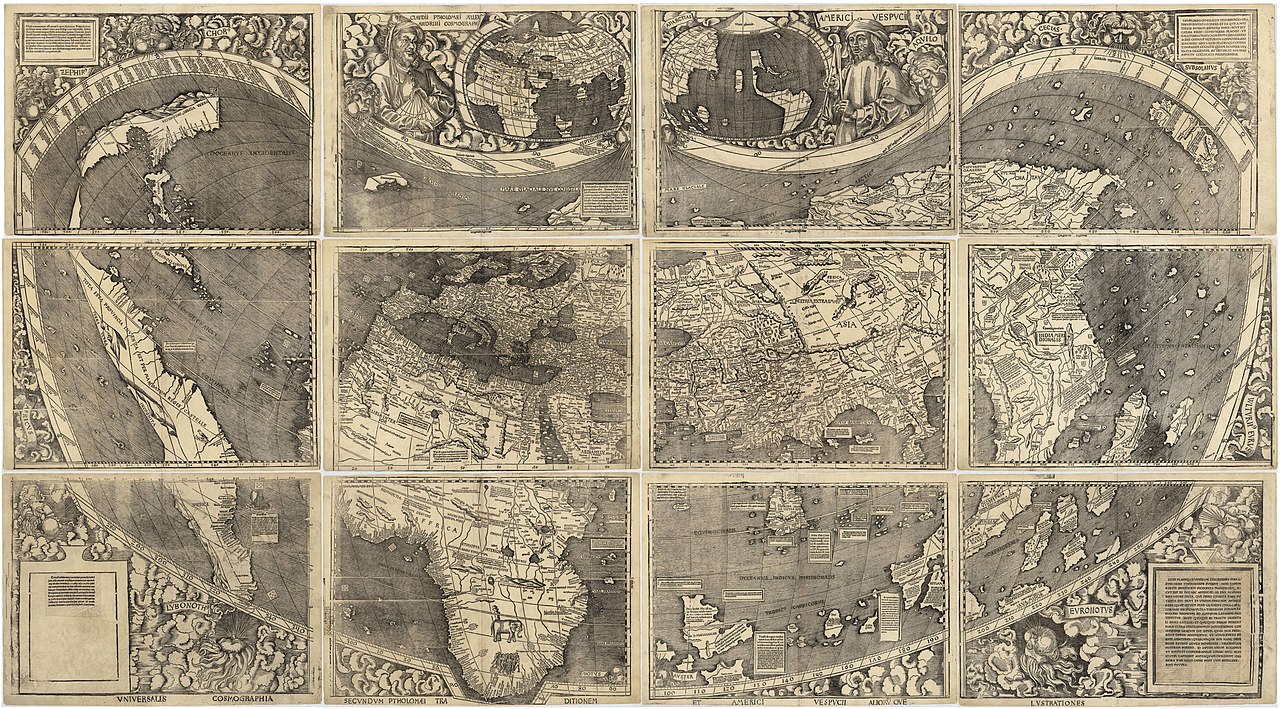
America is named after Amerigo Vespucci, a Florentine merchant and navigator who sailed to the coast of South America around 1500 and argued in widely read letters that the lands he had seen were a "New World", not part of Asia. In 1507 the German mapmaker Martin Waldseemüller and his colleague Matthias Ringmann put the name "America", a Latin form of Amerigo, on a new world map and explained that they were naming the continent after him. They applied it only to South America. The name spread to North America after the Flemish mapmaker Gerardus Mercator used it for both continents in 1538.
Who Was Amerigo Vespucci?
Vespucci was born in Florence in 1454 into a respectable family linked to the Medici. He moved to Seville in the 1490s as an agent for Florentine merchants, helping to supply ships, including some of Columbus's expeditions, and became interested in navigation himself. He is known to have sailed on at least two voyages. The first, around 1499–1500, went with a Spanish expedition under Alonso de Ojeda along the northern coast of South America. The second, in 1501–02, sailed in the service of Portugal far down the coast of what is now Brazil, well south of the equator, perhaps as far as about 50 degrees south by his own account. Other voyages he claimed, in 1497 and 1503, are doubted by most historians.
It was the second voyage that mattered. Sailing along coastline that kept running south towards latitudes where no part of Asia was known to lie, Vespucci concluded that this was a separate landmass. In 1508 Spain appointed him its first piloto mayor, chief navigator, responsible for training pilots and keeping the official chart of new discoveries. He held the post until his death in Seville in 1512.
A Bestselling "New World"
Vespucci's reputation rested on two short printed accounts that spread across Europe far faster than Columbus's reports. The first, Mundus Novus, "New World", published around 1503 as a letter to his patron Lorenzo di Pierfrancesco de' Medici, described the lands to the south as a continent "more densely peopled and full of animals than our Europe or Asia or Africa". It went through dozens of editions in several languages within a few years. The second, the so-called Soderini Letter of about 1505, described four voyages. Historians think both texts were edited and embellished by publishers, and some doubt that Vespucci wrote the Soderini letter as printed. But their message, that a new part of the world had been found, was what readers remembered.
Columbus, by contrast, maintained until his death in 1506 that the lands he had reached lay close to Asia. His voyages had come first, but he never named the lands as a new continent. Spain itself continued for centuries to call its American territories "the Indies", which is why the islands are still the West Indies and why Europeans called the Indigenous peoples "Indians".
What Europe Knew Before 1507
Europeans had reached the Americas before either Columbus or Vespucci, but without recognising a new continent. Norse voyagers from Greenland built a small settlement at L'Anse aux Meadows, on the northern tip of Newfoundland, which archaeologists confirmed in the 1960s. A 2021 study of tree rings in wood cut there dated Norse activity precisely to the year 1021. Those voyages left no lasting knowledge in the rest of Europe. In 1497 John Cabot, sailing for England, reached Newfoundland or Cape Breton, and in 1500 the Portuguese captain Pedro Álvares Cabral reached the coast of Brazil on his way to India. Spain and Portugal had already divided the unexplored world between them in the Treaty of Tordesillas of 1494, which is why Brazil became Portuguese. By 1507 there was plenty of new coastline on European maps, but no agreed name for the whole.
The Map Made at Saint-Dié
The name came from a small scholarly circle in Saint-Dié, in the Duchy of Lorraine in what is now north-eastern France. There, the cartographer Martin Waldseemüller and the poet and scholar Matthias Ringmann were producing an updated geography of the world. In April 1507 they published a large world map, Universalis Cosmographia, printed from twelve woodcut sheets, together with a short book, Cosmographiae Introductio. The book explained that Europe, Asia and Africa had been named after women, and that the fourth part of the world, discovered by Americus, should be called "Amerige, that is, the land of Americus, or America". The feminine form matched the older continents. Ringmann is now thought to have written the passage. Saint-Dié still calls itself the "godmother of America", and since 1990 it has hosted an annual international geography festival.
On the map, the word "America" appears across what is now Brazil. The map is also remarkable for showing the new lands as a separate, narrow continent with an ocean to its west, years before Europeans had seen the Pacific from America. About a thousand copies were printed. Only one is known to survive. It was rediscovered in 1901 in the library of Wolfegg Castle in southern Germany and bought by the Library of Congress in 2003 for 10 million dollars. It has been called "America's birth certificate". Its place in mapmaking history is covered in our history of cartography.
Second Thoughts, but Too Late
Waldseemüller seems to have changed his mind. On his later maps, including the 1513 edition of Ptolemy and his large Carta Marina of 1516, he dropped "America" and labelled the region "Terra Incognita" or described it as land discovered by Columbus. By then the name had escaped him. Other mapmakers and globe-makers copied it from the 1507 map, and in 1538 Gerardus Mercator, the most influential cartographer of the century, applied "America" to both halves of the New World on his world map, labelling the northern and southern parts separately. From then on, the name covered both continents.
The Theories That Challenge the Story
Because the name honours Vespucci rather than Columbus, it has attracted alternative explanations for centuries. One, popular in Bristol, suggests the name came from Richard Amerike, a customs official said to have helped fund John Cabot's 1497 voyage to North America. Another, proposed by the geologist Jules Marcou in 1875, derives it from the Amerrisque mountains of Nicaragua, supposedly a local name that sailors brought back to Europe. Neither is supported by evidence from the period. The 1507 book states its reasoning plainly, and historians accept it. Some writers have also accused Vespucci of stealing Columbus's glory, but he did not name the continent himself and probably never knew that it had been named after him.
Columbia, Colombia and the United States of America
Columbus did get places named after him. "Columbia" became a popular poetic name for the Americas and especially for the United States in the eighteenth century, which is why the national capital is in the District of Columbia and why Columbia University and the Columbia River carry the name. In South America, the republic founded by Simón Bolívar in 1819 was named Colombia, and British Columbia in Canada took the name in 1858.
The phrase "United States of America" first appeared in 1776, in a letter by the Continental Army officer Stephen Moylan and then in the heading of the Declaration of Independence. It became the official name under the Articles of Confederation, drafted in 1777. Using "America" to mean only the United States is common in English, but many people in Latin America object. In Spanish, a United States citizen is usually an estadounidense, while americano can refer to anyone from the Americas, and many Spanish-speaking schools teach a single continent called América. The question of where North America ends, and where Mexico belongs, is taken up in our article on whether Mexico is in North or South America.
The Name in Other Languages
"America" passed into almost every language, sometimes in unexpected forms. In Chinese, the continent is Meizhou and the United States Meiguo, written with the character 美, "beautiful", which was chosen to represent the sound "me" in "America". So the United States is, in Chinese characters, the "beautiful country". In Japanese, by contrast, the United States is often written with the character 米, meaning "rice", which was also first used for its sound, so the country is informally Beikoku, the "rice country". In both cases the meanings are accidents of phonetic spelling, not descriptions.
Where Vespucci Left His Mark
Beyond the name, the Portuguese voyage of 1501–02 on which Vespucci sailed is associated with the naming of places along the Brazilian coast. Its fleet is traditionally credited with entering Guanabara Bay on 1 January 1502 and naming it Rio de Janeiro, "River of January", in the belief that it was a river mouth. Vespucci's portrait appears in the Uffizi's collection in Florence, and his family church, the Ognissanti, holds a fresco by Domenico Ghirlandaio said to include members of the Vespucci family. Today the only reminder most people see of him is the name of two continents and around a billion people, which his letters never asked for.